avatarDark Energy Articles

Free AI web copilot to create summaries, insights and extended knowledge, download it at here

2038

Abstract

hich made it difficult to observe it earlier.</p><figure id="6c5b"><img src="https://cdn-images-1.readmedium.com/v2/resize:fit:800/1*I6aXm_S-bb10q2cr03a1kg.jpeg"><figcaption>[Photo: <a href="https://pixabay.com/pl/users/charlvera-11040068/?utm_source=link-attribution&amp;utm_medium=referral&amp;utm_campaign=image&amp;utm_content=6988250">Chil Vera</a> from <a href="https://pixabay.com/pl//?utm_source=link-attribution&amp;utm_medium=referral&amp;utm_campaign=image&amp;utm_content=6988250">Pixabay</a>]</figcaption></figure><h1 id="c261">An asteroid invisible to the naked eye</h1><p id="ab66">In the case of 2023 EY, there is no risk of the object entering Earth’s atmosphere. It is also too small to be spotted with the naked eye. Its observation was only possible with the help of telescopes.</p><p id="9a61">The asteroid 2023 EY belongs to the so-called Apollo Near-Earth Object (Apollo NEO) group. To date, more than 17,000 asteroids of this kind are known. The group is named after the 1862 Apollo asteroid, discovered in the 1930s of the previous century.</p><p id="2702">These are asteroids whose orbit is larger than the circumpolar orbit in which the Earth orbits. But which at the same time can get very close to the Sun — crossing not only our orbit, but also the orbits of Venus or even Mercury.</p><h1 id="90d8">Planetoid early warning system</h1><p id="b17c">The <b>asteroid </b>has been <b>detected </b>thanks to the <b>ATLAS </b>(Asteroid Terrestrial-impact Last Alert System). This is an asteroid early warning system that operates within the University of Hawaii’s Institute of Astronomy. It was launched by NASA in 2015.</p><p id="fdf9">ATLAS currently consists of four telescopes. Two are located in Hawaii, one in South Africa, and one in Chile. Together, they survey the entire sky once every twenty-four hours. The asteroid 2023 EY was detected thanks to the Sutherland Observing Station, located in South Africa.</p><h1 id="fb15">Are we ready for an asteroid impact?</h1><p id="3fc6">So far, thanks to ATLAS, w

Options

e have learned of the existence of <b>700 asteroids.</b> None of them has come close enough to our globe for there to be a risk of collision. However, it is not out of the question that an asteroid may already be flying towards us, with a chance of hitting us directly. It was recently reported, for example, that an asteroid will appear near Earth in 2046.</p><p id="024c">ATLAS’ goal is to detect such objects as early as possible. Preferably years or even decades before a potential collision. Then we can use other technologies under development — such as DART, which is being tested this fall — to prevent a catastrophe.</p><p id="f6c4">Interestingly, also today two other asteroids will approach us at a minimal distance. One, the size of a bus, will be 2 million km from our globe. The other, the size of a skyscraper, will be 4 million km from Earth. Information about the asteroids that are closest to Earth can be found on a special NASA Asteroid Watch page.</p><div id="5d83" class="link-block"> <a href="https://readmedium.com/the-paleo-diet-has-gained-considerable-popularity-but-is-it-really-so-healthy-and-natural-for-us-9d6860e8b433"> <div> <div> <h2>The paleo diet has gained considerable popularity. But is it really so healthy and natural for us?</h2> <div><h3>We should eat what our ancestors ate, say proponents of a way of eating known as the paleo diet. But switching to such…</h3></div> <div><p>medium.com</p></div> </div> <div> <div style="background-image: url(https://miro.readmedium.com/v2/resize:fit:320/1*32fFtQGZL5yDzkjfb9VF3w.jpeg)"></div> </div> </div> </a> </div><p id="1851"><b>Cool that you made it to the end of this article. I will be very pleased if you appreciate the effort of creating it and leave some claps here, or maybe even start following me. It would be nice if you also left a tip! Thank you!</b></p></article></body>

Near Miss: Chelyabinsk-sized Asteroid Closer than Moon

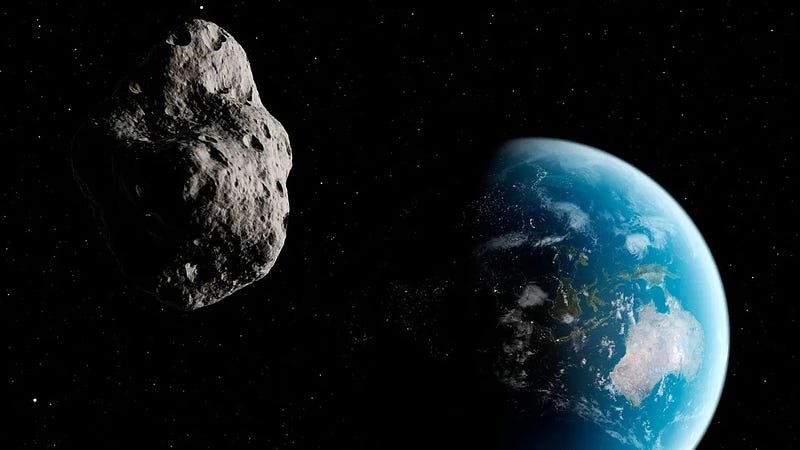
Earth was just passed by a small asteroid. It was separated from us by only 240 thousand kilometers. This is less than two-thirds of the distance between our globe and the Moon.
[Photo: Sebastian Kaulitzki/Science Photo Library/Corbis, CC0, via Wikimedia Commons]

We learned of the existence of this asteroid only three days ago. On March 13, it was discovered that a small object was heading toward Earth. The asteroid has been designated as 2023 EY. It is about the size of a house.

Today it is flying close to our planet. It is expected to be very close to it. The minimum distance between the globe and the asteroid is only 239 thousand kilometers. Thus, the object will be much closer to Earth than the Moon. Our natural satellite is 384 thousand kilometers away from us.

There is no risk of collision

Although the asteroid 2023 EY will fly very close to Earth, there is nothing to fear. There is no danger of a collision occurring. And even if there were, the danger would appear only locally and would not be large. After all, the asteroid is only 16 meters long. That is, the size is similar to the Chelyabinsk meteor, which appeared over the Urals in 2013.

When it entered Earth’s atmosphere, the Chelyabinsk meteor was 17–20 meters in diameter. Later, approaching the boundary of the troposphere, it began to break into smaller pieces. It caused a shock wave that damaged several thousand buildings.

However, it is worth noting that the Chelyabinsk meteor was not detected before it appeared in the sky. Ten years ago it was too small to be caught. It also came from the side of the Sun, which made it difficult to observe it earlier.
[Photo: Chil Vera from Pixabay]

An asteroid invisible to the naked eye

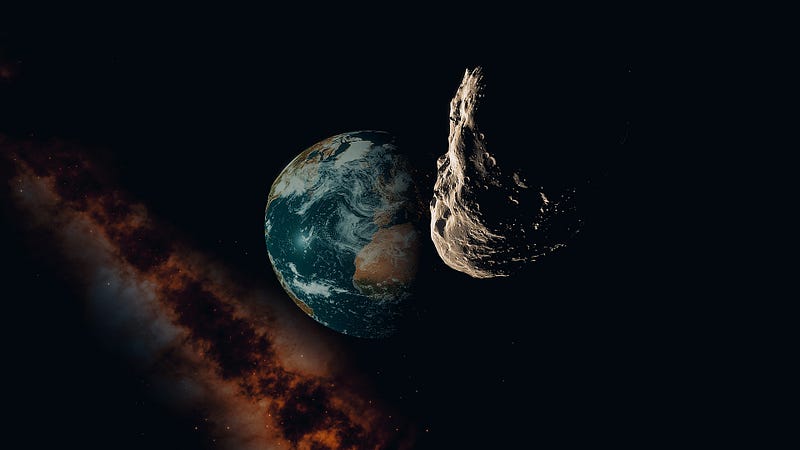
In the case of 2023 EY, there is no risk of the object entering Earth’s atmosphere. It is also too small to be spotted with the naked eye. Its observation was only possible with the help of telescopes.

The asteroid 2023 EY belongs to the so-called Apollo Near-Earth Object (Apollo NEO) group. To date, more than 17,000 asteroids of this kind are known. The group is named after the 1862 Apollo asteroid, discovered in the 1930s of the previous century.

These are asteroids whose orbit is larger than the circumpolar orbit in which the Earth orbits. But which at the same time can get very close to the Sun — crossing not only our orbit, but also the orbits of Venus or even Mercury.

Planetoid early warning system

The asteroid has been detected thanks to the ATLAS (Asteroid Terrestrial-impact Last Alert System). This is an asteroid early warning system that operates within the University of Hawaii’s Institute of Astronomy. It was launched by NASA in 2015.

ATLAS currently consists of four telescopes. Two are located in Hawaii, one in South Africa, and one in Chile. Together, they survey the entire sky once every twenty-four hours. The asteroid 2023 EY was detected thanks to the Sutherland Observing Station, located in South Africa.

Are we ready for an asteroid impact?

So far, thanks to ATLAS, we have learned of the existence of 700 asteroids. None of them has come close enough to our globe for there to be a risk of collision. However, it is not out of the question that an asteroid may already be flying towards us, with a chance of hitting us directly. It was recently reported, for example, that an asteroid will appear near Earth in 2046.

ATLAS’ goal is to detect such objects as early as possible. Preferably years or even decades before a potential collision. Then we can use other technologies under development — such as DART, which is being tested this fall — to prevent a catastrophe.

Interestingly, also today two other asteroids will approach us at a minimal distance. One, the size of a bus, will be 2 million km from our globe. The other, the size of a skyscraper, will be 4 million km from Earth. Information about the asteroids that are closest to Earth can be found on a special NASA Asteroid Watch page.

Cool that you made it to the end of this article. I will be very pleased if you appreciate the effort of creating it and leave some claps here, or maybe even start following me. It would be nice if you also left a tip! Thank you!

Space
Science
Life
News
Asteroids
Recommended from ReadMedium