avatarJames Marinero, MSc, MBA

Free AI web copilot to create summaries, insights and extended knowledge, download it at here

3765

Abstract

ive power is essential</h2><p id="c7f9"><b>The best way to defend a nation’s interests at sea was to take the offensive. He believed that a navy should be designed to attack enemy fleets and disrupt their trade, rather than simply waiting to be attacked.</b></p><p id="88b1">The Falklands Campaign was probably the last significant naval engagement, although not in the conventional sense as was the Battle of Leyte Gulf (the biggest naval battle in history). The Falklands campaign highlighted the increasing role of modern technology in naval warfare, particularly in areas like airpower and missile systems. It also demonstrated the continued importance of submarines in naval warfare as compared with submarines only being required as strategic missile platforms.</p><p id="44fb">Whether we have seen the last of the great naval battles is an open question, given China’s fleet build up and its intention to absorb Taiwan, which the US has committed to defend. Given modern technology, the idea of major naval battles may be hard to envisage, but not completely improbable.</p><h2 id="b423">Concentration of forces is crucial</h2><p id="1624"><b>It is important for a navy to concentrate its forces in order to achieve maximum firepower and surprise. Mahan believed that a dispersed navy was vulnerable to defeat.</b></p><p id="5b5e">Today we have fleets, and within them, carrier strike groups (CSGs)or equivalent formations.</p><h2 id="d768">Bases are essential</h2><p id="ed54"><b>A navy needs a network of overseas bases to support its operations and project power abroad. Mahan believed that these bases could be used to refuel and repair ships, store supplies, and launch attacks.</b></p><p id="d6d3">This continues through to today, although there is increasing resistance to the concept, it being seen as a form of colonialism. The British Royal Navy used to have a huge chain of bases around the world, but now these have all but disappeared. The US has several overseas bases in other countries, including Naples, Yukosuka, Rota, Bahrein and Diego Garcia.</p><h1 id="e921">Criticisms</h1><p id="b707">Mahan’s ideas were not without their critics at the time. Some argued that his focus on sea power was too narrow and that he did not give enough weight to other factors, such as land power and diplomacy. Others argued that his emphasis on offensive power was dangerous and could lead to unnecessary wars.</p><p id="16fb">Today, we see that other factors such as ICBM and nuclear capability have come into play, as indeed has asymmetrical warfare. Ukraine, a country without a functional navy, has now denied Russia freedom of naval operations in the Black Sea, a region which Russia once considered its own.</p><p id="7b1e">And hunter-killer submarines remain essential. Even Russia has a significant fleet of them — less the one docked Kilo class that Ukraine destroyed.</p><p id="8551">Submarines can get through the most elaborate of fleet defences, as Sweden showed in an exercise with the US carrier USS Ronald Reagan.</p><div id="45c6" class="link-block"> <a href="https://nationalinterest.org/blog/buzz/war-games-swedish-stealth-submarine-sank-us-aircraft-carrier-116216"> <div> <div> <h2>War Games: A Swedish Stealth Submarine Sank A U.S. Aircraft Carrier</h2> <div><h3>What's the lesson?</h3></div> <div><p>nationalinterest.org</p></div> </div> <div> <div style="background-image: url(https://miro.readmedium.com/v2/resize:fit:320/0*vv10lgnU0ClF1UvR)"></div> </div> </div> </a> </div><p id="caa7">Certainly it was in 2005 and technology and systems have improved — but

Options

probably on both sides of the battle.</p><h1 id="75ea">Concentration of forces?</h1><figure id="f40c"><img src="https://cdn-images-1.readmedium.com/v2/resize:fit:800/1*19DJYsNeE9ZJ6z57BJnWCw.jpeg"><figcaption>U.S. Navy ships assigned to the USS <i>George Washington</i> Carrier Strike Group sail in formation in the Atlantic Ocean in November 2003.. Credit: By U.S. Navy photo — Public Domain, <a href="https://commons.wikimedia.org/w/index.php?curid=8202193">https://commons.wikimedia.org/w/index.php?curid=8202193</a></figcaption></figure><p id="7bf4">Consider the above picture. It’s known disparagingly as ‘the bullseye formation’ and would not be used in an elevated threat environment. I’m sure that you can see why.</p><h1 id="bc5f">Finally</h1><p id="c8c0">Think about China’s Dong Feng hypersonic carrier-busting missiles and even the relatively modest Neptune anti-ship missiles that Ukraine used to sink Russia’s Black Sea flagship, the Moskva.</p><p id="0f9f">And super-stealthy submarines along with subsea drones.</p><p id="d5c9">China has committed to a major carrier-building program and clearly believes in the doctrine of using carriers to project power. Building a fixed wing carrier capability from zero is a major undertaking. They started with an old Russian carrier and have quickly moved on, with Fujian, their newest carrier, having electromagnetic launch systems. Although not nuclear powered, their next carrier will surely be taking that next step forward.</p><p id="daf3">Today, ten countries have operational full-fledged carriers — i.e. capable of launch and recovery of fixed wing aircraft.</p><p id="1cb2">The Carrier Strike Groups may project power, but in a war between major powers, just how long would they survive?</p><p id="0a78">In the modern world, given Mahan’s ideas and the forward voyage of technology, is there a place for the huge targets that carrier strike groups offer? Are they really defensible?</p><p id="1c98">Would carrier battle groups actually face-off (at whatever range)?</p><p id="2377">Those are challenging questions and I’m sure that Alfred Thayer Mahan would have something to say in response. But it comes back to a basic standpoint:</p><p id="65ae"><b>You have to be powerful to be credible.</b></p><p id="4780">CSGs demonstrate that power. I hope we never see them tested for real. If that happens then we are surely done for.</p><p id="cda8"><b>Sources</b></p><div id="d50c" class="link-block"> <a href="https://en.wikipedia.org/wiki/Alfred_Thayer_Mahan"> <div> <div> <h2>Alfred Thayer Mahan - Wikipedia</h2> <div><h3>Alfred Thayer Mahan (; September 27, 1840 - December 1, 1914) was a United States naval officer and historian, whom…</h3></div> <div><p>en.wikipedia.org</p></div> </div> <div> <div style="background-image: url(https://miro.readmedium.com/v2/resize:fit:320/0*xYbw78NQgx3bSLz7)"></div> </div> </div> </a> </div><p id="ecf8"><i>If you enjoyed that story then follow me - I guarantee variety in your inbox with some unusual perspectives! I write on a wide range of topics that interest me including humour, tech, space, geopolitics and travel</i></p><figure id="d0df"><img src="https://cdn-images-1.readmedium.com/v2/resize:fit:800/1*QeQr0J6dshTDJHUZ_MtLdw.png"><figcaption></figcaption></figure><p id="344d"><i>My novels are available at my <a href="https://jamesmarinero.gumroad.com/">Gumroad</a> bookstore. Also at <a href="https://www.amazon.com/stores/James-Marinero/author/B0055RWF6U">Amazon</a> and <a href="https://books.apple.com/us/author/james-marinero/id490200686">Apple</a></i></p></article></body>

Naval Power and Strategy

Naval Strategy: Rear Admiral Alfred Thayer Mahan

Are his theories relevant today in a naval world he would not recognise?
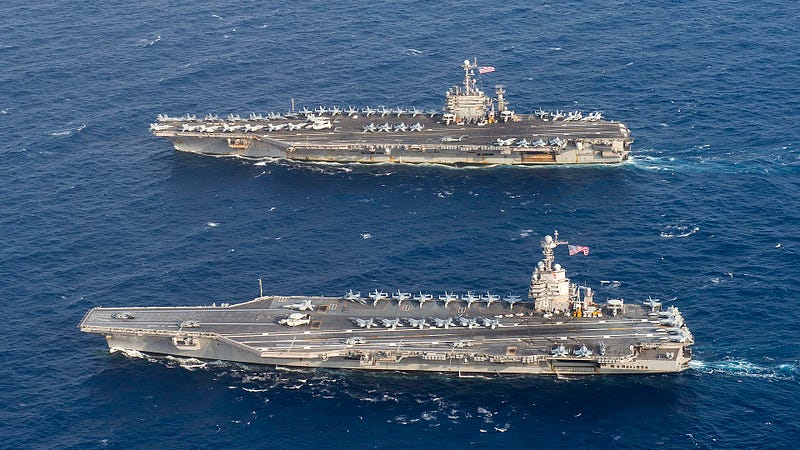
Aerial view of Gerald R. Ford (CVN-78, bottom) alongside USS Harry S. Truman (CVN-75, top). By U.S. Navy photo by Mass Communication Specialist Seaman Riley McDowell. Public Domain, https://commons.wikimedia.org/w/index.php?curid=91115372

A renowned naval strategist of his time and still much respected today, Alfred Thayer Mahan (1840–1914) was not the most skilled of seamen and a number of vessels under his command were involved in collisions. He preferred old square-rigged sailing vessels rather than the smoky, noisy steamships of his own day and he tried to avoid active sea duty.

I confess I had not heard about Mahan until just recently. Although I live on a boat and am closely connected with the sea, naval history and strategy has not been on my radar so to speak, except for having read all the C.S. Forester Hornblower books and also much of Patrick O’Brien’s (Aubrey/Maturin) and Alexander Kent’s (Bolitho) naval thrillers. I have sailed in many of the battle areas of those books (e.g. Atlantic France, the Mediterranean, Caribbean, West Africa, ‘Dutch’ East Indies), and they add a special feeling as I try to imagine the scenes in those days.

Mahan was a United States naval officer and historian, who has been described as “the most important American strategist of the nineteenth century.” His book The Influence of Sea Power Upon History, 1660–1783 (1890) won immediate recognition, especially in Europe, and with its successor, The Influence of Sea Power Upon the French Revolution and Empire, 1793–1812 (1892), made him world-famous. (Wikipedia)

Mahan’s key thesis was that a strong navy was essential for any nation seeking to achieve global power and influence. That idea carries all the way down to the present day, witnessed for example by the US’s 11 carrier strike groups. China too has lately taken note of that idea and is rapidly building its PLA Navy into a serious blue water force, with its third aircraft carrier having just been launched.

Many countries now operate aircraft carriers, even the likes of India and Brazil. Russia has the Admiral Kuznetsov carrier, an ageing oil-fired heap of junk which rarely leaves port. Indeed, Russia seems to completely ignore Mahan’s ideas but that maybe because the country itself spans 11 time zones and could be seen as one vast aircraft carrier.

Mahan’s key ideas

So, what is special about Mahan’s ideas? There are four main planks in his platform:

Sea power is the key to national greatness

A nation’s ability to control the seas is essential for its economic prosperity, military security, and international prestige. He believed that a strong navy could protect trade routes, project power abroad, and deter potential enemies.

In December 2023 we saw the critical trade route through the Red Sea being threatened by Houthi rebels with missiles and drones. An international coalition spearheaded by the US was rapidly assembled in an effort to protect this route.

Offensive power is essential

The best way to defend a nation’s interests at sea was to take the offensive. He believed that a navy should be designed to attack enemy fleets and disrupt their trade, rather than simply waiting to be attacked.

The Falklands Campaign was probably the last significant naval engagement, although not in the conventional sense as was the Battle of Leyte Gulf (the biggest naval battle in history). The Falklands campaign highlighted the increasing role of modern technology in naval warfare, particularly in areas like airpower and missile systems. It also demonstrated the continued importance of submarines in naval warfare as compared with submarines only being required as strategic missile platforms.

Whether we have seen the last of the great naval battles is an open question, given China’s fleet build up and its intention to absorb Taiwan, which the US has committed to defend. Given modern technology, the idea of major naval battles may be hard to envisage, but not completely improbable.

Concentration of forces is crucial

It is important for a navy to concentrate its forces in order to achieve maximum firepower and surprise. Mahan believed that a dispersed navy was vulnerable to defeat.

Today we have fleets, and within them, carrier strike groups (CSGs)or equivalent formations.

Bases are essential

A navy needs a network of overseas bases to support its operations and project power abroad. Mahan believed that these bases could be used to refuel and repair ships, store supplies, and launch attacks.

This continues through to today, although there is increasing resistance to the concept, it being seen as a form of colonialism. The British Royal Navy used to have a huge chain of bases around the world, but now these have all but disappeared. The US has several overseas bases in other countries, including Naples, Yukosuka, Rota, Bahrein and Diego Garcia.

Criticisms

Mahan’s ideas were not without their critics at the time. Some argued that his focus on sea power was too narrow and that he did not give enough weight to other factors, such as land power and diplomacy. Others argued that his emphasis on offensive power was dangerous and could lead to unnecessary wars.

Today, we see that other factors such as ICBM and nuclear capability have come into play, as indeed has asymmetrical warfare. Ukraine, a country without a functional navy, has now denied Russia freedom of naval operations in the Black Sea, a region which Russia once considered its own.

And hunter-killer submarines remain essential. Even Russia has a significant fleet of them — less the one docked Kilo class that Ukraine destroyed.

Submarines can get through the most elaborate of fleet defences, as Sweden showed in an exercise with the US carrier USS Ronald Reagan.

Certainly it was in 2005 and technology and systems have improved — but probably on both sides of the battle.

Concentration of forces?
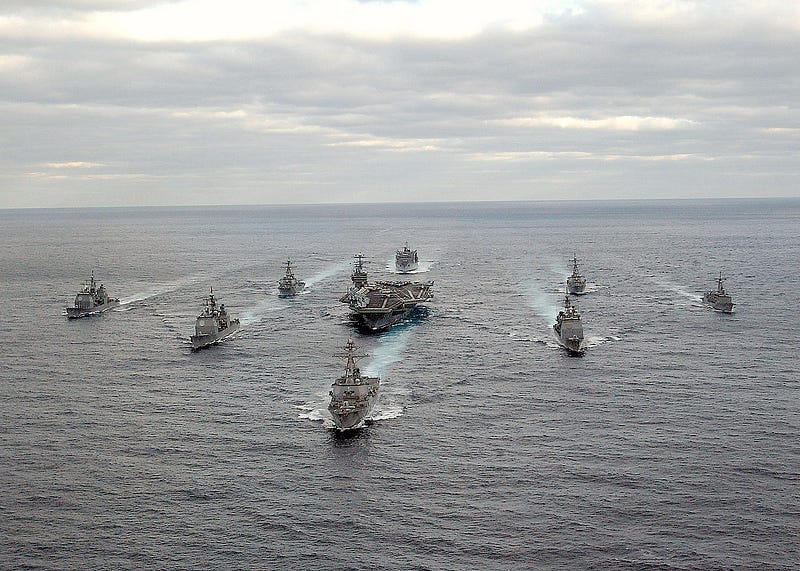
U.S. Navy ships assigned to the USS George Washington Carrier Strike Group sail in formation in the Atlantic Ocean in November 2003.. Credit: By U.S. Navy photo — Public Domain, https://commons.wikimedia.org/w/index.php?curid=8202193

Consider the above picture. It’s known disparagingly as ‘the bullseye formation’ and would not be used in an elevated threat environment. I’m sure that you can see why.

Finally

Think about China’s Dong Feng hypersonic carrier-busting missiles and even the relatively modest Neptune anti-ship missiles that Ukraine used to sink Russia’s Black Sea flagship, the Moskva.

And super-stealthy submarines along with subsea drones.

China has committed to a major carrier-building program and clearly believes in the doctrine of using carriers to project power. Building a fixed wing carrier capability from zero is a major undertaking. They started with an old Russian carrier and have quickly moved on, with Fujian, their newest carrier, having electromagnetic launch systems. Although not nuclear powered, their next carrier will surely be taking that next step forward.

Today, ten countries have operational full-fledged carriers — i.e. capable of launch and recovery of fixed wing aircraft.

The Carrier Strike Groups may project power, but in a war between major powers, just how long would they survive?

In the modern world, given Mahan’s ideas and the forward voyage of technology, is there a place for the huge targets that carrier strike groups offer? Are they really defensible?

Would carrier battle groups actually face-off (at whatever range)?

Those are challenging questions and I’m sure that Alfred Thayer Mahan would have something to say in response. But it comes back to a basic standpoint:

You have to be powerful to be credible.

CSGs demonstrate that power. I hope we never see them tested for real. If that happens then we are surely done for.

Sources

If you enjoyed that story then follow me - I guarantee variety in your inbox with some unusual perspectives! I write on a wide range of topics that interest me including humour, tech, space, geopolitics and travel

My novels are available at my Gumroad bookstore. Also at Amazon and Apple

Geopolitics
Naval Warfare
Military Strategy
Politics
Carrier Strike Group
Recommended from ReadMedium