
Naval Ravikant’s Life Lessons on Joe Rogan’s Podcast To Change Your Life For The Better
I revisit this every six months to refresh my knowledge.

The other day, I was listening to Joe Rogan’s podcast while I was coding on one of my applications, and I was extremely happy to hear the name of the guest.
It was none other than Naval ‘Awesome’ Ravikant. Yeah, awesome is just a lame adjective for a genius like Naval.
For those who are unfamiliar, Naval Ravikant is an Indian-American entrepreneur and investor. He is AngelList’s co-founder, chairman, and former CEO. He is well-known for his early-stage investments in over 200 companies, including Stack Overflow, Uber, Twitter, Postmates, and Clubhouse. Furthermore, he is recognized as an idol by entrepreneurs, a hero by investors, and is respected by just about everyone in Silicon Valley.
However, Naval is popular for being one of the smartest and “nicest” entrepreneurs who have been sharing wisdom with millions of his followers. In fact, on May 31, 2018, he posted a tweet storm that quickly went viral.
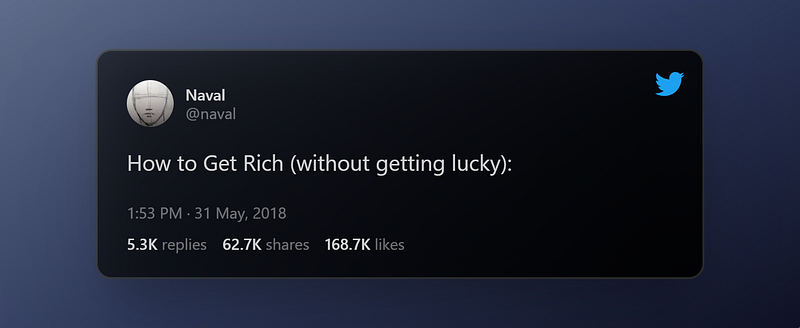
People who didn’t even know about Naval by that time came to know about him. I was one of those people who knew nothing about him. I became so intrigued by him that I strived to absorb as much knowledge from him as possible, anytime and everywhere.
When Naval appeared on the Joe Rogan Experience podcast in 2019, I was listening to it while taking the bus home from work. God-damn, that was the most profound podcast I have ever heard. The knowledge in this podcast is so condensed that you could listen to it every week for years and yet have so much to unpack and understand.
Every sentence he spoke helped me grow in some way. As a result, I attempted to compile a list of some of the greatest quotes/phrases that I found very appealing.
- “When you’re memorizing something, it’s an indication that you don’t understand it. You should be able to re-derive anything on the spot, and if you can’t, you don’t know it.”
- “Your unlimited desires are clouding your peace and your happiness.”
- “Your real resume is just a cataloging of all your suffering.”
- “Desire is suffering… every desire you have is an axis where you will suffer. So just don’t focus on more than one desire to time. The universe is rigged in such a way that if you just want one thing, and you focus on that, you’ll get it, but everything else you have got to let go.”
- “Society will always create new jobs, but it’s impossible to predict what those jobs will be.”
- “Protect your time like it’s all you have.”
- “The peace that we seek is not the peace of mind, it’s peace from the mind.”
- “A lot of intelligence these days is just the external brain pack of civilization.”
- “I would rather read the best a hundred books over and over again until I absorb them, rather than read every single book out there.”
- “I believe everybody can be wealthy. It’s not a zero-sum game. It is a positive-sum game.”
- “There are no get-rich-quick schemes. That’s just somebody else trying to get rich off of you.”
- “Everybody wants to be wealthy, everybody wants to be happy, and everybody wants to be fit. Here’s the good news – all 3 of those things can be taught.”
- “Desire to me is a contract that you make with yourself to be unhappy until you get what you want.”
- “We live in an age of infinite leverage… and because of that, the impacts of good decision-making are much higher than they used to be.”
- “Machines should be working nine to five. Humans are not meant to work nine to five.”
- “In the future, whether it’s 50 or 100 years from now, virtually everyone will be working for themselves.”
- “One of the myths that we have today is that adults can’t be re-educated. We view education as this thing where you go to school, you go to college, you come out, and you’re done… no more education. Well, that’s wrong.”
- “The most powerful people in the world today are the people who are writing the algorithms for Twitter, Facebook, and Instagram because they’re controlling the spread of information. They’re programming the culture.”
- “All our diseases are diseases of abundance, not diseases of scarcity.”
- “You get to make up your own answer, and that’s the beauty of it. If there was a single answer, we wouldn’t be free. We’d be trapped because we’d all have to live to that answer. We’d be robots competing with each other trying to fulfil that meaning more than the next person.”
- “The way to get out of the competition trap is actually to be authentic.”
- “The way to freedom is by avoiding the trap of upgrading your lifestyle every time you make more money.”
I can simply go on forever about Naval since I have watched this podcast so many times and read a book written about him by Eric Jorgenson, which, by the way, can be downloaded for free.
Naval has called his philosophy “Rational Buddhism” and some people in the Valley rightfully call him the “Tech Buddha”. He is known for his transparency, unforgettable wisdom, and penetrating insights. He is one of the few people teaching the world that a wealthy person can be happy and vice versa.
If you liked reading this, then you might also find the below story worth your time.
If you enjoy reading stories that help you learn, live and work better, consider becoming a subscriber. Becoming a member will get you unlimited access to, 10000s of stories, articles, and writers. It is just $5 per month. If you sign up using my link, I will earn a small commission that helps me write more articles.


