avatarAvi Kotzer

Free AI web copilot to create summaries, insights and extended knowledge, download it at here

4022

Abstract

lso prostitutes, but considered lower-class.</p><p id="ae45"><b>Tawaifs</b> were the highest-caliber and most respected women in the profession. Experts in everything ranging from singing, dancing, and acting to literature and cooking, they catered to the nobles and were experts on decorum and etiquette. They were smart, educated, and spoke several languages.</p><p id="ccd7"><b>Kanjaris</b> were sort of tawaif wanna-bes who had no formal training in the arts mastered by their higher-class counterparts. Eventually this word became a derogatory term.</p><p id="ae6e"><b>Nochis</b> were tawaifs-in-training, with the requisite condition of virginity.</p><p id="bea9"><b>Devdasis</b> were the equivalent of nuns: they did not marry and dedicated their lives to service in a temple.</p><p id="1fb2"><i>Nautch</i> girls were not just singers, nor were they prostitutes. Although I’m sure many men — and women — may have treated them that way. They were often married and their husbands formed part of their troupe, called “<i>nautch</i> parties”. This group included musicians, an old maidservant called a <i>mama</i>, and unarmed guards, or <i>muhafiz</i>.</p><p id="9ef1">Three types of <i>nautches</i> became signature dances.</p><p id="91c8">The<b> mor nach</b> (dance of peacock), performed only for men, was very erotic and included short hops followed by whirls with a long skirt (<i>ghagra</i>) to imitate a peacock spreading its feathers. Things went a bit literal sometimes, with the skirt itself being adorned with peacock feathers.</p><figure id="e80e"><img src="https://cdn-images-1.readmedium.com/v2/resize:fit:800/0*Leo-mj_dziaEt1_l.jpg"><figcaption>Photo by Pub Licdomain</figcaption></figure><p id="afd6">In the <b>patang nach</b> (the kite dance), the <i>nautch</i> girl would imitate both the kite and the person who flew it. This was a dance performed at a slow rhythm, sometimes with two dancers. One would play the kitee, the other the kiter. I think I just made up those terms, but you probably got the idea. This dance would be performed for both men and women.</p><figure id="8c57"><img src="https://cdn-images-1.readmedium.com/v2/resize:fit:800/0*C7C0AZL9qn_OXf8a.jpg"><figcaption>Photo by Charles Shepherd; <b>not sure who ripped it.</b></figcaption></figure><p id="f1d3">Finally, the <b>qahar ka nach</b> was a more subtle version of the <b>mor nach</b>, although still erotic and suggestive. Also for men only. As <i>The Friday Times</i> explains:</p><blockquote id="a5a7"><p>The dance was performed in close proximity to the audience. The <i>nautch</i> girl teased a favored few amongst the audience by slowly advancing towards them, in a manner suggestive of an imminent kiss, and retreating at the last moment. The dance was usually the finale of a <i>nautch</i> performance.</p></blockquote><p id="e3a1"><i>Nautches</i> were increasingly popular during the Mughal Empire and the rule of the East India Company, encompassing a period from the early 16th century to the mid-19th century. With the opening of the Suez Canal in 1869, Christian missionaries began arriving in India. Dancing was stigmatized, and <i>nautch</i> girls who could no longer find dance patrons turned to prostitution in order to survive.</p><p id="5133">So, as so often happens with us humans, the “cure” ended up being worse than the “disease”.</p><h2 id="2d07">Baz and Roop</h2><p id="165d">Bayazid Baz Bahadur Khan was the last Sultan of the Malwa Sultanate, and reigned from 1555 to 1562.</p><p id="e7d7">Here is his palace. I don’t know if James Forbes sketched it, but Wikipedia does say that Bernard Gagnon took this photo.</p><figure id="7719"><img src="https://cdn-images-1.readmedium.com/v2/resize:fit:800/0*kh7A4V81T7gGC_X7.jpg"><figcaption>Credit: Bernard Gagnon</figcaption></figure><p id="4c6c">“Baz”, as he was known to no one else except me, didn’t much care for the bothersome and time-consuming task of actually ruling his empire. Which is why he was the “<b>last</b> Sultan of the Malwa Sult

Options

anate”, as I mentioned earlier.</p><p id="6ae2">The (last) Sultan preferred to devote time and energy to the arts and to his queen, Roopmati. She was a <i>nautch</i> girl and a poet from Saharanpur. Despite the fact that Roop was Hindu and Baz was Muslim, they fell in love and married. This beautiful and romantic love story inspired many folk tales in the region.</p><figure id="c89f"><img src="https://cdn-images-1.readmedium.com/v2/resize:fit:800/0*u-rhICOA5SSxgjRf.jpg"><figcaption>Screenshotted by Iva Reztok</figcaption></figure><p id="b166">Now, the story I found is not backed up by decent references, but it’s nice enough for a Friday. And since I’m tired and it’s Friday (have I mentioned that?), I’ll just quote it from Wikipedia. I know that’s lazy, but heck, I’m tired and it’s Friday. (I think I hadn’t explained that already.)</p><blockquote id="3e94"><p>Once out hunting, Baz Bahadur chanced upon a shepherdess frolicking and singing with her friends. Smitten by both her enchanting beauty and her melodious voice, he begged Roopmati to accompany him to his capital. Roopmati agreed to go to Mandu on the condition that she would live in a palace within sight of her beloved and venerated river, Narmada. Thus was built the Rewa Kund at Mandu.</p></blockquote><blockquote id="4348"><p>Unfortunately, the romance of this Muslim prince and Hindu shepherdess was doomed to failure. The great Mughal Akbar decided to conquer Mandu. Akbar sent Adham Khan to capture Mandu and Baz Bahadur went to challenge him with his small army. No match for the great Mughal army, Mandu fell easily.</p></blockquote><blockquote id="a6f7"><p>Baz Bahadur fled to Chittorgarh to seek help. As Adham Khan came to Mandu, he was surprised by the beauty of Roopmati. Rani Roopmati stoically poisoned herself to avoid capture, bringing an end to the love story.</p></blockquote><p id="33ea">This artwork from the <i>Akbarnama </i>(official chronicle of the reign of Akbar) depicts the defeat of Baz Bahadur by Mughal troops in 1561. Roop and her companions view the scene from the terrace of the fort, upper right.</p><figure id="5186"><img src="https://cdn-images-1.readmedium.com/v2/resize:fit:800/0*8_p7JFtuuXGOVlBE.jpg"><figcaption>Art by Jagan, Banwali, I think</figcaption></figure><p id="f297">What can I say? Despite this saccharine-loaded tale of star-crossed lovers and the fact that <i>nautch</i> girls dedicated themselves to the well-respected art of erotic dancing, the editors of the New York Times decided that the word <i>nautch </i>is a <a href="https://www.merriam-webster.com/words-at-play/dord-a-ghost-word"><b>dord</b></a><b>.</b></p><p id="f744">You can check out my previous entry on another <b>dord </b>here:</p><div id="ac38" class="link-block"> <a href="https://readmedium.com/rabato-robata-5d7c59f65eac"> <div> <div> <h2>Rabato / Robata</h2> <div><h3>Not really a case of tomay-to, tomah-to</h3></div> <div><p>medium.com</p></div> </div> <div> <div style="background-image: url(https://miro.readmedium.com/v2/resize:fit:320/1*xdrn5m-eJIFxJeJTpziGOQ.png)"></div> </div> </div> </a> </div><p id="6b7b">*What the heck is a <b>dord, </b>you ask? Here’s the answer:</p><div id="fd2e" class="link-block"> <a href="https://www.merriam-webster.com/words-at-play/dord-a-ghost-word"> <div> <div> <h2>'Dord': A Ghost Word</h2> <div><h3>One of the questions people like to ask lexicographers is this: Can you sneak something into the dictionary? Can you…</h3></div> <div><p>www.merriam-webster.com</p></div> </div> <div> <div style="background-image: url(https://miro.readmedium.com/v2/resize:fit:320/0*mAOc1qYiuCWWyy7z)"></div> </div> </div> </a> </div></article></body>

Nautch

It’s Friday! Let’s go out dancing!
Credit: wikicommons

Today’s New York Times Spelling Bee letters:

Art: Iva Reztok

A, C, H, L, T, U, and center N (all words must include N)

Merriam-Webster says…

Credit: merriam-webster.com

Silly little dictionary! Don’t you know that nautch can’t possibly be a word if the New York Times says it ain’t?

For further fascinating facts, check out the Spelling Bee Master.

What’s your favorite dord* from today’s puzzle?

My Two Cents

In 1765, the British artists and writer James Forbes traveled to India. He had been hired by the British East India Company to write about that country. And write he did! Forbes scribbled up 52,000 (yes, thousand!) pages with notes and drawings about everything he saw. He was also one of the first Europeans to ever see the Taj Mahal, visiting it in 1781.

After returning to England, he published his memories in several volumes beginning in 1813. The book was called Oriental Memoirs, and it was subtitled selected and abridged from a series of familiar letters written during seventeen years residence in India: including observations on parts of Africa and South America, and a narrative of occurrences in four India voyages.

That’s why today we simply refer to it as… Oriental Memoirs. Despite the fact that “oriental” is considered an offensive term nowadays, the book remains a valued record of the culture, flora, and fauna of India at the time Forbes lived there.

Below is his sketch of Shah Baug, a Summer Palace Built by the emperor Shah Jehan on the Banks of the Sabermatty.
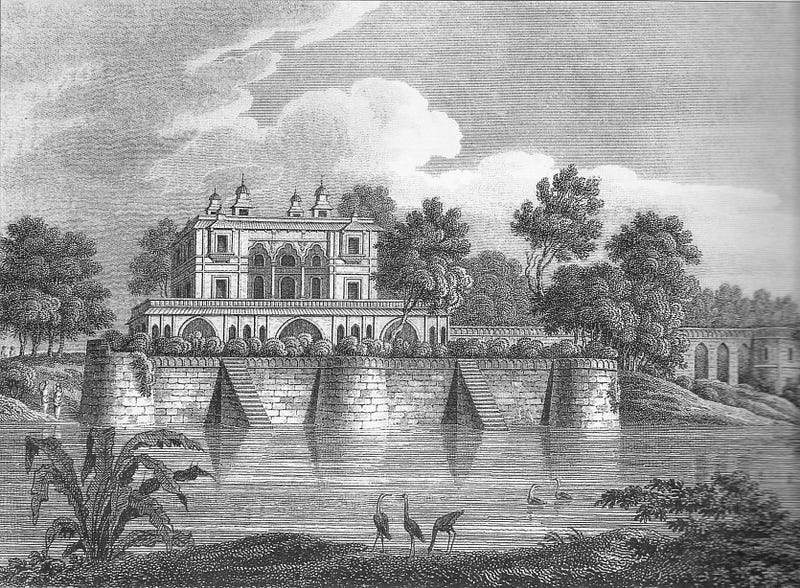
Drawing by James Forbes; screenshot by Iva Reztok

How do I seduce thee? Let me count the ways

Why do I mention Forbes? Because during his time in India, he witnessed nautch girls and wrote about them and their dances.

“They are extremely delicate in their person, soft and regular in their features, with a form of perfect symmetry, and although dedicated from infancy to this profession, they in general preserve a decency and modesty in their demeanor, which is more likely to allure than the shameless effrontery of similar characters in other countries.”

But what is a nautch girl? Well, according to All Adnan of The Friday Times (how appropriate for this article written on a Friday!), here is what a nautch girl is not: “a Domni, Kasbi, Randi, Tawaif, Kanjari, Nochi or Devdasi; she belongs to her own distinctive class.”

All of the above were (or are) references to women whose main job was to indulge and entertain men, going back centuries.

Domnis sang for both men and women, and belonged to a family of singers.

Kasbis were prostitutes who had also been born to families practicing sex trade for generations. Randis were also prostitutes, but considered lower-class.

Tawaifs were the highest-caliber and most respected women in the profession. Experts in everything ranging from singing, dancing, and acting to literature and cooking, they catered to the nobles and were experts on decorum and etiquette. They were smart, educated, and spoke several languages.

Kanjaris were sort of tawaif wanna-bes who had no formal training in the arts mastered by their higher-class counterparts. Eventually this word became a derogatory term.

Nochis were tawaifs-in-training, with the requisite condition of virginity.

Devdasis were the equivalent of nuns: they did not marry and dedicated their lives to service in a temple.

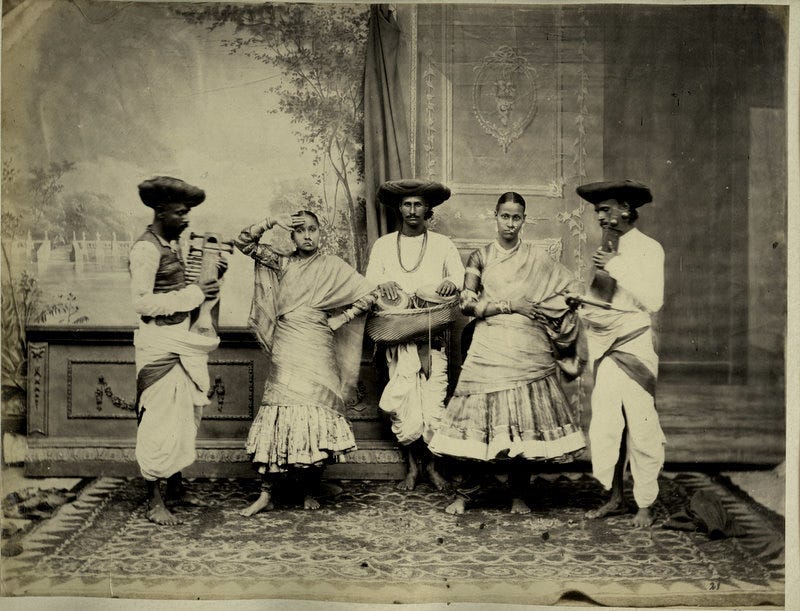
Nautch girls were not just singers, nor were they prostitutes. Although I’m sure many men — and women — may have treated them that way. They were often married and their husbands formed part of their troupe, called “nautch parties”. This group included musicians, an old maidservant called a mama, and unarmed guards, or muhafiz.

Three types of nautches became signature dances.

The mor nach (dance of peacock), performed only for men, was very erotic and included short hops followed by whirls with a long skirt (ghagra) to imitate a peacock spreading its feathers. Things went a bit literal sometimes, with the skirt itself being adorned with peacock feathers.
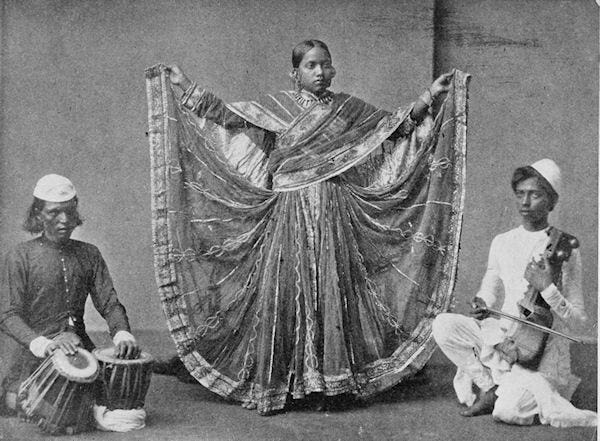
Photo by Pub Licdomain

In the patang nach (the kite dance), the nautch girl would imitate both the kite and the person who flew it. This was a dance performed at a slow rhythm, sometimes with two dancers. One would play the kitee, the other the kiter. I think I just made up those terms, but you probably got the idea. This dance would be performed for both men and women.
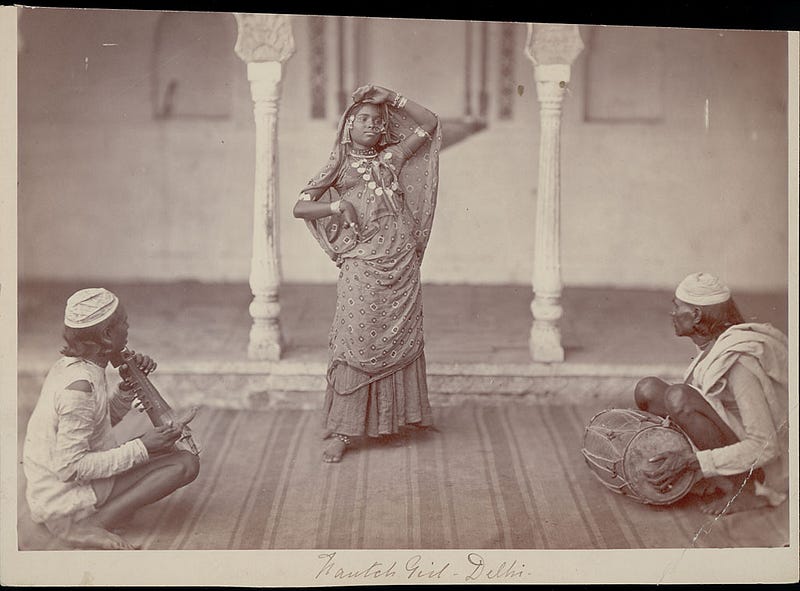
Photo by Charles Shepherd; not sure who ripped it.

Finally, the qahar ka nach was a more subtle version of the mor nach, although still erotic and suggestive. Also for men only. As The Friday Times explains:

The dance was performed in close proximity to the audience. The nautch girl teased a favored few amongst the audience by slowly advancing towards them, in a manner suggestive of an imminent kiss, and retreating at the last moment. The dance was usually the finale of a nautch performance.

Nautches were increasingly popular during the Mughal Empire and the rule of the East India Company, encompassing a period from the early 16th century to the mid-19th century. With the opening of the Suez Canal in 1869, Christian missionaries began arriving in India. Dancing was stigmatized, and nautch girls who could no longer find dance patrons turned to prostitution in order to survive.

So, as so often happens with us humans, the “cure” ended up being worse than the “disease”.

Baz and Roop

Bayazid Baz Bahadur Khan was the last Sultan of the Malwa Sultanate, and reigned from 1555 to 1562.

Here is his palace. I don’t know if James Forbes sketched it, but Wikipedia does say that Bernard Gagnon took this photo.

Credit: Bernard Gagnon

“Baz”, as he was known to no one else except me, didn’t much care for the bothersome and time-consuming task of actually ruling his empire. Which is why he was the “last Sultan of the Malwa Sultanate”, as I mentioned earlier.

The (last) Sultan preferred to devote time and energy to the arts and to his queen, Roopmati. She was a nautch girl and a poet from Saharanpur. Despite the fact that Roop was Hindu and Baz was Muslim, they fell in love and married. This beautiful and romantic love story inspired many folk tales in the region.
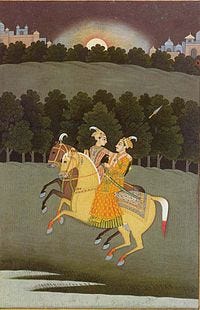
Screenshotted by Iva Reztok

Now, the story I found is not backed up by decent references, but it’s nice enough for a Friday. And since I’m tired and it’s Friday (have I mentioned that?), I’ll just quote it from Wikipedia. I know that’s lazy, but heck, I’m tired and it’s Friday. (I think I hadn’t explained that already.)

Once out hunting, Baz Bahadur chanced upon a shepherdess frolicking and singing with her friends. Smitten by both her enchanting beauty and her melodious voice, he begged Roopmati to accompany him to his capital. Roopmati agreed to go to Mandu on the condition that she would live in a palace within sight of her beloved and venerated river, Narmada. Thus was built the Rewa Kund at Mandu.

Unfortunately, the romance of this Muslim prince and Hindu shepherdess was doomed to failure. The great Mughal Akbar decided to conquer Mandu. Akbar sent Adham Khan to capture Mandu and Baz Bahadur went to challenge him with his small army. No match for the great Mughal army, Mandu fell easily.

Baz Bahadur fled to Chittorgarh to seek help. As Adham Khan came to Mandu, he was surprised by the beauty of Roopmati. Rani Roopmati stoically poisoned herself to avoid capture, bringing an end to the love story.

This artwork from the Akbarnama (official chronicle of the reign of Akbar) depicts the defeat of Baz Bahadur by Mughal troops in 1561. Roop and her companions view the scene from the terrace of the fort, upper right.
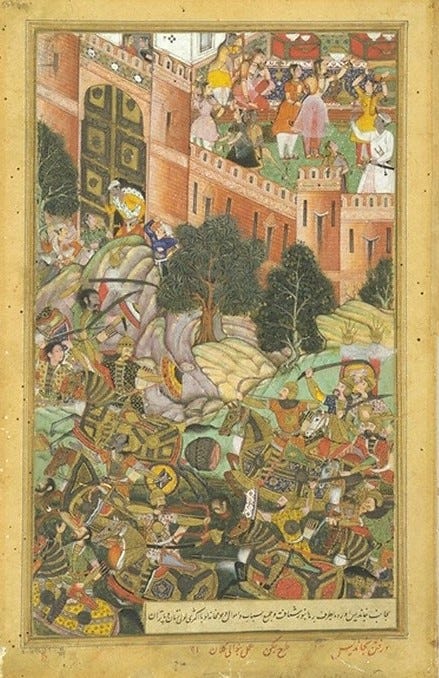
Art by Jagan, Banwali, I think

What can I say? Despite this saccharine-loaded tale of star-crossed lovers and the fact that nautch girls dedicated themselves to the well-respected art of erotic dancing, the editors of the New York Times decided that the word nautch is a dord.*

You can check out my previous entry on another dord* here:

*What the heck is a dord, you ask? Here’s the answer:

Spelling Bee
Language
History
Dance
India
Recommended from ReadMedium