NEUROSCIENCE AND PSYCHOLOGY
Myths and Ideas About the Two Halves of Our Brain — Part 7: Novelty, familiarity, and sex differences
How female and male brains do the same thing, but appear to be organised in different ways
Recap
In the previous article, we discussed Elkhonon Goldberg’s ideas about how the right hemisphere prefers novelty and the left hemisphere prefers familiarity/routines. The evidence for this comes from the experiences of people with brain damage and recording studies of people undergoing tasks as they progress from novel to familiar/routine. I personally think that Elkhonon’s ideas about the left and right hemispheres have merit, and they’re slowly becoming more widely known among researchers.
Today
But we noted last time that this isn’t the end of the story, and we have a whole other dimension to tackle: you’ve heard about left-right, but what about front-back? As we’ll see, the front-back dimension also teaches us a lot about how the brain deals with novelty and familiarity/routines, and leads us into the world of sex differences.
We’ll start by explaining the difference between the frontal cortex and the posterior cortex. We’ll then cover the evidence linking novelty with the frontal cortex and familiarity/routines with the posterior cortex. To finish our discussion of Elkhonon’s ideas, we’ll then talk about how this maps onto some sex differences in the brain.
What exactly are the frontal and posterior cortices?
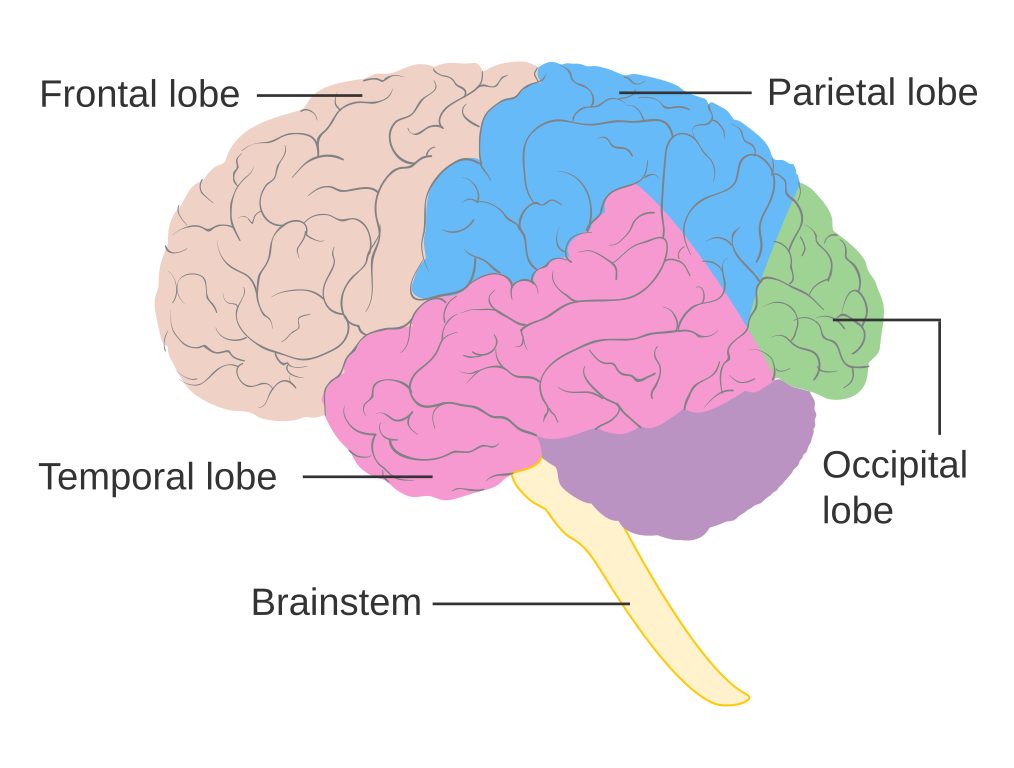
As their names suggest, the frontal cortex is located at the front of our brain, and the posterior cortex is located at the back. The dividing line that separates them can be seen in the diagram below, and includes the central sulcus and the Sylvian fissure. Let’s briefly run through some jargon, because the brain has many terms and they can quickly get confusing.
The frontal cortex is also known as the frontal lobe, while the posterior cortex consists of three separate lobes, each supporting a different sense: vision (occipital lobe), hearing (temporal lobe), and touch (parietal lobe). People will often refer to lobes (e.g., the frontal lobes) rather than a lobe, as there are two of each lobe, one in each hemisphere.
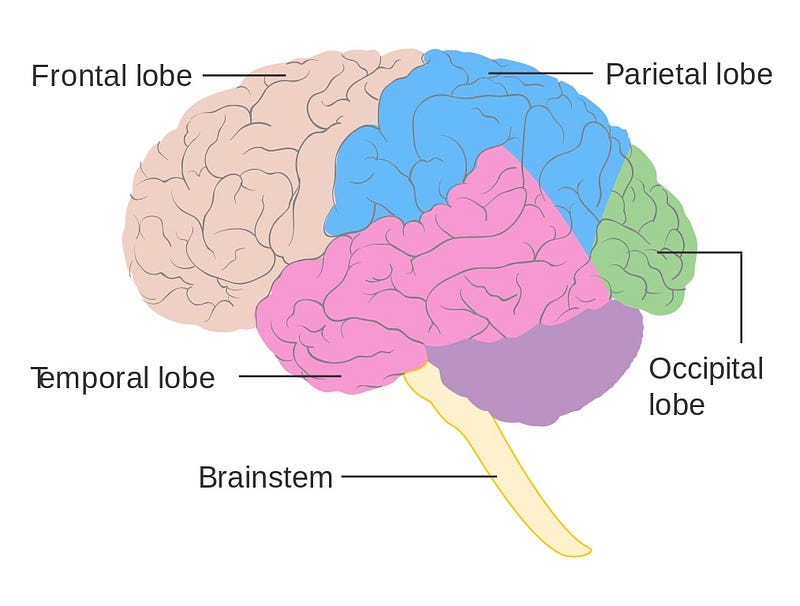
The frontal cortex is associated with voluntary actions (as opposed to reflexes), and the posterior cortex is associated with perception. For example, Broca’s area supports speech production (a voluntary action) and is found in the frontal cortex, whereas Wernicke’s area supports the comprehension of language (perception) and is found in the posterior cortex.
Novelty in the frontal cortex, and familiarity/routines in the posterior cortex
Although action and perception are handled by different areas of the brain, they must interact if the organism is going to function effectively. So what is the relationship between the frontal and posterior cortices? Decades of research suggest that the posterior cortex both processes information during perception and stores information in memory. The frontal cortex may also store information, but its main role seems to be retrieving information that’s stored elsewhere while we navigate our environment.
The library and librarian metaphor
Metaphors for this vary, but I like to think of the posterior cortex as a library, and the frontal cortex as a librarian. The frontal cortex may not have all the answers personally, but it knows where to get the information it needs as we go about our lives. This is thought to explain the anatomy of the frontal cortex, which connects to every part of the posterior cortex. These connections are organised in ‘maps’ that are believed act like a referencing system for retrieving information.
But how does the frontal cortex know what information it needs? And does the frontal cortex always need to be involved or can the posterior cortex sometimes handle things alone? The frontal cortex is very sensitive to our context, and uses cues from the environment as a guide. In highly-complex and/or unfamiliar environments, where we must carefully analyse what information we need in order to inform our actions, the frontal cortex plays an instrumental role, in partnership with the posterior cortex.
However, when we’re confronted with a situation that’s highly familiar, or that involves simple, obvious, logical rules, the frontal cortex can act more as a passenger and let the posterior cortex take the wheel. This means that the posterior cortex is up to the task when situations are familiar, or so simple as to be readily understood with familiar logic and/or routine responses. By contrast, when situations are too novel or complex for routine responses, the frontal cortex steps in to pick up the slack.
The calculator metaphor
On this point, the library-librarian metaphor begins to break down, but the calculator is a helpful replacement. Like a calculator, the posterior cortex can follow an algorithm to produce an answer, but it can’t tell you what the answer means. To make meaning, you need the broad awareness and understanding of the frontal cortex, which creates meaning from raw information by applying norms, values, and goals.
This appears to explain why the frontal cortex is also crucial for making decisions about your own subjective preferences. This is because preferences have meaning but not necessarily logic, as people’s preferences are often arbitrary and self-contradictory. We usually don’t notice the arbitrariness and contradictions, but they’ve been demonstrated experimentally for decades. (Behavioural scientist Nick Chater discusses this in his book The Mind is Flat: The Illusion of Mental Depth and The Improvised Mind.)
Let’s try to make this easier to remember
How can we condense all that down to something memorable? When you need to decide what information is relevant and how to use it, such as in novel and complex environments, or in terms of personal preferences, the frontal cortex will be engaged. But when the situation is sufficiently familiar and/or simple, the frontal cortex can leave things to the posterior cortex and its routines.
This conclusion is based on studies with people who experienced various forms of brain damage, and brain recording studies of people without brain damage. This means that, in both damaged and undamaged brains, novelty and complexity are associated with the frontal cortex, and familiarity and routines are associated with the posterior cortex. This system also turns out to make good metabolic sense, as the frontal cortex is relatively expensive, even by the brain’s standards, so using it only when needed would help to keep down energetic costs.
Based on these findings, Elkhonon argues that his continuum, ranging from novelty at one end to familiarity/routines at the other, applies to the brain’s front-back dimension as well as its right-left dimension. In my view, Elkhonon makes a decent case for his theory. However, he also points out that there’s one last wrinkle to consider, and it brings us to the world of sex differences.
Sex differences in brain organisation and function
The male brain
Elkhonon notes that the asymmetries we’ve spoken about seem to mostly apply to men. For example, in the average male brain, the left hemisphere is larger than the right hemisphere at the back, but smaller than the right hemisphere at the front.
Discovered by Paul Yakovlev, this is known as the Yakovlevian torque, as it’s caused by the way the brain twists and turns during development. This anatomy also maps on to the functions we’ve discussed so far, as recordings of the male brain have found that the centre of mental gravity undergoes a shift from right-front to back-left (i.e., from one enlarged region to the other) as tasks go from novel to familiar/routine.
The average male brain is also asymmetrical in other ways, as various chemical messengers are more active in one hemisphere than the other. Two well known cases are dopamine, which is more active in the left hemisphere, and noradrenaline, which is more active in the right hemisphere.
The female brain
These asymmetries were initially thought to be general features of ‘the brain’. However, it’s since been shown that many of them are less pronounced or totally absent in women.
For example, women’s brains typically show no Yakovlevian torque, as their left and right hemispheres are much more symmetrical than in men. Similarly, estrogen, an important hormone in both women and men, appears to be active at different levels in the hemispheres of the male brain, but equally active in the hemispheres of the female brain.
Some types of brain damage also seem to affect women differently than men. This is evident from a number of studies which found that certain brain functions related to decision making were organised along a left-right axis in men, meaning that damage on the left and right side had different effects. In contrast, damage to the left or right made no difference in women, as their brain functions were organised along a front-back axis.
Male and female brains are both similar and different
We shouldn’t make too much of these findings, as there are also many clear similarities between the male and female brains. But still, these findings do show that, at least in some ways, the average female and male brains are different, including with respect to asymmetries between the hemispheres.
Summing up Elkhonon’s theory
This concludes our tour of Elkhonon’s novelty-routinisation theory of brain function. If you’d like to learn more, I strongly recommend his book The New Executive Brain. To sum up, he argues that the brain is organised along a continuum. This continuum runs from novelty at one end to familiarity/routines at the other.
Novelty is identified with the right hemisphere and the frontal cortex, while familiarity and routines are linked to the left hemisphere and the posterior cortex. The picture is complicated by sex differences that are not well understood and need further study. However, there are also many similarities between the female and male brains, and systematic sex differences are not the norm.
This is very far from an exhaustive explanation of all brain functions, as I’m sure Elkhonon would agree. However, Elkhonon’s theory provided the first coherent account of differences between the hemispheres, and it has withstood scrutiny for over 40 years since he first made the proposal in 1981. In fact, if anything, his ideas are gaining traction over time, even if he isn’t always properly acknowledged for his contributions.
Next time and last stop: Iain McGilchrist
However, we have one last stop before we bring this series to a close. We’ve covered a wide range of findings in connection with the hemispheres, and I personally find that Elkhonon’s theory doesn’t have satisfying answers for some of them. For example, let’s go back to agnosias, where you lose the ability to recall an item’s category after left hemisphere damage. By contrast, right hemisphere damage causes difficulty in perceiving an item, like in prosopagnosia (face blindness).
Elkhonon argues that this supports his theory, as we use categories (left hemisphere) to deal with familiar items, whereas recognising an individual entity (right hemisphere) involves novelty, as it requires us to judge how that thing is unique. I see what he means, but I’m not totally convinced, and there are other findings that his theory doesn’t seem to easily explain.
For example, what about the wild overconfidence and detachment from reality that we sometimes see when people experience right hemisphere strokes? Remember Supreme Court member William Douglas, who denied his paralysis and confidently told journalists that he could play in the NFL. Or US president Woodrow Wilson, who denied his paralysis from the seat of his wheelchair, and never gave up his plans to win back the White House.
This also resembles another example that you’ll only remember if you read the bonus sections (you didn’t think there’d be a quiz!). Remember the studies with people who had so-called ‘split-brain’ surgery? The main connection between their hemispheres, the corpus callosum, was surgically severed to treat life-threatening epilepsy. Thankfully, the surgery was usually successful in improving their epilepsy, but it also prevented the hemispheres from sharing certain information.
Taking advantage of this as a chance to learn about the brain, people like Michael Gazzaniga found that the left hemisphere would rather make up a story than admit it doesn’t know why the right hemisphere did something. The left hemisphere was happy to admit it didn’t know all sorts of other stuff. But if it was about our own actions, the left hemisphere always acted like it was in the loop. When pressed for an answer it didn’t have, this meant cooking up a story using any available cues, and then passionately believing its own invented story.
Could these findings really be explained by differences in whether the hemispheres prefer novelty or familiarity/routines? I’m skeptical that Elkhonon’s theory has the answers we’re looking for, and I think we need more ideas. Fortunately, there’s one last theory to cover, which offers a different perspective on the hemispheres, but is also compatible with Elkhonon’s work. This brings us to the psychiatrist, researcher, philosopher, science communicator, and literary scholar, Iain McGilchrist.
In Iain’s theory, differences between the hemispheres are because they each have different ways of understanding the world. For example, he provides evidence that the left hemisphere focuses on parts and properties, whereas the right hemisphere prefers to think of wholes and relations. If that’s a bit too abstract right now, don’t worry, because we’ll discuss Iain, his theory, and why he has so many occupational titles when we return to close the series next time. Until then!