avatarMatt Williams-Spooner, Ph.D.

Free AI web copilot to create summaries, insights and extended knowledge, download it at here

5298

Abstract

l with language as the left hemisphere.</p><p id="a477">Similar results have also been found in people with damage to language-related areas in the left hemisphere, and in people whose left hemisphere has been <a href="https://www.sciencedirect.com/science/article/abs/pii/S0093934X15300250">damaged in an accident</a>, or either <a href="https://www.sciencedirect.com/science/article/pii/S2211124719313816">removed or functionally silenced by surgery</a>. In these people, <a href="https://onlinelibrary.wiley.com/doi/abs/10.1002/1531-8249(199910)46:4%3C579::AID-ANA5%3E3.0.CO;2-K?casa_token=S71EZF5g9HoAAAAA:GHSsZdMEdXT5EGNqcHxEOvJ3xKppmz2LrLhyyoQVkObM6i1xCswlun9_4Bhy5OHzvvEzYfOG8Q6ci-R0">the right hemisphere can compensate for loss of ‘language’ centers in the left hemisphere</a>, though recovery of function takes time, may be incomplete, and can vary depending on the nature of the brain damage.</p><p id="744e">Although the right hemisphere isn’t a master of language by itself, these findings strongly suggest that the left hemisphere isn’t the only seat of language in the brain — a major slap in the face for the myth of left brain dominance.</p><figure id="6b66"><img src="https://cdn-images-1.readmedium.com/v2/resize:fit:800/0*LVkq_03S6R3Heqgw"><figcaption>Some of the elements that make up prosody. It’s not my area of research, but I think body language and prosody should be understood together rather than separately. That’s because our movements also provide important clues about what we’re trying to say, and many features of prosody can be difficult to interpret, or at least easy to misinterpret, without knowing the speaker’s body language.</figcaption></figure><p id="1e1e">So, if both hemispheres support language in ways that are different but complementary, what exactly does that look like? Based on what we know today, the left hemisphere seems to specialise in the literal meaning of language, as its activity suggests a preference for language rules and word meanings.</p><p id="2a58">In contrast, the right hemisphere appears to specialise in the more implied, less literal aspects of language, such as metaphor, humour, and the way in which something’s said, like a person’s tone and body language.</p><p id="4081">You may be wondering, is this also what you see in the minority of people who buck the usual trend and show right hemisphere dominance for spoken language? In studies so far, the pattern is that specialisation for literal meaning tracks whichever hemisphere dominates for spoken language.</p><p id="a1f0">This means that people with a verbal right hemisphere reverse the usual pattern. They show the typical bias towards literal meaning in their verbally dominant hemisphere, except this involves their right hemisphere rather than their left.</p><p id="446e">But talk of dominant hemispheres can put literal meaning on a pedestal that it doesn’t fully deserve. Literal meaning is only part of language, and there are important things to say about the implied aspects of language, such as prosody (the pattern of emphasis, rhythm and tone) and body language.</p><p id="9986">I’m not a linguist, but, in my opinion, prosody and body language are at least as important as literal meaning. They may even be more important than literal meaning for certain uses of language, like comedy, music and acting. In cases like these, language can actually lose meaning if taken too literally, and body language and prosody are often key factors. Literal and implied meaning can also differ and contradict each other: “It’s not what you said, it’s how you said it!”</p><figure id="0ffb"><img src="https://cdn-images-1.readmedium.com/v2/resize:fit:800/1*1TiOsKqsetBS_sI-54XI7Q.png"><figcaption></figcaption></figure><p id="a44f">The importance of implied meaning and its association with the right hemisphere paint a persuasive picture of different but complementary functions. In addition, a right hemisphere that’s initially nonverbal can learn spoken language when the brain is ‘split’ or the left hemisphere’s damaged, and the right hemisphere dominates spoken language and literal meaning in a minority of people.</p><p id="c833">The shortcomings of the myth of left brain dominance are really piling up. And now the final straw: the idea of a subordinate or minor right hemisphere doesn’t square with the known consequences of right hemisphere damage. Far from the profile of a subordinate and unimportant hemisphere, right hemisphere strokes can have debilitating effects, <a href="https://readmedium.com/myths-and-ideas-about-the-two-halves-of-our-brain-part-2-b618902d9e1c">as we saw with anosognosia in an earlier article</a>.</p><p id="5897">Evidence from split-brain patients also suggests that the hemispheres don’t have a master-subordinate relationship, as the two would sometimes disagree with each other! The people’s arms would make different choices over things like what food to eat or which clothes to wear, putting down what the other picked up and choosing its preferred option instead.</p><p id="e32c">They might close doors and books that the other had just opened, unfold sheets that the other had just folded, or snatch money that the other was trying to give as payment. Disagreements could also be potentially dangerous. In <i>The Mas

Options

ter and His Emissary</i>, Iain McGilchrist cites a passage from a <a href="https://www.sciencedirect.com/science/article/pii/S0028393297000195">1997 research paper</a> from Michael Gazzaniga’s lab:</p><blockquote id="ce44"><p>On several occasions while driving, the left hand reached up and grabbed the steering wheel from the right hand. The problem was persistent and severe enough that she had to give up driving.</p></blockquote><p id="848c">For a subordinate, the right hemisphere is surprisingly willing to disagree with its supposed master. Funny examples of teamwork between the hemispheres of the split brain help to make a similar point.</p><p id="c859">For instance, researchers had to be on the lookout for cheating when running studies, as the two hemispheres would subtly communicate when one needed an answer that only the other had. As Michael Gazzaniga discusses in <i>Tales From Both Sides of the Brain</i>, the hemispheres would work together using clever tricks like counting the number of movements the other made and using that as the answer.</p><p id="1019">In a cool and slightly spooky twist, this sneaky cheating by the split brain apparently occurred outside the person’s conscious awareness! Although the myth would paint them as a dominant master and a subordinate dunce, the left and right hemispheres clearly work best when they’re in cahoots. While the hemispheres do have their own specialties and preferences, cases like these show that the right hemisphere often functions more like a partner than a subordinate.</p><p id="139c">Despite the differences between the hemispheres, we need to remember that the complementary aspect of their relationship is essential to the brain’s overall efficiency, and that, in many cases, the hemispheres are better viewed as a team than as individual players.</p><figure id="c0d1"><img src="https://cdn-images-1.readmedium.com/v2/resize:fit:800/1*5ue0RRYWMP-qzq4EnJUCgQ.png"><figcaption>Researchers studying split-brain patients needed to always be careful when designing their experiments because the two hemispheres would team up to cheat in tasks if they could. Interestingly, and maybe a little spookily, this subtle communication between hemispheres seemed to happen outside of the person’s conscious awareness.</figcaption></figure><p id="abbd">Let’s sum it all up. There’s truth to the idea that the left hemisphere dominates spoken language in many people and vocalisations across some sections of the family tree, <a href="https://readmedium.com/myths-and-ideas-about-the-two-halves-of-our-brain-part-4-the-myth-of-left-brain-dominance-25a4af01f2c3?source=friends_link&amp;sk=68965a42c9904c4defc0a1dc13a453d7">especially among the great apes</a>. However, the idea denies the language skills of the right hemisphere and diminishes its overall contribution, despite the right hemisphere’s obvious importance, <a href="https://readmedium.com/myths-and-ideas-about-the-two-halves-of-our-brain-part-2-b618902d9e1c">as we see in conditions like anosognosia</a>.</p><p id="196b">The myth’s also untrue for most of our vertebrate cousins, relies on a dubious equivalence between language in humans and vocalisations in other animals, and overlooks many exceptions to the rule in people, like lefties and people with right-brain dominance for language. In my view, this is quite damning, and means the end of the line for the myth of left brain dominance.</p><p id="60bf">Since our two myths have bitten the dust, where else can we look for ideas about our brain’s hemispheres? Next time, we’ll dive into Elkhonon Goldberg’s theory: the left hemisphere specialises in routines and familiarity, whereas the right hemisphere specialises in novelty. In my opinion, Elkhonon makes a convincing argument, and ties together many of the things we’ve learned so far about the hemispheres of our brain.</p><p id="1d52">That’s it for today, but read the bonus below to see how differences between the hemispheres may have a surprising link to cooperation and competition!</p><h1 id="6d4d">Bonus: Nervous system asymmetries and the possible roles of cooperation and competition</h1><p id="17fe">Researchers have used computer models to understand how a bias for using one side of the body emerges at a population level. One group found that such a bias could be produced by a balance of cooperation and competition among members of a population, a real-world example of which might be when animals try to escape from predators.</p><p id="3330">The argument gets a bit abstract and technical because it’s based on computer modelling, but the idea is that this improves the robustness of the population. In a straightforward Darwinian sense, this creates a selective pressure from the environment for individuals to have a bias for one side of their body, which perpetuates the trait in the species.</p><p id="4dcf">In the branch of biology inscrutably known as evolutionary game theory, this is called an evolutionary stable strategy. Apologies for the obscure connection, but the link to cooperation and competition was too good to resist! However, as we’ve seen, the situation is complicated, so this logic would apply differently across species, and be irrelevant in about a third of vertebrates. Thanks for reading!</p></article></body>

NEUROSCIENCE AND PSYCHOLOGY

Myths and Ideas About the Two Halves of Our Brain – Part 5: The myth of left brain dominance

Recap

The myth of left brain dominance had us going for a minute there, but it’s becoming clear that it’s riddled with blindspots and exceptions. Evidence that the left hemisphere is our go-to for language and action turns out to be more variable than the myth suggests, as we see with lefties and people who show a right-brain preference for language.

The left hemisphere often shows a bias for vocalisations in our primate cousins, especially our closest living relatives, the great apes, but the rest of the family tree varies a lot. Ditto for handedness, which is even more variable, sometimes random, and completely absent in about a third of vertebrates studied so far.

To put salt in the wound, some animals with asymmetrical nervous systems don’t have language or vocalisations. This questions the basic idea that using one hemisphere for communication could really be a defining feature of nervous system asymmetries.

Today

Consistent with this argument, as we’ll see today, studies suggest that language is actually supported by both hemispheres, not just the left! Research has also found that language functions aren’t as localised and distinct as early evidence from Broca and Wernicke suggested – regions supposedly specialised for language seem to have more general functions, of which language is a special case (take that, phrenology). Let’s get into it!
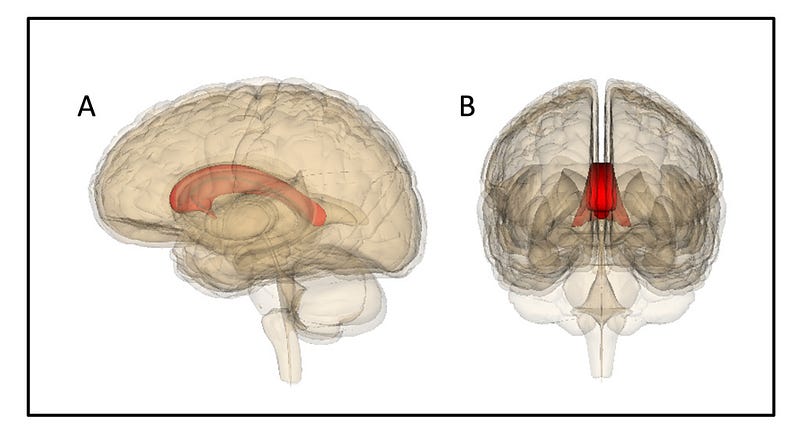
The corpus callosum, shown in red, is the main pathway of communication for the brain’s two hemispheres. Severing this pathway prevents various forms of communication between the hemispheres, like for visual information. The two hemispheres usually work hand in glove, but can sometimes disagree, as has been seen in split-brain patients.

The findings of Broca and Wernicke were inspirational in their day, and still have value, but haven’t entirely withstood the test of time. The neat distinction between the production of language in Broca’s area and the comprehension of language in Wernicke’s area contains elements of truth, but also appears to be overly simplistic.

In a way, this is because we’re still shaking off the legacy of phrenology, which promoted the idea of distinct functions being precisely localised in the brain decades before Broca and Wernicke made their discoveries. So, where did Broca and Wernicke go wrong?

For starters, while listening, speaking and reading all involve distinct areas of the brain, evidence indicates that they also share areas of the brain in common, as they’re supported by networks of regions that are different but partially overlapping. Broca and Wernicke probably could’ve made peace with this finding, but other results are more devastating for their ideas about language and the brain.

For instance, studies have found that areas implicated in language aren’t as narrowly focused as people first assumed. A good example is the planum temporale, a region located in Wernicke’s area and implicated in the comprehension of language (see the diagram below).

In line with the idea that the left brain dominates for language, the planum temporale is highly asymmetrical, as it can be up to 10 times larger in the left hemisphere than in the right. However, as Elkhonon Goldberg explains in The New Executive Brain, newer evidence suggests that the planum temporale has a general role in processing sounds, of which the comprehension of language is only a special case.
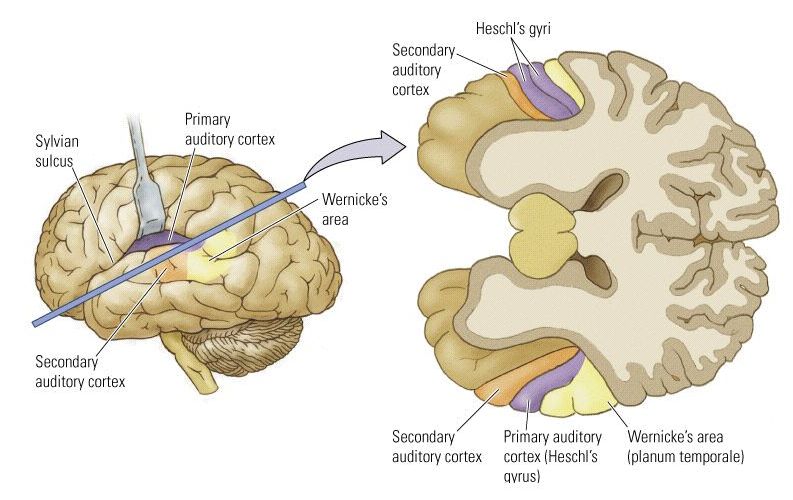
Diagram showing how the planum temporale is located in Wernicke’s area. The diagram takes the typical asymmetry into account, as it made Wernicke’s area/planum temporale larger in the left hemisphere than the right. Confusingly, the bottom of the image on the right is the left brain, and the top is the right brain.

This type of finding has also been observed in processes beyond language, and spells trouble for anyone committed to phrenological thinking in the modern day. But even if these results discredit the idea of brain regions being exclusively dedicated to language, that complicates the myth of left brain dominance without necessarily contradicting it.

The first killer blow for the myth comes from evidence that language is actually supported by both hemispheres, each in different ways. This makes sense, given that studies using brain recordings have found that both hemispheres are active during language tasks.

As Michael Gazzaniga discusses in Tales From Both Sides of the Brain, you can also see this in split-brain patients, some of whom learned to use language with their right hemisphere. To be fair, though, this could take many years, and the right hemisphere didn’t achieve the same skill with language as the left hemisphere.

Similar results have also been found in people with damage to language-related areas in the left hemisphere, and in people whose left hemisphere has been damaged in an accident, or either removed or functionally silenced by surgery. In these people, the right hemisphere can compensate for loss of ‘language’ centers in the left hemisphere, though recovery of function takes time, may be incomplete, and can vary depending on the nature of the brain damage.

Although the right hemisphere isn’t a master of language by itself, these findings strongly suggest that the left hemisphere isn’t the only seat of language in the brain — a major slap in the face for the myth of left brain dominance.
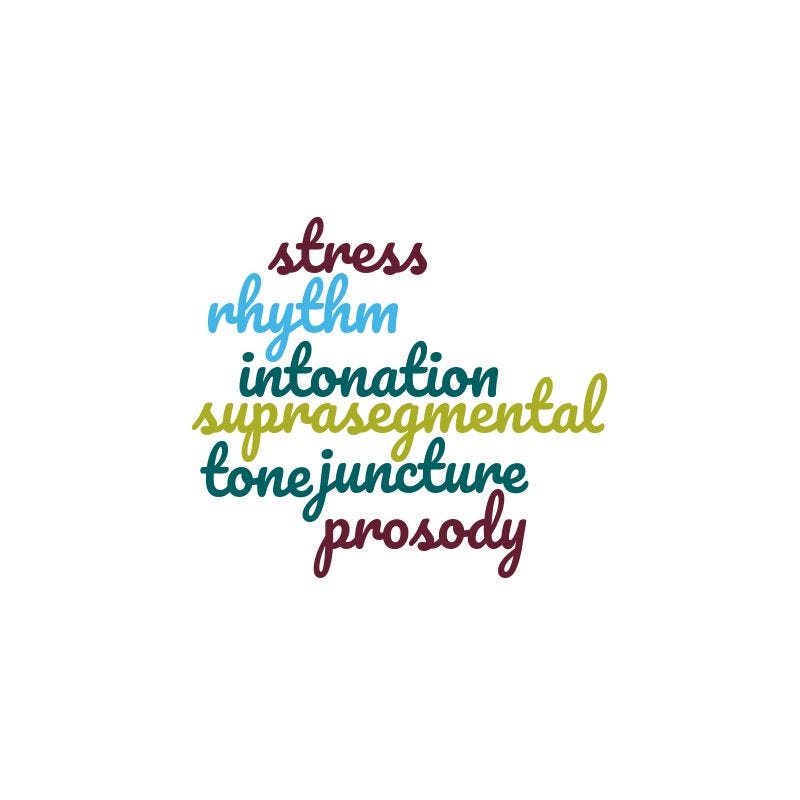
Some of the elements that make up prosody. It’s not my area of research, but I think body language and prosody should be understood together rather than separately. That’s because our movements also provide important clues about what we’re trying to say, and many features of prosody can be difficult to interpret, or at least easy to misinterpret, without knowing the speaker’s body language.

So, if both hemispheres support language in ways that are different but complementary, what exactly does that look like? Based on what we know today, the left hemisphere seems to specialise in the literal meaning of language, as its activity suggests a preference for language rules and word meanings.

In contrast, the right hemisphere appears to specialise in the more implied, less literal aspects of language, such as metaphor, humour, and the way in which something’s said, like a person’s tone and body language.

You may be wondering, is this also what you see in the minority of people who buck the usual trend and show right hemisphere dominance for spoken language? In studies so far, the pattern is that specialisation for literal meaning tracks whichever hemisphere dominates for spoken language.

This means that people with a verbal right hemisphere reverse the usual pattern. They show the typical bias towards literal meaning in their verbally dominant hemisphere, except this involves their right hemisphere rather than their left.

But talk of dominant hemispheres can put literal meaning on a pedestal that it doesn’t fully deserve. Literal meaning is only part of language, and there are important things to say about the implied aspects of language, such as prosody (the pattern of emphasis, rhythm and tone) and body language.

I’m not a linguist, but, in my opinion, prosody and body language are at least as important as literal meaning. They may even be more important than literal meaning for certain uses of language, like comedy, music and acting. In cases like these, language can actually lose meaning if taken too literally, and body language and prosody are often key factors. Literal and implied meaning can also differ and contradict each other: “It’s not what you said, it’s how you said it!”
The importance of implied meaning and its association with the right hemisphere paint a persuasive picture of different but complementary functions. In addition, a right hemisphere that’s initially nonverbal can learn spoken language when the brain is ‘split’ or the left hemisphere’s damaged, and the right hemisphere dominates spoken language and literal meaning in a minority of people.

The shortcomings of the myth of left brain dominance are really piling up. And now the final straw: the idea of a subordinate or minor right hemisphere doesn’t square with the known consequences of right hemisphere damage. Far from the profile of a subordinate and unimportant hemisphere, right hemisphere strokes can have debilitating effects, as we saw with anosognosia in an earlier article.

Evidence from split-brain patients also suggests that the hemispheres don’t have a master-subordinate relationship, as the two would sometimes disagree with each other! The people’s arms would make different choices over things like what food to eat or which clothes to wear, putting down what the other picked up and choosing its preferred option instead.

They might close doors and books that the other had just opened, unfold sheets that the other had just folded, or snatch money that the other was trying to give as payment. Disagreements could also be potentially dangerous. In The Master and His Emissary, Iain McGilchrist cites a passage from a 1997 research paper from Michael Gazzaniga’s lab:

On several occasions while driving, the left hand reached up and grabbed the steering wheel from the right hand. The problem was persistent and severe enough that she had to give up driving.

For a subordinate, the right hemisphere is surprisingly willing to disagree with its supposed master. Funny examples of teamwork between the hemispheres of the split brain help to make a similar point.

For instance, researchers had to be on the lookout for cheating when running studies, as the two hemispheres would subtly communicate when one needed an answer that only the other had. As Michael Gazzaniga discusses in Tales From Both Sides of the Brain, the hemispheres would work together using clever tricks like counting the number of movements the other made and using that as the answer.

In a cool and slightly spooky twist, this sneaky cheating by the split brain apparently occurred outside the person’s conscious awareness! Although the myth would paint them as a dominant master and a subordinate dunce, the left and right hemispheres clearly work best when they’re in cahoots. While the hemispheres do have their own specialties and preferences, cases like these show that the right hemisphere often functions more like a partner than a subordinate.

Despite the differences between the hemispheres, we need to remember that the complementary aspect of their relationship is essential to the brain’s overall efficiency, and that, in many cases, the hemispheres are better viewed as a team than as individual players.

Researchers studying split-brain patients needed to always be careful when designing their experiments because the two hemispheres would team up to cheat in tasks if they could. Interestingly, and maybe a little spookily, this subtle communication between hemispheres seemed to happen outside of the person’s conscious awareness.

Let’s sum it all up. There’s truth to the idea that the left hemisphere dominates spoken language in many people and vocalisations across some sections of the family tree, especially among the great apes. However, the idea denies the language skills of the right hemisphere and diminishes its overall contribution, despite the right hemisphere’s obvious importance, as we see in conditions like anosognosia.

The myth’s also untrue for most of our vertebrate cousins, relies on a dubious equivalence between language in humans and vocalisations in other animals, and overlooks many exceptions to the rule in people, like lefties and people with right-brain dominance for language. In my view, this is quite damning, and means the end of the line for the myth of left brain dominance.

Since our two myths have bitten the dust, where else can we look for ideas about our brain’s hemispheres? Next time, we’ll dive into Elkhonon Goldberg’s theory: the left hemisphere specialises in routines and familiarity, whereas the right hemisphere specialises in novelty. In my opinion, Elkhonon makes a convincing argument, and ties together many of the things we’ve learned so far about the hemispheres of our brain.

That’s it for today, but read the bonus below to see how differences between the hemispheres may have a surprising link to cooperation and competition!

Bonus: Nervous system asymmetries and the possible roles of cooperation and competition

Researchers have used computer models to understand how a bias for using one side of the body emerges at a population level. One group found that such a bias could be produced by a balance of cooperation and competition among members of a population, a real-world example of which might be when animals try to escape from predators.

The argument gets a bit abstract and technical because it’s based on computer modelling, but the idea is that this improves the robustness of the population. In a straightforward Darwinian sense, this creates a selective pressure from the environment for individuals to have a bias for one side of their body, which perpetuates the trait in the species.

In the branch of biology inscrutably known as evolutionary game theory, this is called an evolutionary stable strategy. Apologies for the obscure connection, but the link to cooperation and competition was too good to resist! However, as we’ve seen, the situation is complicated, so this logic would apply differently across species, and be irrelevant in about a third of vertebrates. Thanks for reading!

Psychology
Science
Biology
Evolution
Neuroscience
Recommended from ReadMedium