
Myths and Ideas About the Two Halves of Our Brain – Part 3: The logical vs creative myth
The logical vs creative myth of the brain’s hemispheres is in big trouble. Asymmetrical nervous systems are found in many organisms in which an accountant-like left hemisphere and a creative and emotional right hemisphere don’t make much sense, including worms with just 302 ‘brain’ cells.
Damage to the right hemisphere can also have devastating effects on people’s logic and reasoning, supposedly the left hemisphere’s department. So what about damage to the left hemisphere? What kind of effects are most commonly seen and do they map onto the logical vs creative myth? Once again, the myth’s in for a hard time, and another myth’s waiting in the wings to take its place.
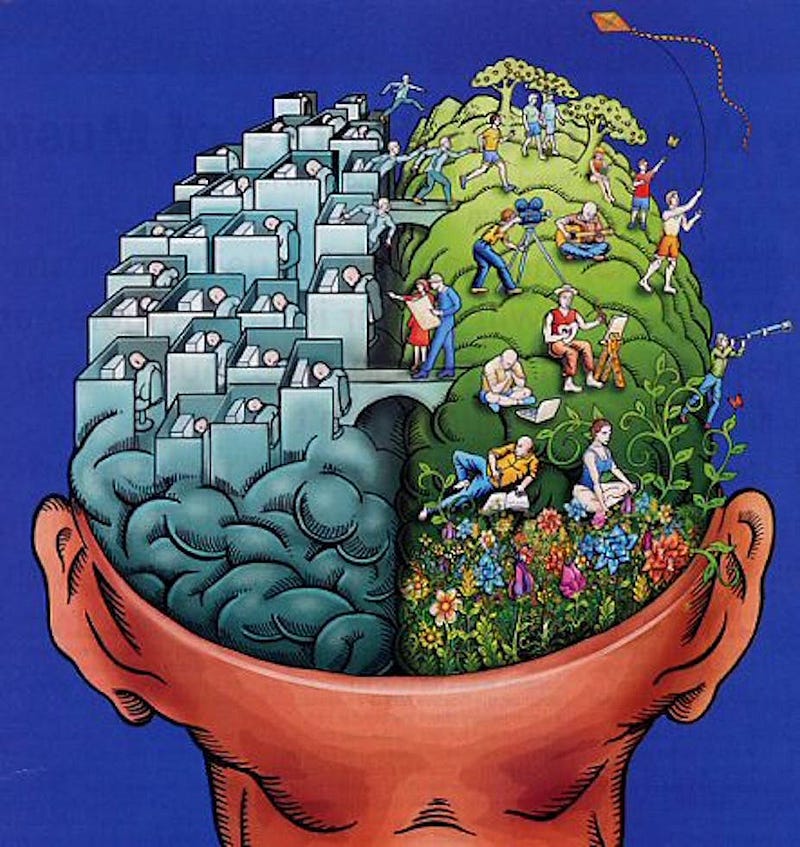
Although we looked at the right hemisphere first, if the modern history of ideas about the brain’s hemispheres began with one of the two, it’d probably be the left hemisphere. A good starting point for that history is in the 1800s, when a battle of ideas was playing out between people who argued that the brain was symmetrical and those who argued it was asymmetrical.
In a testament to the flexibility of people’s reasoning, both camps promoted the idea that humans are basically perfect, or at least so close to perfect that it’s pretty much the same thing. Convinced by the general symmetry of bodies and their own intuitions, the symmetrical crowd argued that symmetry indicates good stuff like health and is even a general organising principle for nature. Since our brain is so perfectly symmetrical, they boldly assumed with little to no evidence, we must be extra awesome.
On the other side of the divide, team asymmetry pointed to growing evidence of widespread asymmetries in the brains of humans and other animals, arguing that we’re actually the most asymmetrical of all. Because humans are obviously so awesome, they naturally reasoned, asymmetry must actually be a good thing, and might even be what makes us so special! Them’s fightin’ words. You can imagine the frosty conversations at the water cooler.
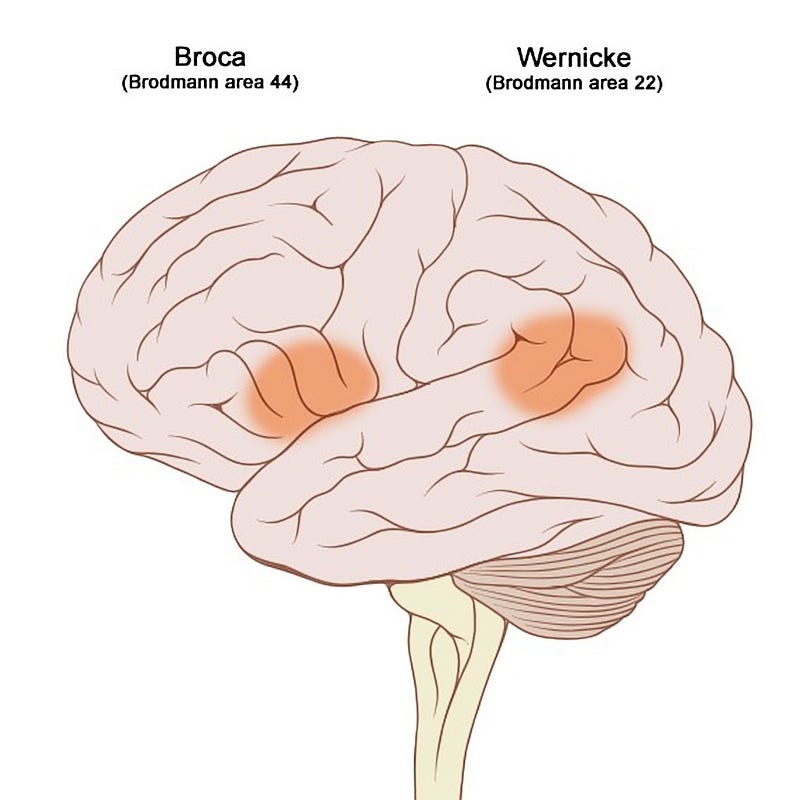
In this context, convincing evidence first emerged in the 1800s that damage to the left hemisphere can have major effects on people’s ability to produce and understand language. The two main figures of this history were a French neurosurgeon named Pierre Broca (1824–1880) and a German neurologist (a doctor who treats people with brain and other nervous system damage) named Carl Wernicke (1848–1905).
Their discoveries indicated remarkable specificity in the brain regions that support the abilities to produce and comprehend language, as you can see in the figure above. This was back in the days when naming rights were up for grabs to whoever made discoveries about brain regions and their functions. (The other organs of the body went through a similar thing, giving us my personal favourite examples of body parts with funny names: the Zonule of Zinn, followed closely by the Canal of Schlemm and the Sphincter of Oddi.)
The two brain regions now named after Broca and Wernicke were associated with different aspects of language: production of language in Broca’s area and comprehension of language in Wernicke’s area. This was based on evidence that people who couldn’t produce language but could still comprehend it had damage in Broca’s area, whereas people who could speak but couldn’t comprehend spoken language from others had damage in Wernicke’s area.
Damage in Wernicke’s area may also cause difficulties in finding the words people wanted to use, as they’d choose the wrong words but speak them clearly. The key point for our purposes is that language impairments were usually observed when this damage occurred in the left hemisphere but not when it occurred in the right hemisphere.
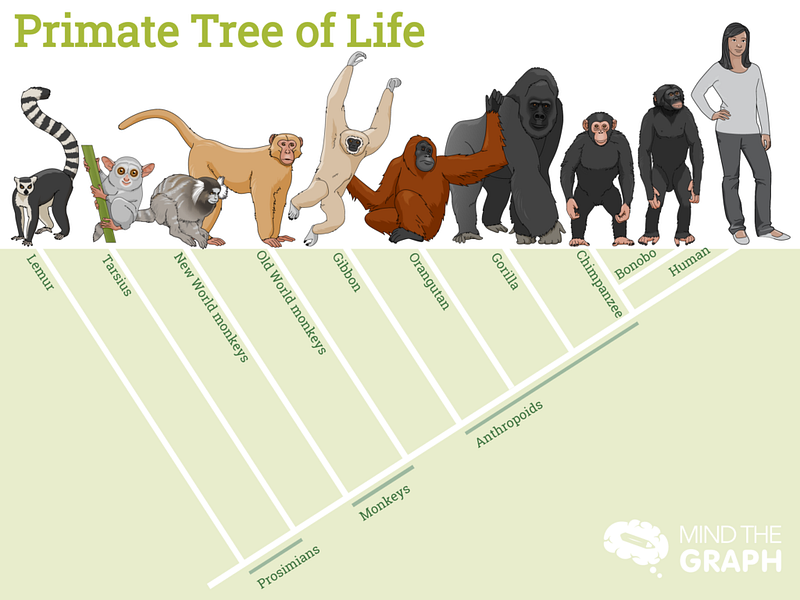
Since then, researchers have gathered various lines of evidence to support the idea of a language bias in the left hemisphere. One line of evidence suggests that left hemisphere dominance for language may have deep evolutionary roots. This is based on evidence of left hemisphere dominance for vocalisations in our primate cousins (e.g., chimps, gorillas, orangutans, and certain monkeys), non-primate mammals (e.g., horses), and some birds.
When you look at the brains of our primate cousins, they also show similar patterns of organisation in regions of the left hemisphere that are involved in language in people. Although vocalisations in non-human animals can be beautiful and complex in their own right, they’re a far cry from the complexities of human language.
Still, researchers are tempted to speculate that a general left dominance for vocalisations among some animals, particularly among our primate cousins, could be an evolutionary predecessor to language in humans. These results also have a fascinating link to handedness, which helped to turn these findings into a new theory of the brain’s hemispheres.
We briefly mentioned last time that the two halves of the brain control opposite sides of the body. An interesting phenomenon that we share with many of our animal cousins is that we have a bias for using one side of our body over the other. In people, right-hand/right-body dominance is the norm, meaning that people have a strong bias towards using the side of the body controlled by the language centre of the brain: the left hemisphere.
Researchers wondered, could it really just be a coincidence? Surely not, this has to be evidence of nature’s hand at work! The new myth practically wrote itself: the left hemisphere is our dominant hemisphere, being the primary seat of language and action, whereas the right hemisphere is the subordinate or minor hemisphere and specializes in nonverbal stuff like object identification.
As Iain McGilchrist discusses in The Master and His Emissary, based on what was known around the 1980s, there was even general disdain for the mental abilities of the right hemisphere. For example, one major figure in brain hemisphere research, Michael Gazzaniga, suggested in 1983 that the cognitive skills of the right hemisphere were vastly inferior to those of a chimpanzee. Gazzaniga no longer holds that view, but ideas such as this helped to bring the myth of left brain dominance to life.
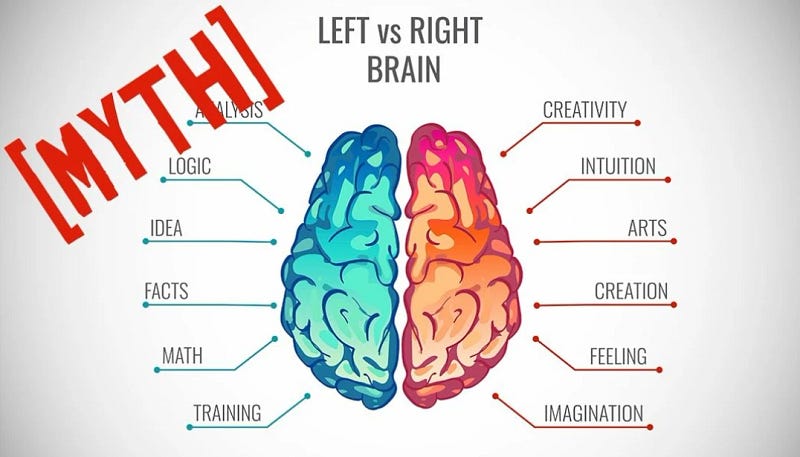
From the point of view of the logical vs creative myth, there isn’t a compelling reason to identify language with either the left or right hemisphere. Language would be relevant to the functions of both, though in potentially different ways. The left hemisphere’s apparent domination of language is another nail in the coffin for the logical vs creative myth.
However, we’ll see next time that it’s not as simple as all that. For example, you might be asking, what about the lefties?! We’ll find out about that and more next week. In the meantime, read below for a brief history of phrenology, how it relates to the discoveries of Broca and Wernicke, and how it continues to shape our understanding of the brain today!
Bonus: How the findings of Broca and Wernicke saved phrenology and shaped the history of brain research
Brain damage in Broca’s and Wernicke’s patients indicated a sharp distinction in the areas of the brain that perform language-related functions. Broca’s area seems to support language production, and Wernicke’s area seems to support language comprehension. This type of finding is known as a double dissociation, where one brain region supports function A but not B, and a second brain region supports function B but not A.
As a funny accident of history, this type of finding breathed new life into the infamous discipline of phrenology. The story of phrenology is a bit odd. In the current day, it’s dismissed as pseudoscience. Curiously, phrenology’s ideas were also rejected by researchers and doctors when it was proposed by German neuroanatomist Franz Joseph Gall (1758–1828).
Despite being dismissed as quackery by Gall’s contemporaries in research and medicine, phrenology enjoyed a strange revival decades after Gall’s death with the discoveries of people like Broca and Wernicke.
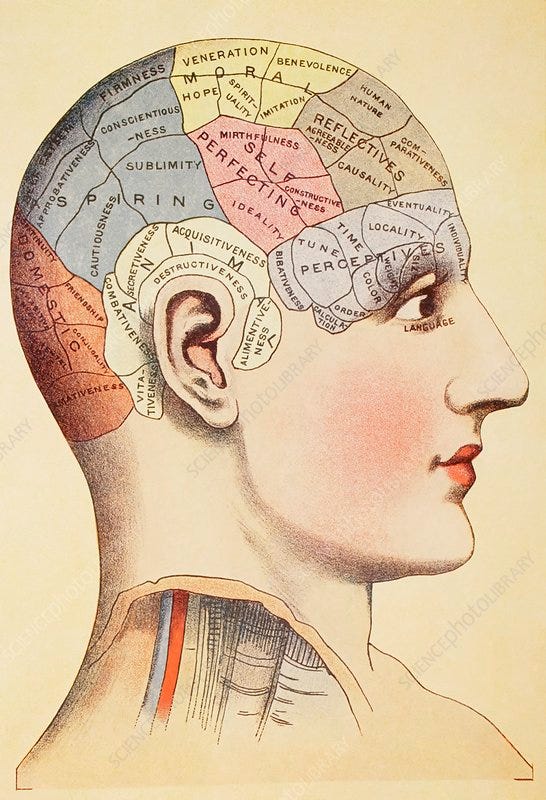
Phrenology eventually faded again due to a lack of supporting evidence. The hilariously specific and abstract functions that people came up with for different brain regions, as you can see in the example above, also give it a strong smell of being completely made up.
Nonetheless, the basic idea of phrenology – that we can localise very specific functions to precise areas of the brain and build a functional map of brain processes – actually remains the dominant view today. Against all odds, phrenology lost the battle but still sort of won the war. This approach reached its peak in the 20th century under the name of modularity, but has been criticised as ‘neurophrenology’ in more recent years.
It’s still a hotly contested area, but researchers are gradually shifting towards a view that embraces three principles: (1) brain regions can have multiple functions, (2) they participate in networks of brain regions in which they have both individual and collective functions, and (3) the same function can be performed by different brain regions and networks under different conditions. Thanks for reading!


