
WOMEN’S HEALTH
My Years-long Battle with Undiagnosed Endometriosis
“Patient Reassured”
Feb. 8, 2024. This story has been updated with new research!
As a 16-year-old senior in high school, I wore my gym clothes to school under my regular outfits to avoid exposing my skinny, underdeveloped, naked body to the jeering eyes of my much more round and bosomy classmates.
Not only a year younger than everyone else — I had skipped third grade — I was also physically behind my own age group in height and weight, and had not yet started my period. My mother was so concerned that she dragged my reluctant scrawniness to her doctor to “find out what is wrong with her.”
Quoting statistics, as medical professionals are wont to do, he said, “she’s in the normal range, a bit on the late side, but nothing to worry about.” He declared his diagnosis without examining me beyond a cursory glance. It felt like he had patted me on the head.
Finally, in the summer of my 17th birthday, just before entering college, it started. I could feel odd sensations before the blood came, unpleasant twinges and tingles and throbs in my vulva, followed later that day by waves of incapacitating abdominal pain.
Cramps. Every woman knows about cramps, although many women never experience them. It’s just part of being a woman. So sayeth the medical profession. BigPharma has a solution for the pain. Here, take this pill.
As often happens, we college girls in the dormitory got our periods within a day or two of each other, having synced our cycles after a few months together.
But I was the only one of us who couldn’t get out of bed for three days. One of my roommates’ fathers was a physician who freely handed out opiates, speed, and birth control pills. Only if/when you need them, girls!
And I needed them. The pain was excruciating, and, thankfully, my generous roommate shared her painkillers with me every month so I wouldn’t have to miss so many classes.
Eastern Airlines, Age 21
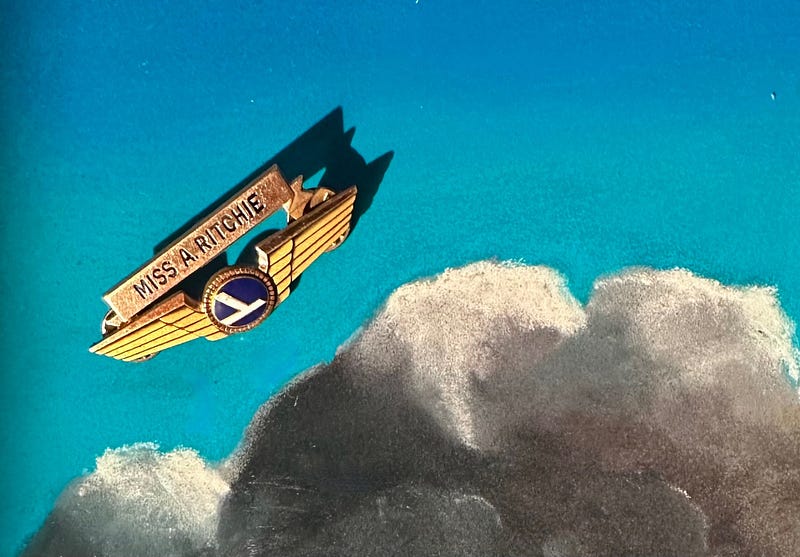
After college, I landed a cool job with a customs brokerage and freight forwarding firm in Norfolk, VA, a busy port city and Navy town on the east coast of the United States. My bosses were generous with sick leave, fortunately. They could well afford to be, as I was only paid $250/month.
But the instant I turned 21, I knew what I wanted to do and be — have adventures and travel the world as a stewardess! (Nota bene: do NOT call today’s flight attendants by that moniker!)
Before I knew it, I was flown to Miami Springs, FL, and housed at Eastern’s “Stew School” for six weeks with nearly 100 other young women, where we were all processed into cookie cutter copies of the perfect, slender, attractive, EAL air-mannequins.
This was the greatest adventure of my life! Classes were easy, leaving plenty of time to hang out at the pool in my new bikini, surrounded by drooling stew-sharks. Life was good.
But soon, that inevitable time of the month hit like a ten-ton boulder, flattening me to a writhing, bloody pulp. I called in sick.
The outrage from the front office was swift and explosive. There is no ‘sick’ for stewardesses! Report to Medical immediately!
I crawled to the medical department, bent double, where I received a lecture about how every woman has a period, and no period pain is any excuse for missing work. Here, take these pills and get to class, NOW.
The pills were Darvon, a very effective, but highly addictive, opioid pain-killer made by Eli Lilly. They worked. I was back in my sassy groove in minutes, already on the path to addiction.
Still no diagnosis, but don’t worry. It will all stop when you start having babies.
London, Age 23
I married a Navy man who was transferred to a communications center in downtown London. What a dream assignment!
For three weeks every month, I had a blast exploring, shopping, raising puppies, and learning how to be a married person.
But that dreaded fourth week! Now I was supplementing my Darvon with scotch, and still not able to function. And sex was often painful deep inside. Not a good thing for a newlywed.
Desperate for relief, I drove to the American military hospital in High Wycombe. On the table, legs akimbo, staring at the smiley-face painted on the ceiling, same old, same old.
After the exam, the doctor asked me how big my husband’s penis was. I wish I could remember the doctor’s name so I could sue him.
A year later, the pain was so great that I would sometimes pass out cold. One such event landed me in a British hospital, where I received an abdominal massage (it did actually help), and was sent on my way.
The following month, I went back to the VA hospital to see a different doctor. His name was Dr. McNee, who claimed to have been the Queen’s obstetrician. He seemed ancient to me, and claimed to be so old that he didn’t require a nurse to be present for the exam. I didn’t even mind.
During a pelvic exam — and his was thorough— one never wants to hear, Hmm. Hummmm! Hmmmmmm….there appears to be a mass.
Oh, shit.
The Surgery
Having arrived at a diagnosis of endometriosis, Dr. McNee opened me up from hipbone to hipbone, claiming that the incision will still be below the bikini line, not to worry.
Inside he found what’s called a chocolate cyst (aka endometrioma) the size of a grapefruit, which apparently had been growing in there for at least eight years, and easily palpable by anyone who would have bothered to look.
He carefully removed it, cleaned up everything else he could, and stitched me back together. I was young and recovery was swift.
But I didn’t recover from the monthly pain. My ovaries and uterus were still more or less intact, and the disease was still present and seemingly roaring back a year later.
By this time we had transferred back to the States, and I saw another doctor about this ongoing difficulty. He was a practicing Catholic and very hesitant to relieve me of my childbearing capabilities. I finally convinced him that I had no plans to be a mother, ever, especially since my husband’s vasectomy was irreversible.
A complete hysterectomy was the only option remaining. Hey, Doc, while you’re digging around in there, grab that pesky appendix too, will ya?
Life After Endometriosis
My cute, red-haired, Catholic doc — I still remember his black and white saddle oxford shoes — prescribed Premarin hormone replacement therapy (HRT), since I no longer had ovaries to supply estrogens. And at 27, we didn’t think it would be fun to go through menopause so early.
From that day forward to today (I’m 75 now), I have never been sick, no menopause, no arthritis, I’m youthful for my age, strong, and healthy. And still on Premarin. Sadly, for the past 20+ years, I have had to fight every physician I’ve seen to continue this prescription. They tell me things like:
- You don’t need it any more, being well past menopause age (whatever TF that means)
- It increases your risk for breast cancer. (I get a mammogram at least every two years — all clear. No studies have ever been done relative to breast cancer in women without ovaries and on long-range HRT.)
- We don’t know what the long-term effects might be. (The long-term effects for me have been excellent health and resistance to age-related diseases. I’m celebrating nearly 50 years on Premarin!)
- When asked the difference between older men being prescribed testosterone (for “low T”) and women being prescribed estrogens, it’s always well, men need it for other reasons.
Update regarding long-term estrogen: “A lifetime of prolonged exposure to estrogen gives women a protective effect against dementia, and this needs to be factored into clinical practice to help understand and prevent dementia,” Park said, in Newsweek, Feb 06, 2024.
Final Words
Endometriosis has been around forever, but even today it is seldom diagnosed, even though approximately 10% of all women suffer from it to one degree or another.
According to the New York Times, a 20-year study found that women with endometriosis were 52 percent more likely to have had a heart attack, 91 percent more likely to have had angina, and 35 percent more likely to have undergone coronary surgery.
But worse, much worse, is the fact that endometriosis is still considered to be a minor problem suffered by complaining women. Today I read a piece, published in honor of Women’s Day by Australian Bindi Irwin, who shared a story so similar to mine that I was prompted to share mine as well.
Bindi Irwin: Doctors dismissed endometriosis as pain women ‘deal with’
So, all you mothers and grandmothers, physicians, husbands, humans, know this: what women “deal with” is lazy, incompetent, and dismissive physicians. We need to challenge them ferociously. Recurring pain is not something anyone should have to “deal with,” especially in these modern times.
Please make sure your daughters, granddaughters, nieces, cousins, and girlfriends are aware, not only of endometriosis but of the unfortunate fact that our medical system is based on statistics rather than delving into what’s actually happening in an individual’s body. Prepare them to challenge the male-centric medical establishment and get treatment!
Endometriosis is NOT something we have to “deal with” with anymore.
Author’s note: Regarding Darvon, the pain-killer I was on for about seven years — it was reviewed by the FDA in 2010, who recommended that all women stop taking it and all doctors stop prescribing it. Why? Studies found that that the drug can cause serious toxicity to the heart, among other issues like addiction, and recommended that suppliers voluntarily take this drug off the market.
And while I’m in the mood to celebrate women and diss the establishment, these: