My Unapologetic Wax Tip for the 2023 American Birkebeiner
If the wax doesn’t work, it just makes it easier to climb the hills!
Over the weekend I took my kids out skiing at Tower Ridge. It was a nice 30 degree day. I always try to take my kids out skiing when it’s 30 degrees because there’s no quicker way to ruin skiing for a person than to take them out when it’s -28.
I happened to run into a friend who I hadn’t seen in about ten years. He was on his way back from the Mora Vasaloppet and wanted to stretch his legs before making the drive to Milwaukee.
After I got done chatting with him, my daughter turned to me and asked, “Daddy, why are all cross-country skiers friends?”
Kids have a way of saying things that rattle you to the core. I realized her question contained the essence of exactly why I do this sport. There is a really nice community around cross-country skiing. We all know how miserable the Birkie can be. We all suffer together. We all cheer for each other. We help each other out.
So, it’s with that in mind that I offer my wax tip for the 2023 American Birkebeiner. If you’re really nervous about your skis, I suggest you take them to a shop and have them prepared. But if you just want a decent wax job that you can do at home, then read on!
Full disclaimer, I don’t really care about wax
There was a time when I used to meticulously prepare my skis every time I went out for a training day. Those days are long gone.
I mean, between watching episodes of The Real Housewives of Miami, who has time to wax skis?
I’m at that age where wax just isn’t all that important to me anymore. I’m not all that fast. I’m just doing this to stay healthy. So it’s a big, “Meh” for wax from me.
Obviously, that makes me the perfect person to take advice from on how to wax your skis for the biggest race of the year.
Do you know how many times a year I wax my skis?
Once!
I only wax them before the Birkie. I used to wax two pairs but I can’t even be bothered to do that anymore.
The upside of all this is that my skis always feel like rocket ships during the Birkie because I never have good wax throughout the rest of year.
Perspective. The key to happiness is to lower your expectations (if that’s not a quote already, it should be).
That being said, my skis were fast last year
The thing about the Birkie is that you’re always going to suffer. Suffering is a guarantee. On the years when you’re having a good Birkie, you’re suffering and passing people. On the years when you’re having a bad Birkie, you’re suffering and people are passing you.
Last year, I was passing people. I even moved up a wave. Granted, I was in wave 6. It’s highly possible that “fast skis” in wave 6 don’t match up with fast skis from wave 1. But I was happy (and if I’m being honest that’s all I really care about)!
My “good” (for me) Birkie came as a total surprise because I had all kinds of health issues leading up to the race (you can read about those here).
The big thing was that I lost weight prior to the race (that’s way more important than your wax).
A few words about ski selection
Here’s another thing y’all have to know: if I had to choose between the right flex and the perfect wax, I’d take the right flex every time.
I’m at that age where the downhills scare me more than the uphills. I just look at uphills as an opportunity to get warm. The downhills are fast and I want skis I can control.
Competitive athletes will choose skis with a soft tip at the Birkie because they climb better. I always choose stiff skis because they’re easier to steer. I don’t like skis that feel at all “sloppy” in the tip.
There are skis that offer a happy medium, but I find that unless it snows on the actual day of the Birkie, the trail generally holds up very well. Yes, most of the uphills turn into churned up walls of mush (especially in wave 6), but that just proves my point. You aren’t going fast on the uphills anyway, pick skis that help you navigate the downhills.
This advice is the exact opposite of anything they’ll tell you at a ski shop, but they tend to have the mindset of 1st wave skiers. Those of us in the back are willing to sacrifice for safe, stable skis.
Then again, my “stiff” skis are so old that they’ve pretty much flexed out. I thought I’d be lucky to get through the race on them last year, but here I am again. Also, I have a big old blister from an overheating mistake that’s probably the equivalent of skiing with the parking break on.
Yeah, I’m the perfect guy to get wax tips from (you should be laughing, the point of this article is to put you at ease)!
So, anyway, here’s the process I’ve used on about 12 of my 19 completed Birkies.
Some form of graphite
It’s a 100% guarantee that the above header made a large number of legit wax techs wince. But they always say you’re wrong just to establish themselves as an authority.
I tried to buy some graphite at the expo last year, and the guy didn’t want to sell it to me. He also didn’t want to give me his wax tip. I started to wonder why he was even there.
I don’t know if graphite helps or not, it’s just how I start. Somebody once said something about how it helps drive out the debris in the snow, and it cuts down on drag from static electricity, or whatever. These are just sales pitches.
It’s a habit, I throw some graphite on there. It’s not expensive and it’s the first layer so it will probably be buried. I think I used a non-fluoro Fast Wax graphite last year. I’m not sure what it was, it was a bloc of something I found at the bottom of my ski box.
Start Green
I remember when Start Green first came onto the scene. Everyone was relieved because it was the first wax that provides you with any glide in cold temperatures. We all thought it was a miracle, and it was cheap!
To be honest, you’d have better-than-average wax for most Birkies if you never used anything but Start Green. Some serious skiers insist that Start Green isn’t a “race” wax. They’d much rather sell you something that costs 86 times more and works about the same.
Start Green is this super hard, durable wax that is consistently adequate (I think I’m going to adapt that sentence for my epitaph. Here lies Walter Rhein… you can be called a lot worse than “consistently adequate”).
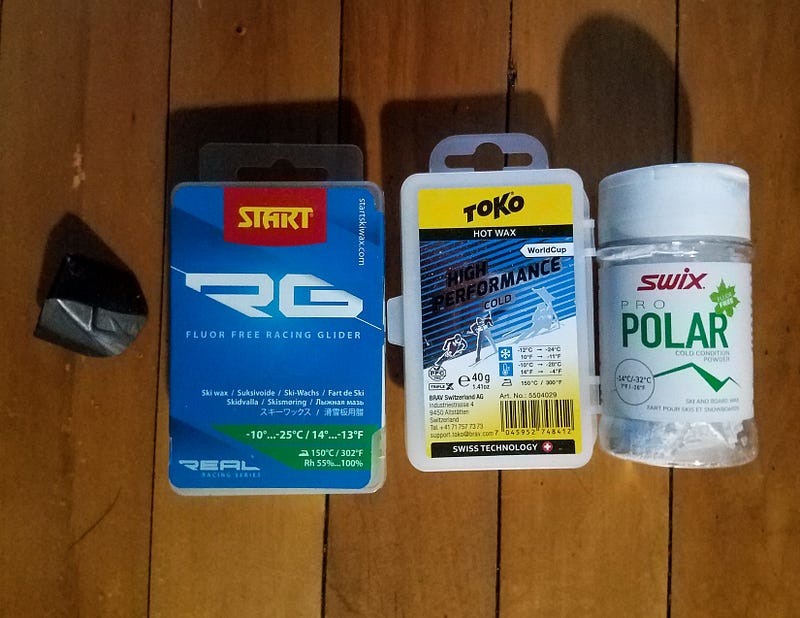
Actually, now that I look at it, I’m not entirely convinced the stuff in the above picture is actually Start Green.
Back in the old days, life was easy. If the wax was green and the package said Start, it was Start Green. These days they have all kinds of options. When I bought the package, I thought it was more expensive than it should have been, but I think that about everything these days (I blame the tax cut for the rich).
Just get something that says Start… and Green… and non-fluoro.
Toko World Cup Blue
Some people think that you can’t mix waxes from different brands together. I think they assume that they’re not chemically formulated to bind together for maximum performance. Or, maybe they’re afraid that you might mix two waxes together and get an explosion (that happened to me in High School Chemistry).
I prefer the danger! I deliberately try to mix in a wax from every different manufacturer. So, if you’ve got some old blocks of non-fluoro Rex, Rode, Holmenkoll, Star, or Solda, let me know! Let’s dump it on there and see if we get a fire!
Fire is FAST!
I specify non-fluoro because the Birkie has a ban on fluorinated waxes. Finishing a Birkie is too difficult to risk a disqualification of your 3,000th place finish because they detected fluoros on your skis.
The big secret here is that fluoros have never worked really well in cold conditions (you’re better off with Start Green).
Last year I went into a ski shop and purchased a block of the new non-fluoro Toko World Cup Blue. Foolish me, I thought it might be inexpensive because they always used to say the fluoros caused a spike in production costs. But… no, non-fluoro world cup race wax is just as expensive as the old stuff.
I used this for the very first time at the Birkie last year. Have you ever done that? Have you ever lined up at the Birkie with a wax you’ve never even tried before? I was pleasantly surprised that it seemed to work great!
Trial by fire!
Swix cold powder
Of course Toko makes a cold powder too, but I mixed in the Swix stuff instead just because I thought it was funny. You just shake it onto the world cup blue as you’re ironing.
It just hardens up the wax and makes it more durable. You need this stuff.
A few notes on scraping and brushing
Some people turn into these delightful old grandfathers who spend all day sanding down boards until they fit together so well you can’t even see the dividing line between them. I guess they must find it relaxing. These guys are meticulous. They prepare their skis with tender loving care. They spend hours passing horsehair brushes over the bases, and when they’re finished, the p-tex positively glistens.
That’s not me. In fact, I’m the opposite of that.
When I do wax, I often don’t even bother to scrape. I’ve found the abrasive snow rips off the wax in about 30 km. Go experiment with that.
When I’m preparing for the Birkie I scrape and brush, but I usually contain myself to two or three passes (at least on the early layers). There’s no point in exhausting yourself preparing your skis. I’ll spend a little more time on the last layer, but you don’t want to brush out all your wax (that’s not a thing, no real ski tech would ever say that)!
Here’s an important tip: clean out your ski bag! You don’t want to spend all your time meticulously preparing your Birkie skis, and then go and stick them in a ski back that’s dirty with kick wax.
People do this.
My waxing philosophy has a greater focus on avoiding the catastrophic mistake. It seems to have worked well so far.
Structure
I always do two passes with a rilling tool. This is because my skis are so old I’ve skied all the structure right out of them. I should go in and have them stone ground, but I think the tech won’t be able to do anything about the blister I mentioned.
The rills create little pathways so water can escape. It’s the difference between driving with bald tires or tires with tread. I’ve experimented throughout the years with and without adding a rill, the rill always seems to be better in my experience. I quit questioning it (something about an old dog).
Relax, you’re going to be fine!
The thing about the Birkie trail is that they always get it in tip-top shape. Yeah, sometimes there is a storm, or rain, or skyrocketing temperatures, but all those things are outside of the organizers’ control. They’re out of your control too.
Don’t worry about them. Also, keep in mind that if those things happen, your wax isn’t going to matter anyway.
Give your skis a quick look to make sure they’re not about to delaminate. Throw on a couple layers of hard, non-fluoro wax, and brush them enough so that there aren’t big chunks of wax creating friction.
Or, if you want some real peace of mind, take them down to a wax shop and let them take care of it. They’ll do an excellent job.
At the end of the day, your wax job isn’t going to make or break your Birkie. As long as you don’t go tip-to-tail Klister, you’ll have some amount of glide.
Finishing the Birkie is all about maintaining a positive attitude. If you don’t have any glide, just focus on how much easier it is to climb the hills!
Good luck out there!
Overheard at the start of the 2023 Birkie. “I got my wax tip from a guy who said no glide makes it easier to climb the hills…”
Upcoming presentation
If you are in Chippewa Falls, Wisconsin and you feel the need to talk Birkie a little more, be sure to check out my presentation at the Public Library on February 16th (it’s Thursday even though the poster says Tuesday).
If you can’t make it, pick up a copy of Beyond Birkie Fever. Put it under your pillow. Memorize it.

Subscribe to my emails here. Sign up to Medium via my referral link here, and THANK YOU!


