My Top 5 Investment Picks for 2021
My favorite investments that I’m doubling down on in 2021

1. Investing Time to Make More Money
This is my first investment pick given the potential for the huge ROI. I say this in almost every post single post because it’s true; if we all learned one thing from the pandemic, it should be the importance of generating additional income streams outside of our day job and becoming self-reliant.
You don’t need to build a giant YouTube following or film yourself dancing on TikTok to make extra cash outside of work. Content creation has been the hot girl at the party the past few years, but there are other more traditional side hustles that can be started part-time and scaled into 6 or 7 figure business, which I wrote about here:
Personally, I’m interested in content creation and have started writing in the Finance space. I post here on Medium and am in the middle of creating a blog, which I hope to turn into an authority site (if you want to start a blog, but you don’t want to write the posts-consider outsourcing the writing to freelancers on Fiverr).
I started posting on Medium at the end of January and have earned over $700 thus far-not bad!
Lastly, I’m in the housing market this year, and one of my key rules for home buying is to have enough income from my side hustles and investments to be able to cover the mortgage and property taxes if I find myself caught up in a layoff.
Besides being diagnosed with a health condition, there’s nothing I’d rather NOT deal with than buying a home, losing my job, and running through my emergency fund.
2. Alternative Investments
Many of the males reading this will roll their eyes when I say that I splurge on designer bags as an investment. I stumbled upon the handbag resale market in 2016 after meeting an entrepreneur in Silicon Valley that owns an online authentication and bag re-selling service (similar to eBay, but she specifically sells a handful of designer bags, shoes, and accessories).
I love fashion, and when I learned that I could buy a purse that is undervalued and re-sell it for a higher price, I became intrigued. I found an article on Harper’s Bazaar, which showed the price increases of Chanel bags in comparison to the housing market and the S&P 500, as shown below:
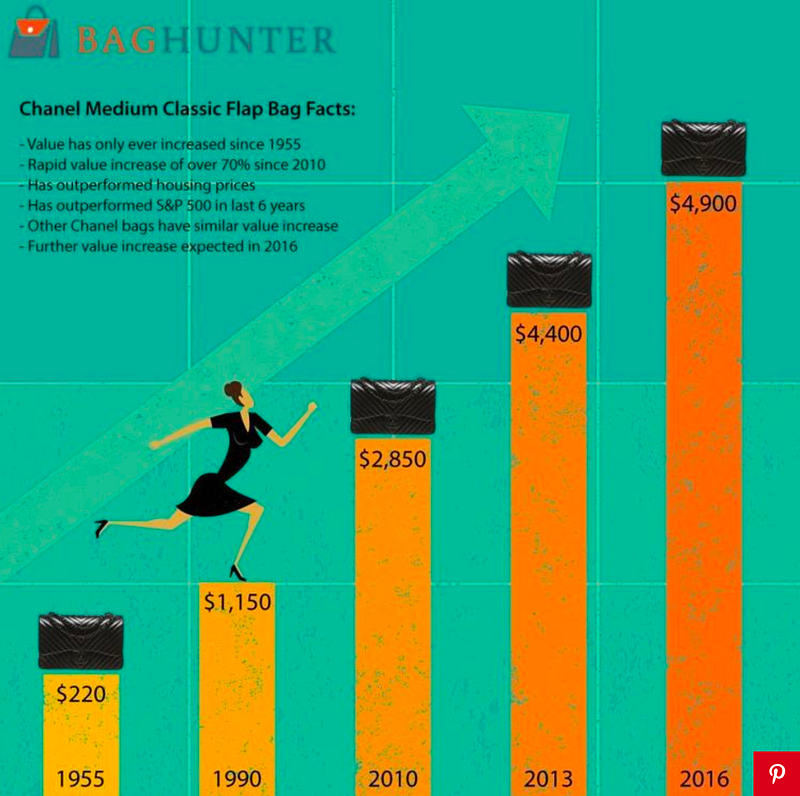
Over the next few months, I spent time going on eBay looking for a black Chanel Medium Flap Bag in caviar leather. I finally found the perfect bag in great condition with all of the receipts in early 2017. I’ve held onto the bag and it is currently worth more than 2.5 times what I paid from appreciation and purchasing at a low cost. I’ve made similar under-valued purchases of lower-end brands (like Coach) and re-sold on eBay at a profit.
This year instead of buying and selling, I’m focused on acquiring another Chanel classic bag or two and holding for the foreseeable future. Chanel, Louis Vuitton, etc., continue to increase their prices, as they still have plenty of willing customers. They never discount any of their classic bags, as there is no need. If you are unfamiliar with the Chanel or Hermes market, you cannot simply walk into a store and purchase any bag you desire. There are far fewer bags than customers looking to purchase, and hence the re-sale market does very well.
I’m not saying that everyone needs to run out and buy as many Chanel bags as they can; I’m simply suggesting that if you have a passion for watches, art, etc., you should at least explore the idea of purchasing them as investments.
3. Mid-Cap and Sector ETFs
I know I consistently sing the praises of Vanguard’s ETFs, and for the very simple reasons that they offer excellent returns, broad diversification, and low expense ratios. Here are a few that I’m investing in this year:
- Vanguard’s Extended Market ETF (VXF): VXF has performed exceptionally well this year, with a current 1 year ROI of 56.45% and an ROI of 18.65% over the past 3 years. There are a total of 3351 stocks in the ETF, with the largest holdings in the IT, Health Care, and the Financial sector. Some of the largest companies in the ETF are Zoom, Uber, and Moderna, and given the current environment of remote work and vaccine production and distribution carrying into 2021, I’d expect the above-mentioned companies to perform fairly well. Moderna as an example produced $803 million in revenue in 2020 in comparison to $60 million in 2019.
- Vanguard’s S&P Mid-Cap 400 ETF (IVOO): IVOO is another ETF that has performed well over the past few years, with a 1- year ROI of 39.86% and a 3 year ROI of 11.94%. The largest holdings in the ETF are Generac Holdings Inc. at number one (a manufacturer of backup power generation products), Penn National Gaming Inc. (a casino operating company that holds a 36% stake in Barstool Sports), and Monolithic Power Systems Inc (a power circuit provider). Shares of Generac alone have returned 203.8% this past year in comparison to the 160.3% growth of the industry. Yahoo did a great write-up on how the changes in the energy landscape/power infrastructure will spur growth for the company, which can be found here.
- Vanguard Consumer Discretionary ETF (VCR). VCR is an ETF that I invested heavily in 2020, and am continuing to buy in 2021. VCR has a 1 year ROI of 64.09% and a 3 year ROI of 22.23%. The largest holdings are in the Internet & Direct Marketing Retail and Automotive industries, which includes Amazon, Tesla, and Home Depot. We all know how well Amazon fared through the pandemic-their revenue increased by 37.62% between 2019 and 2020. Tesla also did well and saw a 28.31% increase in revenue in 2020-at large, the automotive industry is expected to see double-digit growth in 2021 according to The Economist.
4. Real Estate Syndication
If you aren’t familiar with real estate syndication, it’s also commonly referred to as “real estate crowdfunding”. Essentially, you are acting as the hard money lender with other investors to purchase properties via syndicated funds.
Real Estate syndication was previously reserved for accredited investors but is now open to non-accredited investors through a company called Fundrise (I have no affiliation with them).
I have personally used Fundrise for the past two years with great results; the average ROI for most projects that I have invested in is between 10–11%. The benefits that I’ve experienced from investing in syndicated funds over physical real estate are as follows:
- I don’t have much experience in acquiring real estate, and I’d rather let experts find and purchase undervalued gems on my behalf.
- I don’t have to worry about evictions or other issues of non-payment. If a project doesn’t payback successfully, I’d rather let Fundrise’s legal team handle the situation vs. me owning physical real estate and having to evict tenants.
- I don’t have to deal with coordinating repairs or dealing with property management companies.
The minimum to get started with Fundrise is $500, and there are multiple plans you can select from, depending on whether you desire passive income through dividends, or if you’d rather earn a higher ROI through appreciation. I did an in-depth review on Fundrise in the article linked below about liquidity, penalties, etc.
5. Private Equity (Proceed with Caution)
This is where I need to make my disclaimer that private equity is a higher-risk investment and not a retirement strategy. This is a good place to leverage your “play money” that you’d usually spend in Vegas but aren’t (thanks to the current quarantine).
Most private equity opportunities are reserved for accredited investors, which I’ll cover briefly. The other option for non-accredited investors is investing in Fundrise’s IPO (which is what I’m currently invested in) and will be increasing my investment later this month, when the opportunity to invest returns on March 15th.
If you’re curious about the private equity market vs. traditional investments, liquidity, etc. I’ll link one of my favorite posts on the topic here.
For Accredited Investors: An online marketplace that I’ve found (through my Silicon Valley peers) for buying pre-IPO employee shares from privately held startups is EquityZen. EquityZen acts as the broker to match buyers and sellers and coordinates much of the paperwork and the transaction associated with the transfer of shares. The minimum investments start at $10,000 and holding periods are typically 2–5 years.
If the company is acquired or goes public, shares are distributed to your brokerage account, or cash is deposited to your bank account.
Some of the companies that I’ve found on EquityZen are some of the hottest Silicon Valley startups like Snowflake and Robinhood. Just a quick note: not every company on the platform always has shares available. You can get on the waitlist for the company to be notified when the shares are available for purchase.
For Non-Accredited Investors: Fundrise is a great option for Non-Accredited investors to get a piece of a company’s Pre-IPO pie. To qualify, you must be a current investor on their platform (it doesn’t matter which plan you have). The maximum investment is limited to 50% of your existing real estate investments on the platform. If you’d like to increase your max investment amount, you can place additional investments into your Fundrise real estate portfolio between now and the IPO offering, which is on March 15th.
Final Thoughts & Recommendations:
If you are new to investing, I’d highly recommend exploring Vanguard’s ETFs as a starting place. If you are a seasoned investor but haven’t purchased any of Vanguard’s sector or growth ETF’s, there are many to explore outside of the ones mentioned above (those three are my current favorites).
Real Estate crowdfunding through Fundrise has proven to be a solid investment in my portfolio, weathering the economic storm we experienced in 2020 (and out-performing the Vanguard total stock market ETF).
Lastly, investing in alternative assets (art, designer bags, etc.) and private equity can be associated with higher risk and requires a bit more expertise, therefore, investors should exercise caution.
For more information on how I built my net worth to $500k before turning 30, you can read about it here: