3 Simple Ways I Generate Passive Income
Passive income is frequently sought after and often a confusing topic for many. Passive income requires an upfront investment of either time or money. In this post, I’ll cover the three simple methods that I use to purchase passive income.

Passive Income Requires Active Income:
As a preface to this post, I need to get on my soapbox for a few seconds. Despite what any “guru” would like to tell you, there is no “magic way” to generate passive income into your bank account without any upfront work required. Simply put, passive income requires active income from your job, side hustle, or business. Also, many “gurus” on the internet will try to sell you on buying their course or e-book on passive income strategies, in which they’ll teach you how to design a course or e-book of your own. While I am not discounting that you can eventually earn passive income from launching a course or an e-book that others see value in and are willing to pay for, that strategy is still considered producing active income. Creating content to sell often requires building an audience, and that falls under generating active income.
Now that I’m off my soapbox, let’s get into the details of creating passive income. The three methods that I’ll cover are purchasing dividend ETFs, real estate syndication, and purchasing a website that cash flows.
Purchasing Dividend ETFs (Exchange Traded Funds)
If you are unfamiliar with ETFs, they trade just like a regular stock, but instead of purchasing a single stock, you are buying a bundle of stocks. The benefit to purchasing an ETF over a single stock is the diversification. You can gain broad exposure into the market (or sectors of the market), by purchasing a single ETF; this is great for taking any guesswork out of picking a winning dividend-paying stock. My personal preference for purchasing ETFs is Vanguard. Vanguard has very low expense ratios and is often recommended by Warren Buffet. Vanguard has multiple ETF options, but my recommendations that I own are VIG and VYM. VIG is a large-cap blend with a one year ROI of 11.38% and a 1.61% Dividend Yield. Some of the largest holdings within the fund include Microsoft, Walmart, and P&G. VYM is a high dividend yield ETF with a one-year ROI of 3.11% and a 3.17% dividend yield. The largest holdings in VYM include Johnson & Johnson, JP Morgan, and P&G. Vanguard does have a rather newer international dividend ETF (VIGI), which was created in 2016. VIGI has a one year return of 15.94% and a dividend yield of 1.43%. The top three holdings in VIGI include Tencent Holdings LTD, LVMH Moet Hennessy Louis Vuitton SE, and Nestle SA.
My recommendation: Purchase ETFs over single stocks to provide diversification and mitigate risk.
The platform that I use and recommend: Robinhood; Robinhood has an account minimum of $0 and is commission-free.
Real Estate Syndication:
I love real estate syndication! Real Estate Syndication is one of my favorite ways to generate passive income, as it’s a simple process with minimal time and effort required (and you do not have the hassle being a landlord). The platform that I currently use is Fundrise. Fundrise is an online real estate crowdfunding platform that provides everyday investors access to private real estate deals. The platform was created for accredited investors, but that requirement has been removed. I am approaching my second anniversary on Fundrise as an investor, and I couldn’t be happier with the customer service and performance, which I will cover below.
How it works: You are essentially the hard-money lender. Typically, if you are in the market to purchase a home, you would go to the bank for a loan to buy the house. When you invest your money through Fundrise, they invest broadly across multiple real estate projects on your behalf.
An Overview of Fundrise’s Supplemental Income Plan:
Fundrise offers multiple plans for investors to select. Their current offerings include Supplemental Income, Balanced Investing, and Long-Term Growth. To get started, there is a minimum investment of $10 as of November 2021!
For the primary objective of investing for cash flow, the Supplemental Income offering is an excellent choice.
Key Objectives of the Supplemental Income Plan:
- Provide investors returns through quarterly dividends and less appreciation than the Balanced and Long-Term Growth Plan.
- Invest in real estate that is income-generating and produces consistent cash flow.
How Fundrise Invests Your Money: As noted above, Fundrise’s primary objective for projects under the Supplemental Income plan is to invest in income-generating assets. This can vary between lending to a new-build developer or buying a property with existing tenants, in which they will collect rent or interest to pay dividends to investors.
Returns:
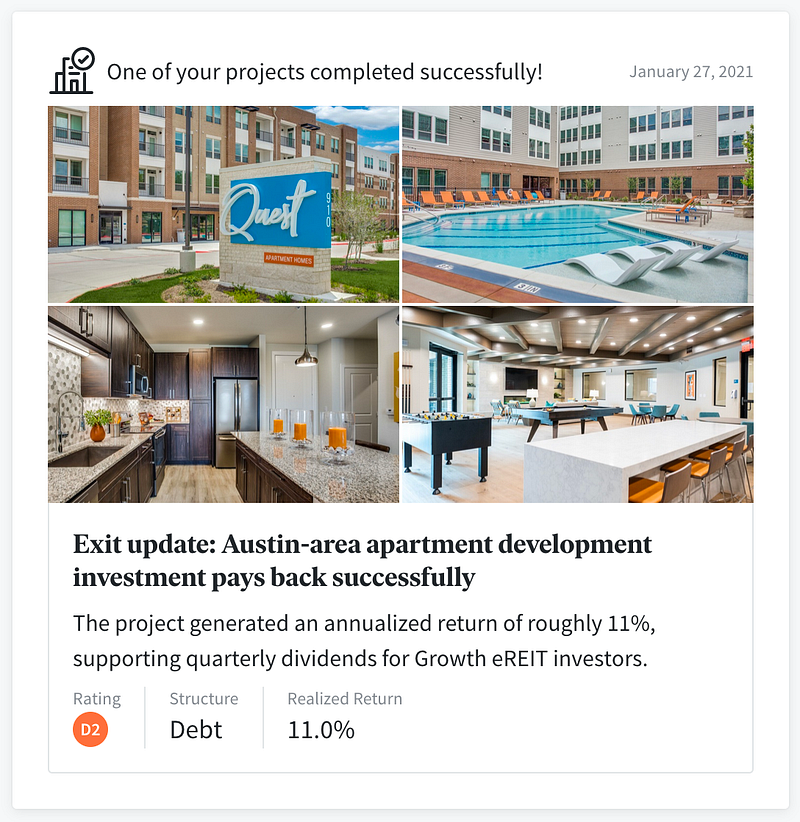
The above is an example of a completed project in my portfolio that Fundrise invested in. An 11% return-not bad if you ask me! I personally re-invest the dividends, but you can withdraw them if you wish. For new projects, you will receive a “projected return”, as shown below:
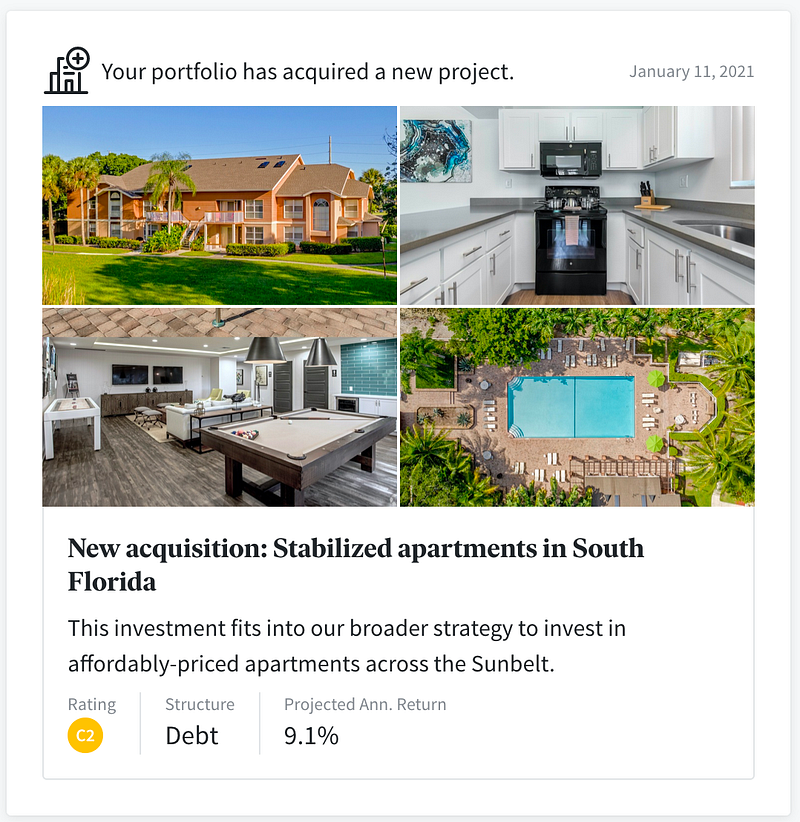
For any new acquisitions to your portfolio, Fundrise will send you a notification to your email and provide the projected annual return, as shown above.
Performance:
After the first half of 2020, Fundrise issued a statement highlighting the performance of Fundrise Vs. Vanguard’s Total Stock Market ETF and Vanguard’s Real Estate ETF. The result? Fundrise out-performed both Vanguard ETFs.
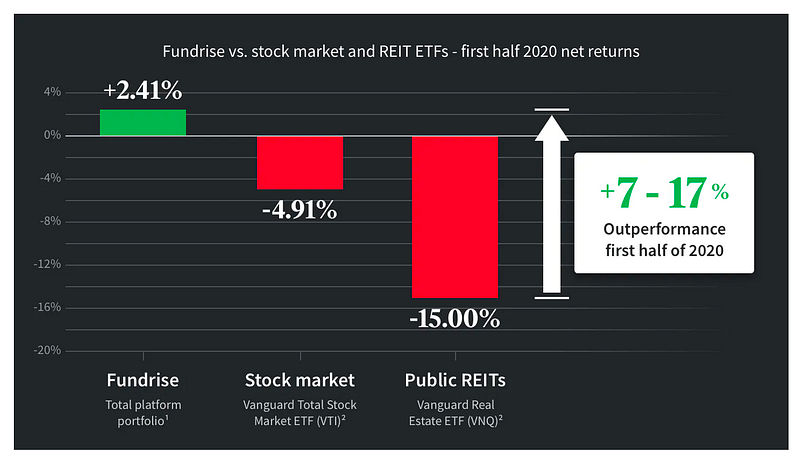
Fundrise has not yet released the platform’s performance for the full 2020 calendar year; I should note that Fundrise does have the data for 2019, and the platform produced a total net return of approximately 9.47%.
Fees and Liquidity:
Fundrise currently charges a 1% fee to cover asset management and investment advisor costs. Another consideration is that Fundrise is designed for investors that are planning to hold their investments for at least 5 years. While you can hold for less time, there are penalties for withdrawing before the 5-year mark.
Cash-Flowing Websites
I first learned about cash-flowing websites in college from a former classmate who was 21 years old and driving around in a Bentley. Being judgemental, I automatically assumed that he came from extreme wealth-I couldn’t have been more wrong. He was an online marketer who owned a business buying blogs and other websites that are income-producing. When he first started as a teenager, he created a blog where he’d write about technology. He grew up in one of the poorest parts of Arizona, and couldn’t afford much. Traffic picked up on his blog, and he had advertisers reaching out to see if they could place banners on his blog in exchange for money. As the blog progressed, he started running Google Adsense and adding affiliate links to generate income. From that point on, he realized he could turn this into a business.
Fast forward to college, and he was running a full-time business buying websites out of his college dorm room. To scale to run multiple businesses, he began buying the websites and paying writers (which you can now find on Upwork) to craft multiple articles a day on his sites and rank in Google’s search engine.
If you’re in the market to purchase a website, you can utilize a broker like Flippa. I have used Flippa for a few years, and you do need to be careful and ask a lot of questions. I would personally recommend avoiding starter sites with minimal data, in addition to starting as small as possible from an investment perspective. You will find websites with a wide variance in price; there are websites for $500, and websites for $100,000+ across many different niches. Flippa also discloses the website’s earnings on most listings, so you’ll be able to get an idea of the average monthly profit. Some listings will be displayed as “confidential”, in which you will have to contact the seller to learn more about the financials. The website’s description often lists information from the seller on the average time spent working on the site each week, if the income is passive, etc. To scale and grow the website to generate additional income, you can always outsource new content or revise the current content to add affiliate links.
Another key call out-If you purchase an existing website and scale it, you do have the option to potentially sell it for much more than you initially paid.
Purchasing a website that already produces an income is much faster than building a cash-flowing website; that being said, If you have a passion that you would like to create content for, you can build passive income over time in addition to having a career that you enjoy.
Closing Thoughts: These are just a few ways that I have generated passive income over the past eight years. I would love to hear your thoughts or ideas on other ways that you have generated passive income!
2022 Passive Income Update:
One of my favorite ways to generate passive income that I discovered in 2021 is holding my cryptocurrency (Bitcoin, Etherium, and Stablecoins in BlockFi (a cryptocurrency bank) to earn a 9% interest rate (something that cannot be achieved with a traditional bank). You can read more about this here . If you’d like to open a high interest account and earn up to $250 in free cryptocurrency, BlockFi has offered to work with my/provide this to my readers. You can sign up here.
The link to BlockFi is an affiliate code, but that doesn’t change my opinion of them. I’ve used their platform since spring of 2021, and have invested over $51,000 on their platform to outpace inflation.
If you enjoyed this post, you may enjoy the following:


