My Ten Favourite Disney Animated Films
Does your favourite make the Dillon Empire cut?
Warning: Contains spoilers for the films listed herein.
The first film I ever saw in the cinema was Snow White and the Seven Dwarfs. This was back in the halcyon days when one had to wait to see Disney animated classics on big screen rereleases, which occurred every few years. They were a special occasion, rather than a case of simply sticking on a VHS tape (later DVD, Blu Ray, or — I choke on the phrase — streaming service). It goes without saying that the experience was a formative one. My conversion to the church of cinema occurred whilst seeing E.T. The Extra-Terrestrial a couple of months later, but Snow White was the equivalent of a kindly evangelist, pointing the way to celluloid salvation.
Since seeing Snow White, I regularly attended Disney animated features at the cinema, either on rerelease (in the case of the early classics) or during their first run (in the case of Disney animation’s second golden era, from 1990 to around 1994). I also got to take my younger brothers, who were part of the last generation to experience proper 35mm rereleases of these classics, before Disney finally began to release them on VHS. A part of me is sad that happened, as these films just aren’t the same viewed at home. Still, another part of me is glad to have them in my own DVD and Blu Ray collection.
Here then are my ten favourite animated Disney films, presented in chronological order. For this list, I’ve stuck to my ten-year rule, so no Frozen. However, Frozen would not have appeared regardless. I like it, but it has been rather overpraised and overrated in my not remotely humble opinion. I’ve also avoided all Pixar animated films, as I think they deserve a separate list. Without further ado, on with the selection.
Snow White and the Seven Dwarfs (1937)
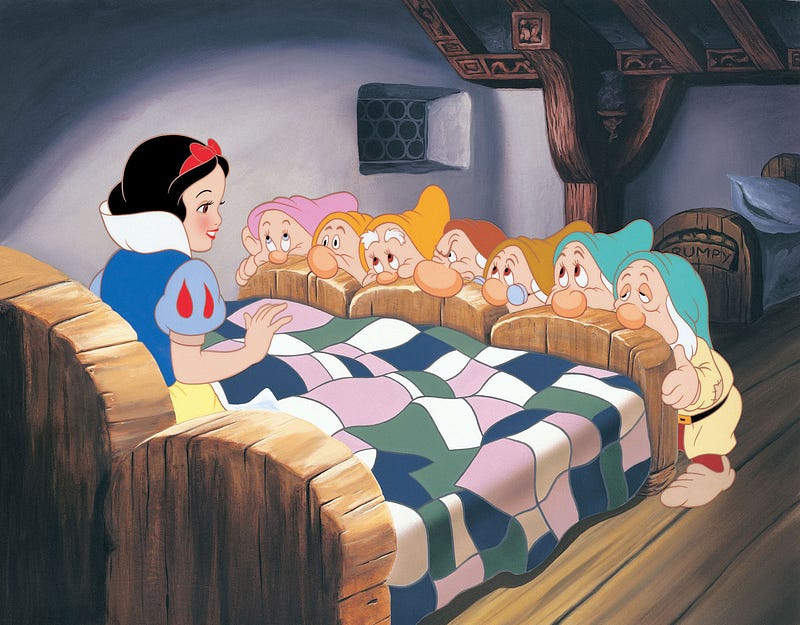
Walt Disney’s great folly turned out to be a landmark in motion picture history, paving the way for every animated film that followed, including Disney’s first golden era in a mostly unbroken run of classics between 1937 and 1942. In adapting the Snow White fairy tale, Disney created two of Disney’s most terrifying moments; the evil queen’s transformation into the hag, and Snow White’s terror as she flees into the forest, prior to meeting the dwarfs. The latter sequence scarred the childhood of Roman Polanski, who cites it as an inspiration for his horror classic Repulsion.
Whilst preserving the sexual jealousy theme of the source material, the film doesn’t do much to develop Snow White as a character, and the Prince is a total non-entity. However, the seven dwarfs themselves — Sneezy, Grumpy, Bashful, Doc, Happy, Sleepy, and Dopey — are wonderful creations, each a metaphor for different aspects of male frailty. It features iconic songs (especially Heigh-Ho and Some Day My Prince Will Come), and needless to say, the animation is extraordinary. I’m going to some pains in this article to credit the actual directors (working under Uncle Walt’s close supervision); in this case: David Hand, William Cottrell, Wilfred Jackson, Larry Morey, Perce Pearce, and Ben Sharpsteen. Without their efforts, animated cinema as we know it would not exist.
Dumbo (1941)
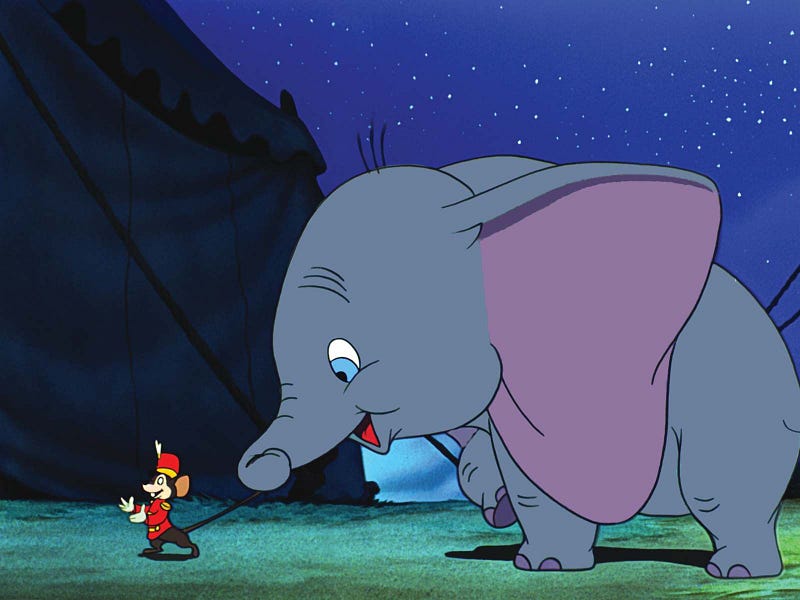
Made on a lower budget than other Disney animated features of the time, Dumbo nonetheless proved a remarkable achievement (thanks to the largely unsung efforts of directors Ben Sharpsteen, Norman Ferguson, Wilfred Jackson, Bill Roberts, Jack Kinney, and Samuel Armstrong). The elephant born with oversized ears who is teased, bullied, and outcast as a result, stands as a poignant metaphor for all “othered” outsiders. Disney instructed that for every laugh, there should be a tear, and there are plenty of those here, especially in the heartbreaking sequence where Dumbo visits his incarcerated mother to the tune of Baby Mine.
On the less tearful side, we get amusing scenes with Timothy the mouse, as well as a group of crows who help Dumbo turn the tables. However, I’m including this mostly for the surreal, hallucinatory, occasionally frightening pink elephants sequence. I’m not sure what drugs the animators were on, but they were definitely taking something. Great songs too, including Look Out for Mr Stork and When I See an Elephant Fly.
Bambi (1942)
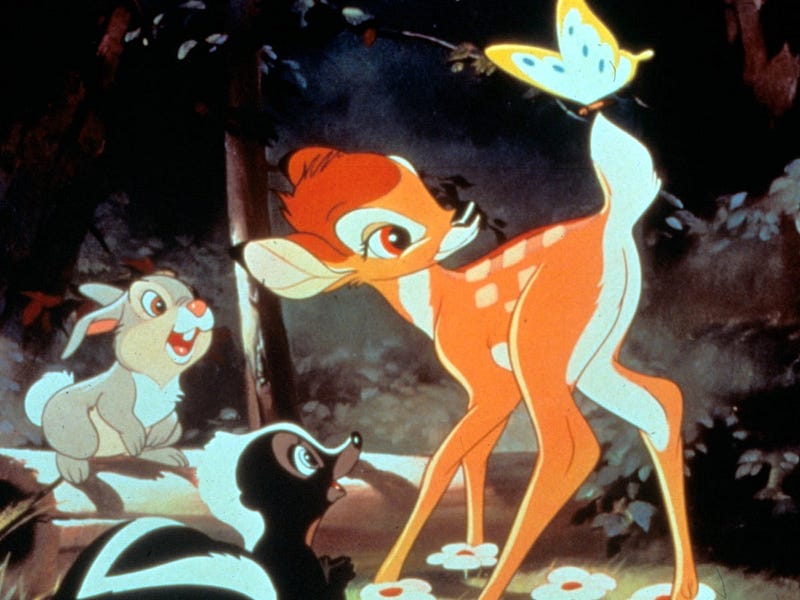
As far as I’m concerned, this is the greatest animated film in the Disney back catalogue. For a start, the animation is staggeringly detailed and achingly beautiful (take a bow supervising director David Hand, and his army of sequence directors: James Algar, Samuel Armstrong, Graham Heid, Bill Roberts, Paul Satterfield, and Norman Wright). Consider the opening, which has none of the frenetic pace expected of modern films, but slowly draws the viewer in, allowing the imagery to be properly appreciated. As for the narrative, the circle-of-life tale of the eponymous Bambi, is simply but flawlessly told. Yes, it is sentimental at times, but this is brilliantly undercut with the offscreen menace of “man”, whose presence remains a constant threat.
This is a film that has caused trauma for multiple generations of children, concerning the death of Bambi’s mother. It’s a brave scene, brilliantly and bluntly realised, that doesn’t patronise its young audience one bit. Too harsh? I don’t think so. The film as a whole is full of understated but important messages about respect for nature, how precariously life can hang in the balance, and how tragedy can suddenly strike in a dangerous world. The terrifying forest fire finale is another example. On the other hand, these darker elements are perfectly balanced by slapstick comedy, especially in the form of the adorable Thumper, and even at one point the deer equivalent of wedlock. All in all, a remarkable achievement.
101 Dalmatians (1961)
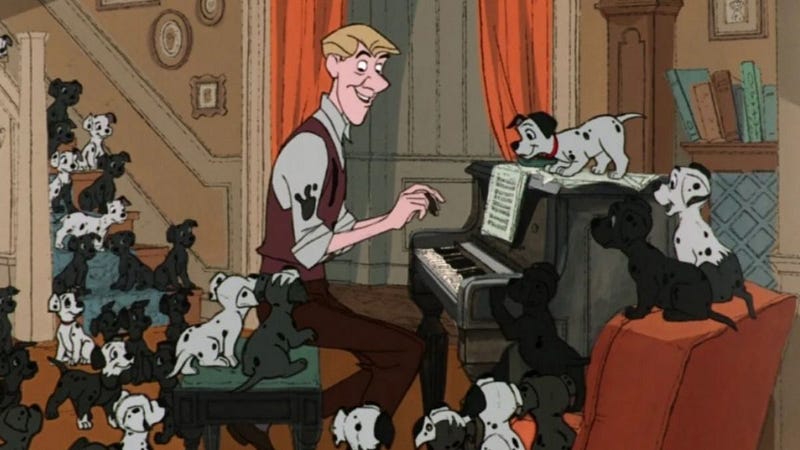
This delightful adaptation of Dodie Smith’s beloved novel features one of Disney’s most memorable villains: The terrifying Cruella De Vil. Yes, all right, we now have an entertaining origin story that provides nuance and, dare one say it, sympathy for the De Vil, but despite this, I prefer Cruella as pure, unrepentant evil. Wanting to slaughter dalmatian puppies to create a fur coat is possibly the most deranged and horrible aim of any Disney villain to date.
Of course, Pongo, Perdita, their offspring, and various other lovable animal chums rise to Cruella’s challenge. Along the way, we also get the amusing first act romance between both canine and human characters, with Roger and Anita’s meeting. The usual gags about dogs looking like their owners ensue, to agreeably entertaining effect. In addition, the animation is lovely (courtesy of directors Wolfgang Reitherman, Hamilton Luske, and Clyde Geronimi), the Cruella De Vil song is an earworm, and Horace and Jasper are entertainingly inept as Cruella’s partners in crime.
The Jungle Book (1967)
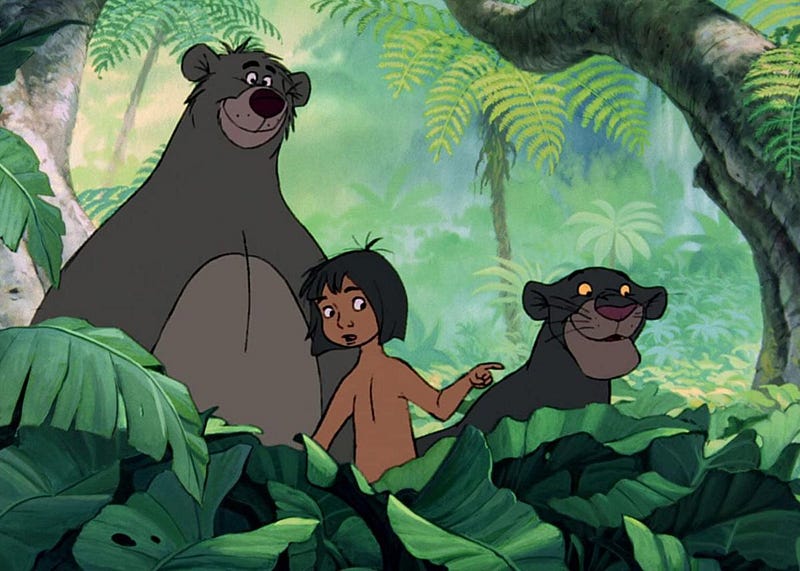
This wasn’t the first time Rudyard Kipling’s famous book had been adapted for the big screen, nor was it the last. However, it is unquestionably the most memorable. After being raised by wolves, young Mowgli is told he is to be escorted back to the man village, as the tiger Shere Khan (voiced with silky malevolence by the excellent George Sanders) has sworn to kill him. Mowgli is escorted by the panther Bagheera, who knows this is best for him, but Mowgli is determined to stay in the jungle instead. Frustrating Bagheera’s efforts further is Baloo the bear, who sings Bear Necessities, one of many classic songs.
Other memorable characters include orangutan King Louie, duplicitous snake Kaa, and the hilariously pompous Colonel Hathi, leading his patrol of marching elephants. Then there are further great songs courtesy of the Sherman Brothers, including I Wanna Be Like You and Trust in Me. A delight from start to finish, The Jungle Book was the last film Disney personally oversaw, supervising the direction of Wolfgang Reitherman.
The Little Mermaid (1990)
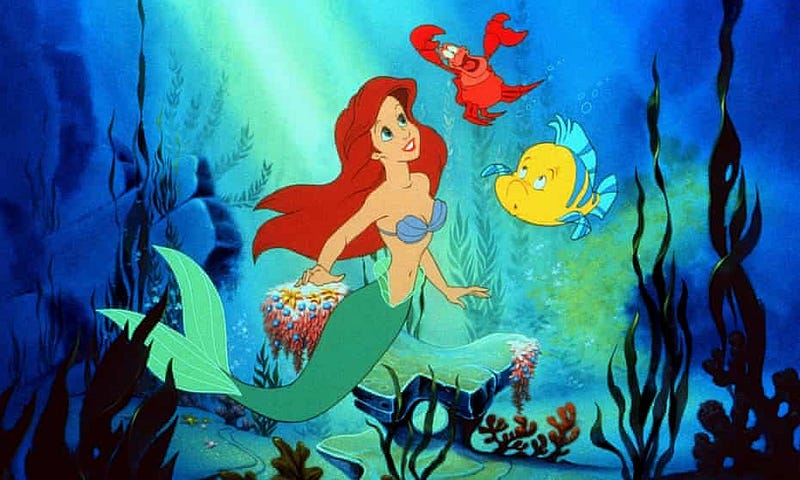
These days The Little Mermaid — the film that began Disney’s second animated golden era — gets criticised for being not feminist enough. Frankly, I don’t care for such killjoy arguments, which I think are somewhat flawed in any case. For instance, Ariel giving up being in the undersea kingdom to be with her man can’t be entirely bad, considering she wasn’t happy or fulfilled there, and her father was a rather heavy-handed disciplinarian, to say the least. But I won’t spend time expounding my rebuttal in detail. Instead, I’ll focus on why I love Disney’s take on the Hans Christian Anderson classic, even though it waters down the ending (pun intended).
First, there’s the sublime animation, supervised by directors Ron Clements and John Musker. Second, Alan Menkin’s and Howard Ashman’s toe-tapping songs are the best from this era (Under the Sea and Kiss the Girl being the standout tracks). Thirdly, the comedy animal sidekicks are hilarious, especially the crab Sebastian, whose altercation with a deranged French chef has me guffawing with every viewing. Fourthly, Ursula the Sea Witch is a splendid villain. Fifthly, the romance is charming, poignant, and as dramatic as it can be, before it inevitably but understandably wusses out on the unhappier ending found in the source material. Yes, Ariel’s a hopeless romantic, but as I’m one myself (and also a bit of a rebel), I find her rather endearing.
Beauty and the Beast (1991)
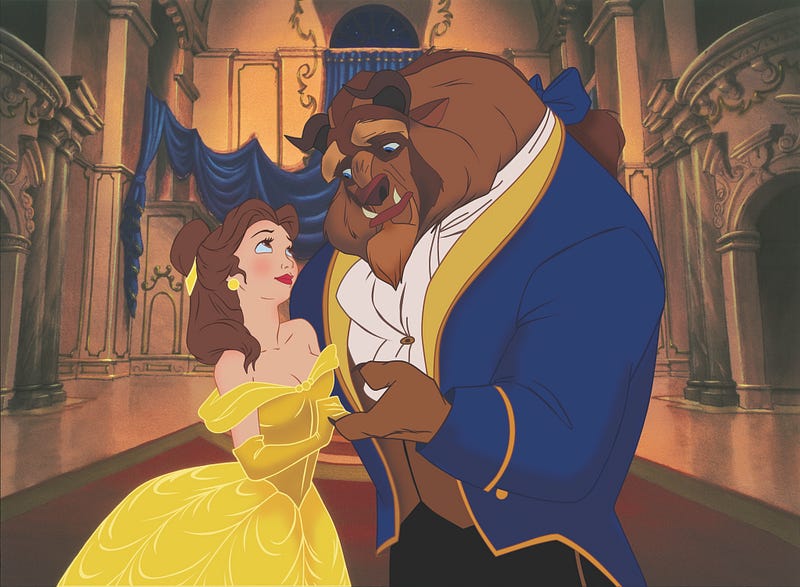
On points, this is my favourite from the classics in Disney’s second golden era of animated films. For a start, the animation is as wonderful as you’d expect, the songs are terrific (Be Our Guest in particular), and the narrative does a splendid job of making Stockholm Syndrome look romantic (I’m joking — it’s a fairy tale, dammit). But a couple of other factors elevate this film for me. Firstly, Belle’s refusal to settle for boorish Gaston and her love for books elevate her to top-tier Disney heroine. Secondly, Gaston himself has a song that brilliantly sends up his absurd machismo and has me crying with laughter every time I watch. (“No one’s neck’s as incredibly thick as Gaston!”)
I won’t say this is my favourite version of Beauty and the Beast (that would be Jean Cocteau’s 1946 live-action monochrome masterpiece La Belle et La Bete). However, it got an Oscar nomination for Best Picture, and frankly, I wish it had won (yes, even over The Silence of the Lambs). This isn’t the first time I’ve wanted an animated film to win Best Picture (Inside Out in 2015 is the most recent example). However, I fear it will never happen, even though sometimes an animated film is the best film of the year, as in this case. Directors Gary Trousdale and Kirk Wise had to settle for Best Animated Film Oscars instead.
Aladdin (1992)
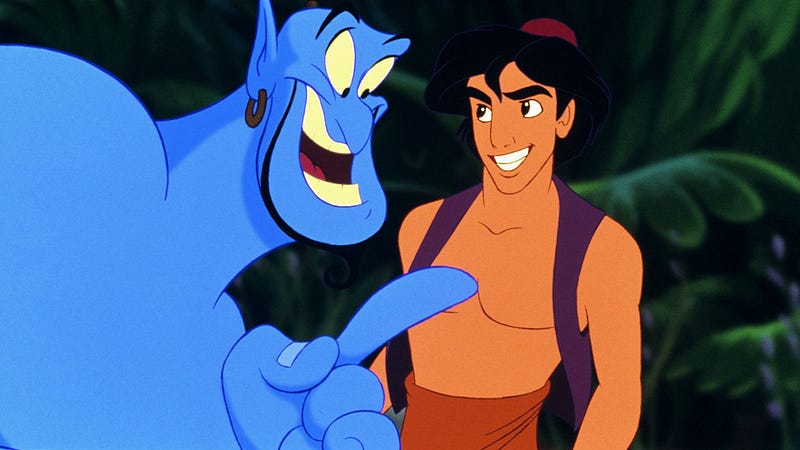
A dazzling, first-rate adventure, featuring superb animation, plenty of heart, romance, comedy, magic, and excitement galore. Street rat-turned princely suitor Aladdin is the spirited lead undone by his confidence problem, yet quick-thinking enough to ultimately save the day. The object of his affection, Princess Jasmine, has a bit more spark and fire to her than some of the more passive princesses in the Disney back catalogue. For instance, she is initially unimpressed with Prince Ali (aka Aladdin in disguise) due to his hilariously pompous entrance (aided and abetted by the hysterically funny Prince Ali song). Speaking of songs, they don’t all hit the mark. A Whole New World in particular has always fallen flat for me. On at least one occasion, I’ve responded to someone singing “I can show you the world” with “I can show you the door.”
Such musical nit-picking dwindles into insignificance in the face of Aladdin’s secret weapon: Robin Williams. His sublime vocal performance as the Genie is a masterstroke. Wisely allowing their star to let rip, directors John Musker and Ron Clements animated their picture around Williams’s ad-libs, leading to some guffaw-inducing gags, including one riffing on Robert De Niro in Taxi Driver. I also particularly enjoy his sarcastic cheer-leading late in the film, aimed at boo-hiss evil magician Jafar. That demented parrot always makes me laugh too, adding cracker gags to a cracking movie.
Tangled (2010)
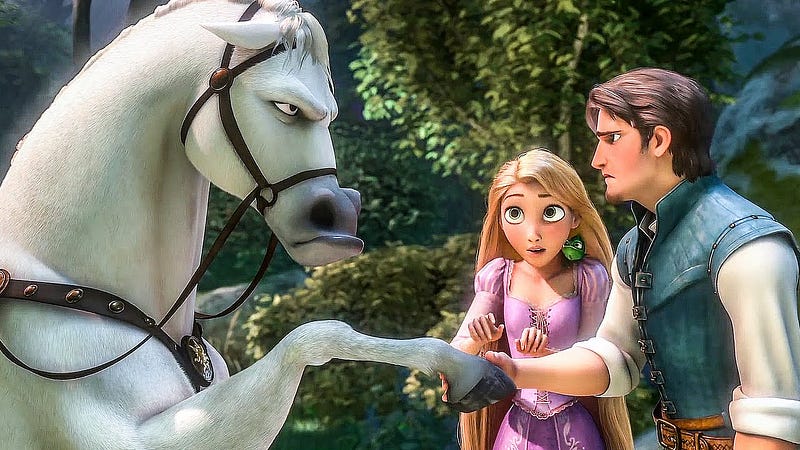
Tangled was on the receiving end of some inexplicably mean-spirited reviews during the initial release. I’ve no idea why, as this charming reworking of the Rapunzel fairy tale has heart, romance, and wit to spare. The masterstroke is to tell the story from the perspective of ne’er-do-well Flynn Rider; a thief who, having stolen the crown of the Kingdom’s missing Princess, happens upon said Princess in the tower where she has been stashed ever since being kidnapped by the wicked Mother Gothel.
Cue a hilarious interrogation scene involving Flynn being tied up with Rapunzel’s hair, leading to the expected romance, amusing songs (particularly Mother Knows Best), and comedy animal shenanigans. The latter consists of a wily chameleon and a particularly guffaw-inducing horse behaving like a dog. Vocal performances are all good (trivia fact: the cast includes Richard Kiel aka Jaws from The Spy Who Loved Me/Moonraker). Directors Nathan Greno and Byron Howard ensure the animation is bold and colourful, and the overall effect is funny and poignant. In short, I love it.
Wreck-It Ralph (2012)
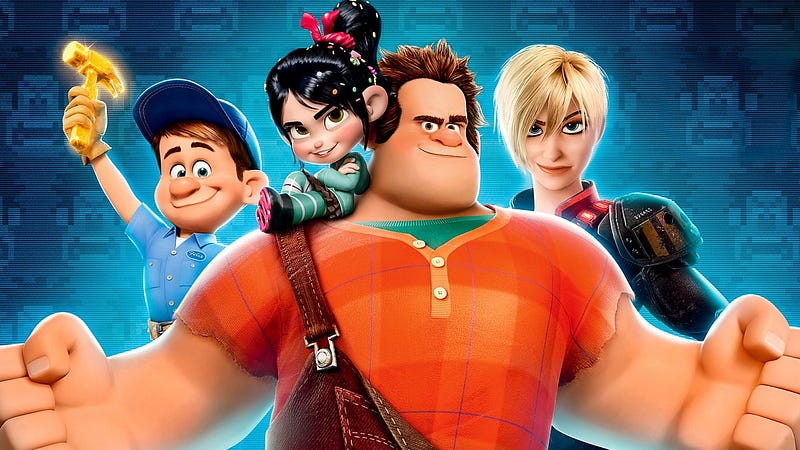
My ten-year rule means Rich Moore’s Wreck-It Ralph rounds out my list by the skin of its teeth. But the inclusion is well deserved. The plot may be yet another variation on the be-yourself sermon Disney has been preaching for decades, but it’s a very effective one. In a Tron-esque parallel universe, the eponymous Ralph, an arcade game villain fed up with being the unappreciated bad guy, makes an ill-advised visit to a soldiers and giant bugs shoot-em-up. (“When did video games get so violent?”). This is followed by a lengthy sojourn in Sugar Rush; a surreal, candy land racing game where Ralph befriends a mysterious “glitch” called Vanellope; a girl the decidedly slippery King of Sugar Rush is trying to eliminate.
Twists and turns ensue in the inspired screenplay, along with colourful, eye-popping action and some great jokes. The Wizard of Oz oreo gag in particular very much tickles the funny bone, and who doesn’t want to see a film where someone grimly demands to know: “What’s going on in this candy-coated heart of darkness?” The central relationship between Ralph and Vanellope is funny and touching, but funnier still is the truly ridiculous love story subplot between Sergeant Calhoun, the gung-ho heroine of the soldiers/bugs game, and mild-mannered Fix-it-Felix, the hero of Ralph’s game. Alas, the path of true love doesn’t run smoothly for Felix, since the object of his affection has been “programmed with the most tragic backstory ever: The one day she didn’t do a perimeter check.” All in all, this is beautifully animated and hugely satisfying entertainment.
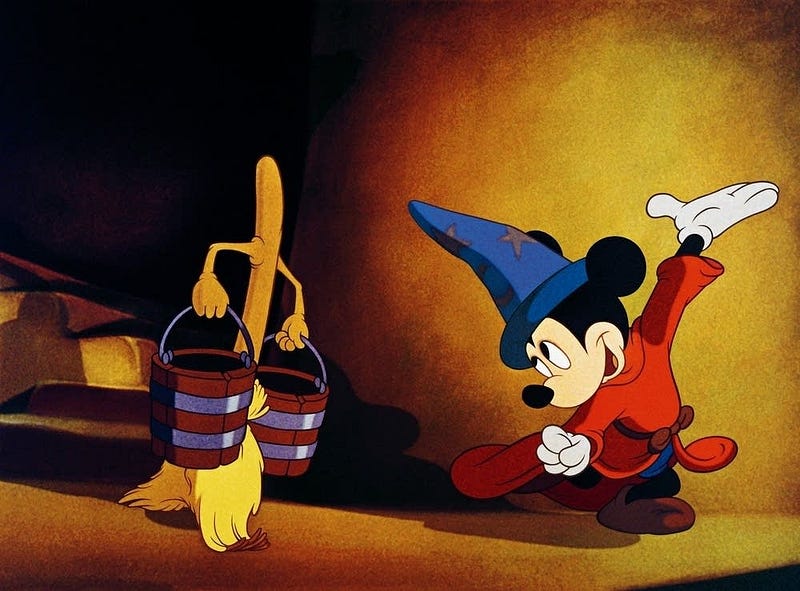
Needless to say, some of you are now foaming at the mouth because I omitted The Lion King (I like it, but it’s essentially Bambi meets Hamlet and I prefer both those stories). Or you’re upset I’ve left out Frozen (despite my earlier explanations as to why). Heck, you may have steam coming out of your ears over any number of other oversights. I myself was rather pained to leave out Pinocchio and Fantasia (hence the photograph at the head of this article). The Night on Bald Mountain sequence from the latter is one of my all-time-favourite traumatise-the-children Disney moments. However, I chose to keep this list to ten, so with regret, Fantasia got the boot. Should I have kept it in? Let me know in the comments.
Author’s note: I hope you enjoyed this article. For more about me and my writing on Medium, please click here. For information on my writing outside Medium, please click here. For a list of my published novels and other works, please click here.