
9/11
My Students and I Faced Our Own Ground Zero
In a high school classroom 20 years ago, we all learned courage
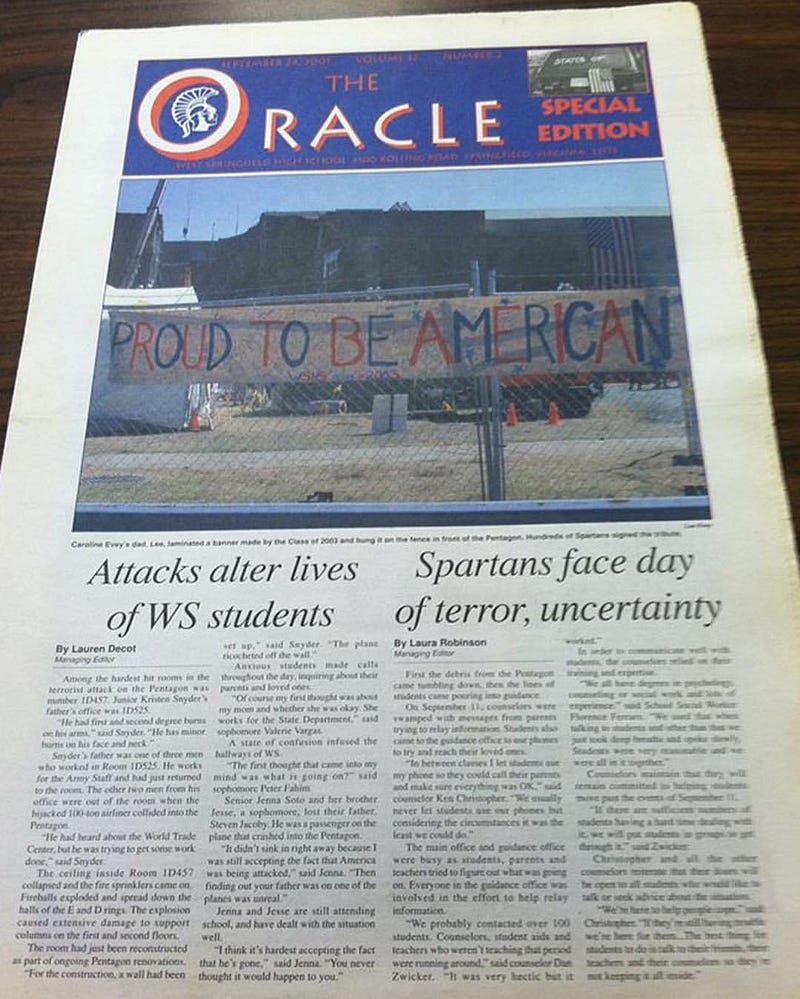
Twenty years ago, a room full of high school juniors taught me how to be brave.
The second class of the day was supposed to begin soon.
But then all hell broke loose. The slightly stooped but always salty Judy Harris, Grande Dame of the English Department, came running down the hall. She stopped at each of our classroom doors and hollered at her startled colleagues.
“Turn on your TV! Turn on your TV!”
Judy was slight of stature and crusty in manner. The kids adored her. No one had ever seen this guardian of grammar run so fast nor act so agitated.
Turns out Judy had been at the dentist, and was just arriving at school. She’d heard the first apocalyptic news on her car radio.
A little background: Our school is located in the D.C. suburbs. We are relatively close to the Pentagon — about 10 miles straight down the Interstate. Because of this proximity, more than 50% of our school’s students hail from military families.
On September 11, 2001, a good amount of the kids in my AP English class had one or both parents working at the Pentagon.
The five-sided behemoth, symbol of America’s military might, which is wedged between Arlington Cemetery and the Potomac River.
No lingering in the halls between classes that day. Word of the first plane hitting the North Tower spread quickly through the school. I stood before 28 terrified students, sitting mute in their seats. As high school juniors, they were all 16 or 17 years old.
Dr. David Smith, our beloved principal, came on the PA about 9:10 a.m. He knew the hallways were clear, and he knew his kids. They were in their classes, with their teachers, because they were scared and wanted to be closest to those they knew best.
Dr. Smith told us about the North Tower of the World Trade Center. But like most Americans that day, he was a little behind the curve. We turned on the TV just in time to see a replay of a passenger plane knifing into the South Tower, 17 minutes after the first plane hit the North Tower at 8:46 a.m.
Oh, God, the news kept getting worse.
My kids were frozen in their seats. I squeezed the television remote so tightly it left bruises on my fingers that didn’t disappear for days.
Dr. Smith came on the PA again, around 9:25 a.m. A sputter, a sigh, a “Hello again. I have some more news to report.” Flight 93 had been hijacked. Rumors spread that the plane was headed for either the White House or Capitol Hill.
No one told us to keep quiet about what was happening. In fact, as they arrived to class, my students gravitated to the tube. They demanded to know what was happening.
And they deserved to have this knowledge. America was under attack.
We devoured the wall-to-wall coverage. I said a silent prayer. And at 9:37 a.m., Flight 77 hit the Pentagon — 10 miles from our school, where so many moms and dads worked.
Dr. Smith announced the news from the PA about 10 minutes later. A slow intake of breath from both teacher and students, sort of that sucking noise that results when one doesn’t yet know how to proceed. The kids looked as if each had just been told their lives were ending that very minute.
“Mrs. Nelson, what do we do?” The young woman blurted this question, then burst into tears. I asked, then, for a show of hands.
“How many have parents who work at the Pentagon?” Several of my 28 students raised their hands. Most too stunned to cry.
“How many of y’all have cell phones?” Remember, this was 20 years ago. The age of the flip phone. No one had heard of an iPhone yet. And not everyone had a calling plan in 2001.
About 10 students raised their hands.
Of course, the landlines — I had one in my publications office — were jammed. The cells didn’t fare much better. But we kept dialing loved ones who may have been in harm’s way.
The school went into lockdown. Parents were allowed to come pick up their children, but no one else had permission to leave.
For some incredible reason, the bank of phones behind the big counter in the main office started ringing again. A small and determined army of parents showed up at the school, to answer phones and then calm fears as they ferried notes down to classrooms, telling students and teachers their loved ones were safe.
That’s how I found out about my two children, one in 6th grade and the other a high school freshman. Moker, my husband and their dad, called the main office to let me know everyone was OK.
My students alternated between trying to get in touch with parents and watching — sometimes screaming at — the television. Kelsey’s dad called to say he was OK. Brandon’s mom phoned to say she had made it home.
One by one, parents got in touch with their kids, or children reached Mom or Dad on a borrowed cell. Within the hour, almost everyone had confirmed that their family members were safe.
Except for one young woman. Her dad was Navy, and worked in the “D”-Ring of the Pentagon, which suffered the most fatalities that day.
At first, she couldn’t get through to either parent. Then, her mom called. No one had heard from Dad. The phone lines all over the region were still impossibly dysfunctional.
We waited. One kid took a Bible out of her backpack. Others hugged. All eyes bored into the television, mounted into its black metal brackets in the corner of the room, high above the anxious congregation.
Our principal — basically our lifeline to the outside world — decided everyone should stay where they were. AP Nelson, as the students called my morning class, lasted several agonizing hours that day.
One by one, as parents came by, students trickled out the door. A wave, an expression of hope; then most disappeared down the hall, holding hands with their folks— even a couple of the macho football boys.
My student who hadn’t yet found her dad wanted to try one more time. She didn’t have a cell, so I tossed mine to the frightened young woman.
She sighed. Flipped her hair out of her eyes. Shrugged her shoulders. Wiped the tears and mascara off her cheeks. Dialed.
Her face lighted up. “It’s ringing!” She started to do a little dance around the desk. “Hello? Hello! Daddy?” She started to cry again.
Her dad answered from outside the Pentagon, where he was sitting out on the lawn by the North Parking Lot. He had been at an appointment, away from the building that morning.
We found out later that Dad had been having his teeth worked on — a trip he’d been dreading. He ended up more than grateful he’d made the decision to sit for hours in the jawsmith’s chair. And that choice saved his life.
