
My Selections — “Sioux City Sue”
A song by Dick Thomas
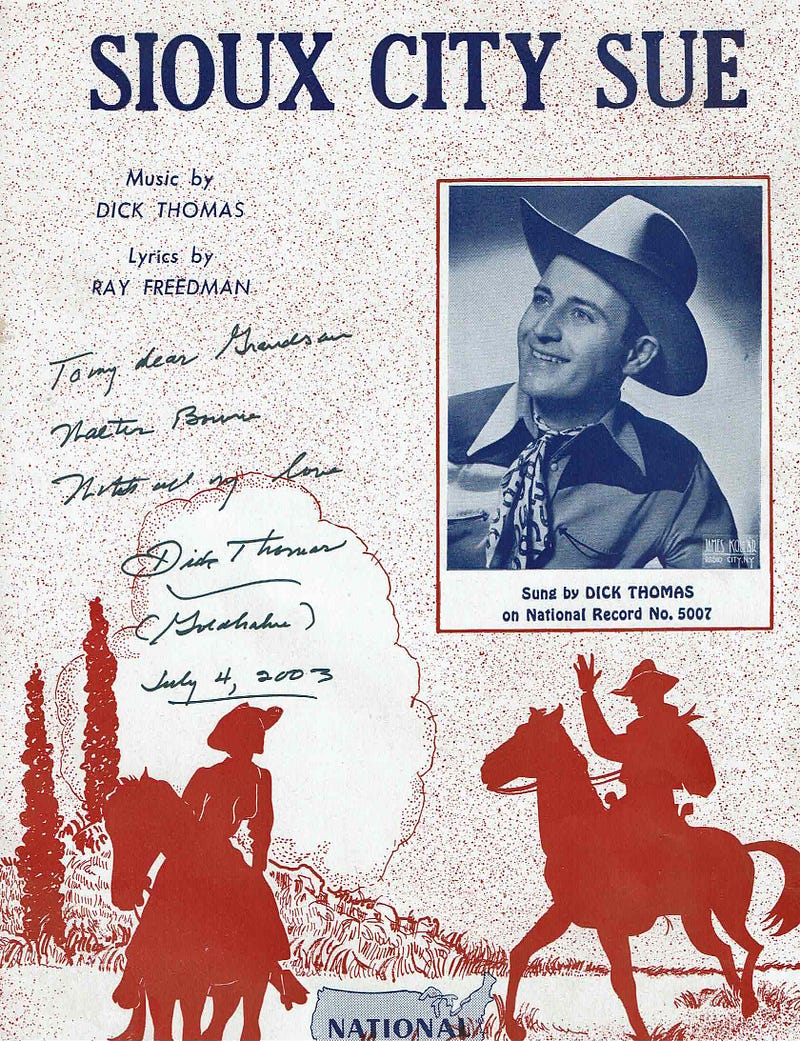
Did a song actually give birth to me?
Well, kinda. My mom was named after my grandfather’s hit from 1945 — “Sioux City Sue.” His professional name was Dick Thomas — his real name — Richard Goldhahn. For his whole life, he was a professional musician, a singing cowboy, and a nightclub entertainer. I think after I said “ma, and da, and ball” — I yodeled.
Do you think I’m kidding? Let’s just say my yodel is not aesthetically genetic.
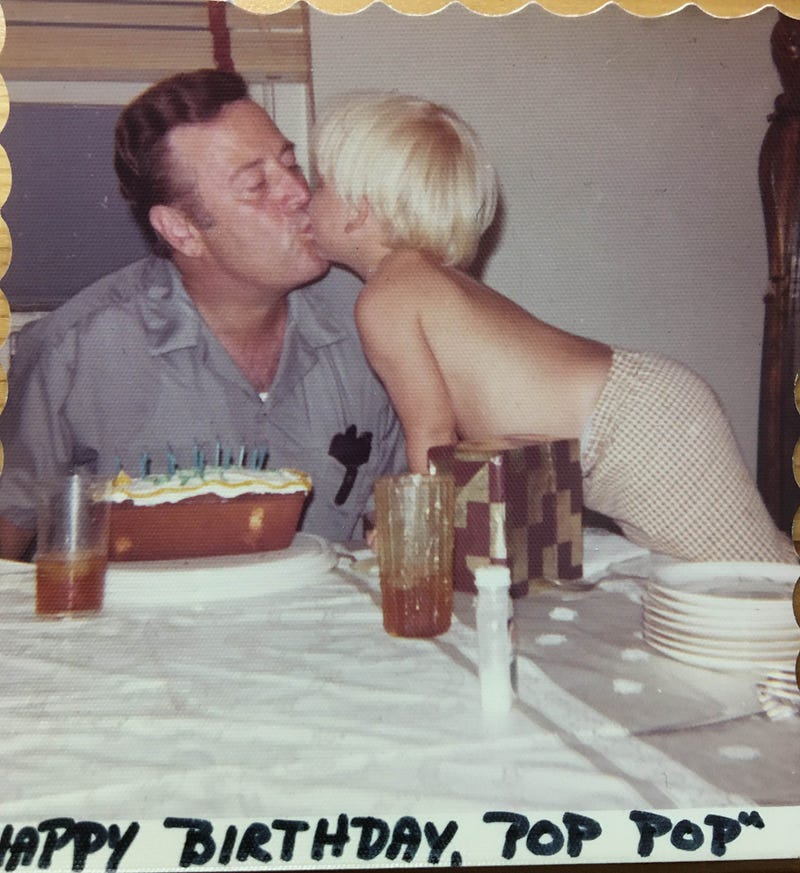
So the song has been my lullaby, my rocking chair, my nursery rhyme, my nourishment, and my forever world. It may not even be my favorite from his — I have two full CDs of his music.
I’m a rock and roll dude — but you put grandfather on, and I’m smiling. When listening, it’s hard not to smile. When you’re down, the last thing you need is Nirvana or Smashing Pumpkins or Nine Inch Nails, right?
I put Dick Thomas up there with Johnny Cash — two-country dudes who knew music. The music DNA from the family has definitely impacted me — music as essential as air.
My mom, Susan Goldhahn, gave birth to me in Camden, New Jersey, within a stone’s throw of Walt Whitman’s grave. Music and lyrics have always been central to the family — piano and guitar — and singing and recording and jamming.
During family gatherings, Pop-Pop and Mom-Mom would come over to New Jersey from Philly, and my grandpop would not only provide entertainment by singing and playing the piano, but he would regale us with stories of Frank Sinatra and Bugsy Segal and the Rat Pack — and what Hollywood and Los Angeles were like in the early days after World War II.
By the time I was twelve, I think I knew all of the stories, but I wanted to make sure I had it all down. So I interviewed him on video. I’m so glad I did.
I was newly married, and our daughter Madeline was running around his old farmhouse in Southwest Philly — surrounded by row homes — and I asked him to tell me about his life — making sure to keep his stories for posterity about growing up in Meadows, what is now, largely, the Philadelphia Airport, and about the pig farms, and learning the accordion — and eventually becoming a “Musiker.”
I have written so much about my grandparents and their house — it’s all available on Medium.
It’s funny that my grandfather is from Philadelphia when he sings:
I drove a herd of cattle down from old Nebraska way That’s how I come to be in the state of Iowa I met a gal in Iowa, her eyes were big and blue I asked her what her name was, she said, Sioux City Sue.
It’s like Creedence Clearwater Revival hailing from San Francisco, but singing about cotton fields and Green River and Proud Mary — so many Southern locales.
The chorus is so catchy — and it may just be biased, but I like my grandfather’s version better than Gene Autry or Bing Crosby’s. I mean, come on, they’re good — but to have heard this live for so many years — in my house, in his music room — like some old curiosity shop of music memorabilia — and in the nightclubs in Philly when I was older. What can top that? My friend and family relation Robert Ruelan has a YouTube of Dick Thomas— playing at my mom’s house in 2000.
Sioux City Sue, Sioux City Sue Your hair is red, your eyes are blue I’d swap my horse and dog for you Sioux City Sue, Sioux City Sue There ain’t no gal as true as my sweet Sioux City Sue.
Now, it’s 1945 — not 2021 — and some of the lyrics are rather, well, not of this generation, but can I blame my grandfather for that? He composed the music. Max Friedman — not Freedman, wrote the words. For some legal reason, Max used his wife’s name, Ray, on the sheet music.
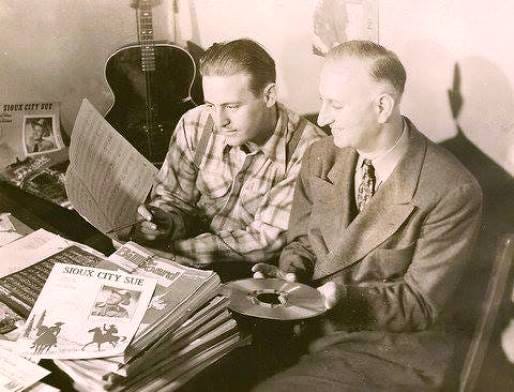
I always laugh when I hear:
I’m admitting Iowa, I owe a lot to you ’Cause I come from Nebraska to find Sioux City Sue I’m gonna rope and tie her up, I’ll use my old lasso I’m gonna put my brand on my sweet Sioux City Sue.
I’m not sure my wife Mary Jane would appreciate putting my “brand” on her — like some piece of cattle. But should we actually take this literally or just tongue in cheek?
Not necessarily 2nd Wave Feminism, right? But when you listen to Rogers and Hammerstein and the lyrics from the big Broadway shows — like Oklahoma or Carousel or Music Man — it’s just corny and from the “times,” right?
I recall being excited when we drove through Sioux City, Iowa in 1989 on a trip west. I felt like my mom should have stopped and shook hands with the mayor: ‘Here’s the real Sioux City Sue.”
Occasionally, during family gatherings, my uncles will reprise the song on guitar. It’s great. It’s nostalgic, and they’re so damn talented — but who can yodel like my grandpop? Here’s the “GoldPickers” performing “Sioux City Sue” at the Bus Stop Music Cafe, Pitman, NJ.
In fact, if you’re interested, you can search for Dick Thomas on Youtube. You may be just as hooked too from the sounds of so far away. Here’s a great video for a song called “Jingle Jangle Jingle” by Dick Thomas in 1942 — the war years. Here’s another great one: “Rosalinda” from 1946 with the Nashville Ramblers.
What I learned from him — and it’s not piano skills, but people skills — working an audience. He was Billy Joel “Piano Man” when I knew him. He played the Springfield Inn in Sea Isle on the Jersey Shore in the early 70s, and at clubs in and around the Philly area. People would come not just for his music — but also my grandpop would know the person’s name and remember the song he wanted, and he made everyone feel special.
He was a natural storyteller — and could make people believe things in his stories that weren’t even true — and then reveal it was all fiction. Like the time he convinced my mom’s smart friends in middle school that he was a Venusian. Heck, when he’s singing, I think he’s a cowboy. As a writer, I like to think I get that modeling from him.
Holidays and birthdays and Christmas carols were always special. Nothing like the family singing while my grandfather was playing. He often did his “nightclub” routine in our living room in Voorhees, New Jersey. It was so special. He could call out someone’s name, like my sister Noelle, and he said, “This one goes out to the newlyweds, Noelle and Andy,” and then play some love song.
Sometimes, especially after his wife — Maria McGarrigan — or Mickey, passed away, he would play their songs, their love songs, and he would tear up — and he taught me not to be shy with emotions and tenderness.
I like to think I do that for my students in the classroom. I do sing, too, like last week I was singing along to “Let It Go” from Frozen about tenets from Transcendentalism — and not being ashamed of one’s gifts and needing to leave society in order to find yourself.
I like to think my grandfather helped people that way. He gave them a slice of heaven, along with a cocktail and a smile. Not a bad way at all to live a life. He followed his bliss. He supported a family of five — and maybe he just made his own luck.
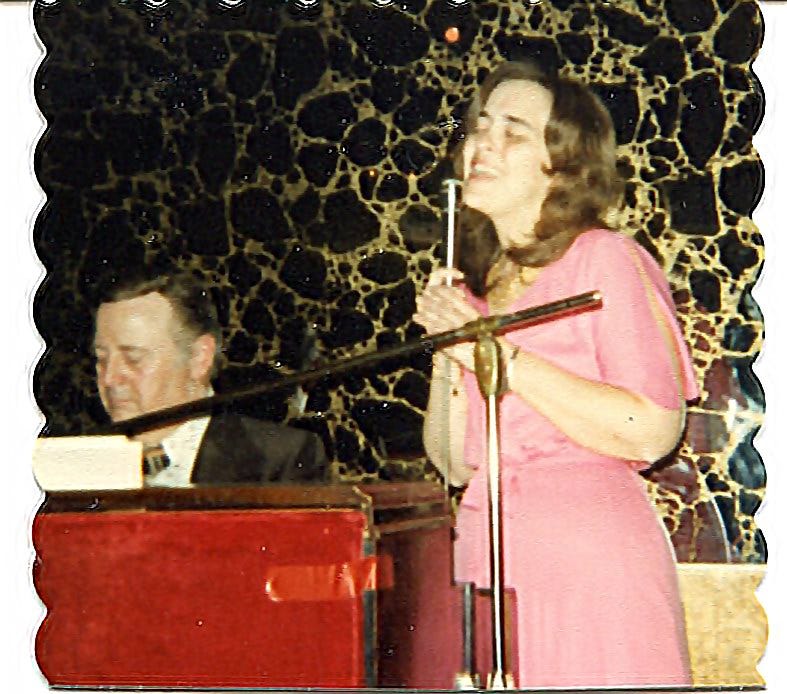
Then I would be really proud when my mom — who has an amazing voice, by the way, would be called up and she would sing “You Light Up My Life” and other songs — and she could really hit those notes.
It’s awesome to see my grandfather perform on old YouTube videos — like “Where the Mountains Meet the Sky” from 1945. God — he was such a good-looking guy. But it was that voice — and his timing on the piano — and the way he would play chords and talk over the chords as an introduction — often giving a two or three-minute singing lecture about the song he was about to play — and it all worked.
At his funeral, my daughter Madeline, who was only four, drew a picture of his great grandfather playing the piano in heaven. I’m sure he’s entertaining the angels. He could bring out a smile on the devil, actually. He was that charming and talented.
And God I miss him. But we always have his music. Always the music.


