
My Selection — Resetting The Table
Robert Paarlberg serves up some semi-informative side dishes amidst what could have been a buffet of hopefulness
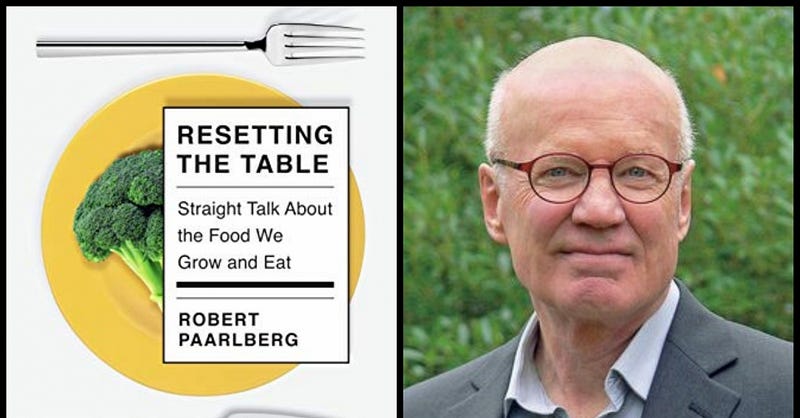
Harvard and Wellesley professor Robert Paarlberg specializes in academic theory and research dealing with environmentalism and agriculture. So, while I was initially excited about the prospect of reading this book authored by him, I ended up sorely disappointed and dejected.
Previously, I wrote an expanded critique of his 2021 book entitled Resetting the Table: Straight Talk About the Food We Grow and Eat. Although I wouldn’t recommend this book, I did glean some limited useful tidbits from it.
In his Introduction, Paarlberg outlines a reasonable enough preface to his overarching belief that small-scale farming can’t be feasible in every location all of the time:
A return to preindustrial food and farming methods can work on a small scale for those with plenty of money to spend, but it will never be a society-wide solution. Scaling up to supply most of the market may not really be a food movement goal. Alice Waters puts a higher value on her culinary integrity, and derides “scaling” as a term from fast-food culture. Other celebrity chefs also seem comfortable with exclusivity: they advise us to eat seasonably, but then they fly off to Sicily in April to give cooking workshops where they won’t have to suffer with late-winter vegetables. The Blue Hill restaurant, at the picturesque Stone Barns Center for Food and Agriculture, thirty miles north of Manhattan, promotes delicious farm-to-table meals sourced from the Hudson Valley, but the fixed-price menu is $258 per guest, and that’s exclusive of beverage, tax, and a 20 percent “administrative fee” in lieu of tips.
When putting on trial the nutritional value (or lack thereof) of food products versus their economic value (or lack thereof) to shoppers, Paarlberg says:
The American diet is not, however, determined by what America’s farms grow. Our farms do produce a lot of corn, but more than one-third of it never enters the human food supply because it is used to make ethanol, an alcohol we mix with gasoline for auto fuel. Another 14 percent of our corn crop is exported to foreign livestock producers, along with 52 percent of America’s soybeans, so none of this enters America’s food supply either. Corn and soy are principally animal feeds, and we grow more of these crops today because rising incomes, particularly in East Asia, have driven up consumer demand for meat, milk, and eggs in the global marketplace…most critics misunderstand the operation of farm subsidies. They assume farm subsidies are making food artificially cheap when they actually do the opposite. The purpose of these subsidies has always been to increase the income of farmers, and one simple way to do this is to push up the price that farmers get for their crops, and this is typically what happens…by restricting imports from abroad, sometimes by paying farmers to take land out of production, and sometimes by mandating the purchase of farm commodities for things like ethanol production or foreign food aid. The result in each case will be fewer commodities left in the American market, not more, and hence a higher price paid by domestic consumers.
Praising the precision agriculture techniques (PA) employed by Indiana farmer John Nidlinger, he writes:
John planted the previous spring using a GPS-steered twenty-four-row planter, a smart machine preprogrammed by [his son] J.D. to put down seeds with variable spacing within rows, matched also to the small variations in elevation that make some parts of the field drier than others. Critics of industrial farming claim that it tries to impose uniformity on nature, but this planter delivers a continuously variable seeding pattern tailored precisely to location-specific needs. A base station on the farm is capable of logging small errors in the incoming GPS satellite data, then sending correction signals to roving equipment in the field via radio or cellular modem. This allows the position of the field equipment to be known, in real time, with sub-inch accuracy. Sub-inch accuracy, in a cornfield. John also uses precision when fertilizing his corn. Rather than spreading uniform quantities of nitrogen, phosphorous, and potash, John’s equipment applies these chemicals at variable rates, based on previously[-]mapped variations in the chemistry of the soil. During the growing season, John also uses tissue samples from his plants to calibrate when and where to add a bit more nitrogen, or when and where to treat against fungus. By adopting these modern PA methods, John Nidlinger has been able to reduce his nitrogen use for each bushel of corn harvested by more than one-third since the 1980s. This saves him money on chemical costs, but it also reduces chemical runoff into the local water supply. This is a collateral benefit to all who are downstream, including people in Toledo at the western tip of Lake Erie. John monitors his nitrogen use closely. “I’m concerned with the water in Toldeo, and I don’t want to be spending money on nutrients if I don’t need to,” he says. Duane [Kiess; the Vice-President of Nidlinger Farms] is also hungry for better information and is thinking about installing in-field sensors to gather real-time nitrogen, moisture, and even chlorophyll readings.
He recalls one of his past interpersonal brushes with kid-friendly marketing of unhealthy food products, and links it to the greater problem of “food swamps”:
…I was back at my own local Stop & Shop in Massachusetts, looking for paper towels, laundry detergent, and some milk…when I spotted a six-foot-tall Tony the Tiger swaggering toward me wearing a bright orange-and-white mascot suit. He had big yellow cartoon eyes, a blue nose, a red bandanna, a happy smile, and was waving his two front paws to the shoppers and their kids. A public address system then came on to tell us Tony was in the store to promote a special on Kellogg’s Frosted Flakes, and he was eager to shake hands and have his picture taken. I checked the Fooducate app on my phone and found that Frosted Flakes earned only a C- because each serving had 3 teaspoons of added sugar and contained a controversial additive known as butylated hydroxytoluene…The Alice Waters strategy of never setting foot inside a supermarket is no longer enough, since unhealthy foods are now displayed and marketed nearly everywhere, including in convenience stores, gas stations, department stores, and pharmacies. The Target store in my local mall has a “grocery” section selling thirteen different categories of chips, snacks, and cookies. When I go to my local CVS for a prescription, I walk through an aisle stocked with cookies, crackers, chips, bread, ice cream, cereal, salted nuts, snacks, juice, and soda before I finally get to the pharmacy counter. In a single visit, CVS patrons can now guard their health and ruin their health at the same time.
Paarlberg explains, while illustrating the process of marketers exploiting consumers’ food addictions:
Food companies have also discovered precise mixtures, textures, and ingredients in foods that will trigger a dopamine high, one that teaches the reward circuit in our brains to crave such foods. Food scientist Howard Moskowitz was the first to describe this as a “bliss point,” one that sends intense reward sensations to our brain. The brain remembers the sensation, associates it with the product, and any future connection with that product will cue a brain-driven desire to consume again, whether or not the stomach needs the food…This is why food companies advertise heavily, and why they want their products always to be “within an arm’s reach of desire.” The brain science behind food cravings is still in its infancy, but brain helmets with functional magnetic resonance imaging, adapted from medicine, are producing brain scans that reveal more all the time.
He analyzes the four different types of restaurant patrons that can be found:
Some restaurant patrons do seek better nutrition, but for most this has not been the priority…restaurant[-]goers can be sorted into four broad categories. First[,] there are the Basic Eaters, who use restaurants regularly out of necessity and are looking for affordability. They tend to favor fast food. Second are the Experientialists, who also use restaurants frequently, but for social ambience or novelty, so[,] once again[,] nutrition and health are not the first priority. A third group are the Quality Essentialists, who do look for food quality, but mostly in terms of ingredients, careful preparation, seasoning, and taste, largely apart from nutrition or health. Only then do we come to the Progressives, who do make choices based on nutrition and health, but they are influenced by food fads and fashions as well. These Progressives are pushing restaurant chains toward more plant-based items today, but when Applebee’s made changes to attract more Progressives it drove away the Experientialists and Essentialists. Full-service restaurant chains in the upscale urban settings attractive to today’s [M]illennials are wise to offer more healthy fare, but less so elsewhere.
While praising Andrew Rodgers’s Clark Farm as a positive model for sustainability, he illustrates the obstacles of replicating its techniques on a mass scale:
For a small operation, Clark Farm generates impressive sales. The eighty to ninety members who buy the large annual food shares for $900 provide the farm with $81,000 in revenue, while the other 220 members buying smaller shares for $630 generate $138,600. If you add in the revenue from farm-stand sales, farm-to-restaurant and local retail sales, and now the new winter shares, Clark Farm falls into a respectably[-]high sales class for an American farm. The farming is labor-intensive. Andrew plants and harvests some of his best crop beds four times every year. Clark Farm has twelve acres of row crops, with forty beds in each acre and with rows two[-]hundred feet long. Each bed might have six[-]hundred heads of organic lettuce, which sell for two dollars each, roughly twice the supermarket price for conventional lettuce. Farming this way requires continuous human labor because organic certification does not allow the use of manufactured fertilizers or pesticides. Andrew makes his own compost for fertilizer, fights insect and fungus pests with nonsynthetic pesticides, and hires high school students at minimum wage in the summer to help keep weeds under control. He also hires an assistant farm manager plus several foreign workers on J1 Exchange Visitor visas, which are available to those who want to work on organic farms. In recent years[,] he has employed summer crew members from Brazil, Kenya, and Ecuador.
Although Paarlberg is highly-skeptical of the widescale viability of CSA expansions, he gives Rodgers a platform to disagree with Paarlberg’s own position:
Small-scale specialization might be one key. “There’s going to be a niche for really small CSAs. I wouldn’t be surprised if fresh produce in the future comes from micro farms, with people growing stuff in their backyards, then selling it to a co-op or restaurant. Maybe you just grow really great hot peppers, and for just one small part of your income.” Andrew takes quickly to challenges and thinks all the time about boosting his own efficiency. Like all vegetable growers, he worries about spoilage before his produce can be sold. He knows this risk will increase under the CSA model if he gets a bumper crop, since he sells to a relatively[-]fixed number of customers every season. In these situations[,] he feeds the surplus to his pigs or spades it into the ground to enrich the soil, but these are suboptimal commercial strategies. Andrew fantasizes about refrigerated trucks pulling up to his farm on a weekly basis to take his surplus production for delivery to paying customers, but he hasn’t gone in this direction so far…A picked vegetable will rot only half as fast if it can be kept at 40 degrees Fahrenheit versus 60 degrees, and on large farms the vegetables will be refrigerated in the field, packed at a low temperature, transported in a refrigerated truck, stores in a refrigerated warehouse, then put out for final sale in a chilled display case. Andrew’s packing shed has good refrigeration, but small local growers that sell through farmers[’] markets often experience serious losses at the marketing stage. If the temperature reaches 80 degrees, vegetables on open display without refrigeration rot four times as fast as at 40 degrees, and the produce not sold by the end of the day may be impossible to market later. I asked Andrew if raising pigs so close to a residential community had ever caused trouble with his neighbors. He reminded me his small numbers of pastured pigs make almost no smell at all, something I had noticed myself. What he worries about are his hens polluting the local water system by putting too much phosphorus into the soil…Andrew does his own soil testing and knows it would be irresponsible to increase the number of hens on his farm. “I sell out of eggs all the time, so the market is telling me to grow more chickens, but I can’t. Three[-]hundred birds, that’s all I can do on my thirty acres of pasture. That’s it.” If the hens were confined indoors, their waste could be contained, but that’s not a compromise Andrew is willing to make.
He comments on the trend of ultraprocessing:
While some processing can be good, too much becomes a serious dietary problem. Ultraprocessed foods are a risk to personal health, in part because they cause us to eat too fast, and hence[,] too much. A fascinating study published in the journal Cell Metabolism in 2019 mapped the food intake of inpatient volunteers given a sequence of diets. For two weeks[,] one group was offered unlimited quantities of ultraprocessed foods, while a second group was offered the same foods but minimally processed. After two weeks[,] the diets offered were reversed. Even though the two different diets had similar densities of sugar, sodium, fat, fiber, micronutrients, and calories, the individuals on the ultraprocessed diet consumed an average of 508 more calories per day[,] and[,] as a result[,] gained an average of two pounds; on the minimally[-]processed diet, they lost an average of two pounds. The higher intake of calories was correlated with a faster rate of eating. According to the participant surveys, the ultraprocessed foods did not “taste” any better, but they went down faster due to less chewing, giving the stomach too little time to warn the brain it had been satisfied. Ultraprocessed foods are surprisingly pervasive today. The NOVA Food Classification System, developed in Brazil, defines ultraprocessed foods as “industrial formulations made entirely or mostly from substances extracted from foods (oils, fats, sugar, starch, and proteins).” Using this definition, one study at Northwestern University in 2019 examined the top twenty-five food manufacturing companies by sales volume and found that almost nine out of ten of their products could be classified as ultraprocessed.
Paarlberg explores some of the cognitive dissonance found within organic farming and its modern-day classifications:
The organic rule says we can use nitrogen from animal manure to replace soil nutrients, but not nitrogen synthesized from the atmosphere in a factory. Chemists find no merit in this distinction. No matter what method we use to get a supply of nitrogen for use of fertilizer, it will be the same element within the periodic table, with all the same chemical properties…Nature is often alluring and attractive, yet natural materials can be anything but safe. Arsenic, nickel, and chromium are all dangerous carcinogens, and all come from nature. Many plants that are found in nature contain dangerous poisons, ranging from the deadly ricin found in castor beans (familiar to fans of Breaking Bad) to the itch-inducing urushiol in common poison ivy. Microbes from nature have given us malaria, HIV, tuberculosis, botulism, tetanus, and now COVID-19…By focusing on natural versus synthetic, the organic rule loses sight of actual risks. Copper sulfate is permitted as a fungicide because it isn’t synthetic, but careless use of this chemical can leave dangerous residues on food and pollute our streams. Animal manure is natural, and an excellent fertilizer when composted, but dangerous bacteria will be introduced into fields and also into groundwater systems if a farmer fails to get the heat in the compost pile up to at least 140 degrees. A close friend with a field of organic blueberries on her hilltop farm in Maine developed serious stomach problems when she located her compost pile too close to the well. The biggest weakness in the organic rule is absolutism. Cutting back on the use of manufactured fertilizer is frequently a good idea, but the idea of cutting back to zero is needlessly rigid and absolute. It becomes a particularly strange quest for purity when it leads to a use of animal manure instead.
From his perspective, the purported superior quality of nutrients in organic foods can be overhyped:
Advocacy organizations nonetheless continue to promote residue fears. The Environmental Working Group (EWG) produces an annual “Dirty Dozen” report, listing fruits and vegetables with the highest pesticide residue levels. Strawberries and spinach were at the top of the list in 2018. The name given to this list is deceptive, since in any examination of multiple products, one will have to be the “dirtiest” even if all are essentially clean. It’s a bit like warning swimmers about the deepest part of a wading pool, or telling climbers to avoid the tallest mountain in Florida. One paper published in 2011 looked at average pesticide exposures on that year’s EWG “Dirty Dozen” products. All were well below the EPA reference dose, and the vast majority were at less than 0.01 percent of the reference dose. Consumers who allow themselves to be influenced by the “Dirty Dozen” list may needlessly avoid some of our most healthful foods, including both strawberries and spinach. Advocates for organic foods also like to claim nutrition benefits, yet[,] once again[,] independent experts have not been convinced. In 2012, a review of data from 237 studies conducted through the Center for Health Policy at Stanford University and published in the Annals of Internal Medicine, concluded there were no convincing differences between organic and conventional foods in nutrient content or health benefit. The Organic Center, a pro-organic institution founded in 2002, has argued to the contrary. It published a study of its own in 2008 claiming that plant-based organic foods have more [V]itamin C and [V]itamin E, as well as a higher concentration of polyphenols like flavonoids. Conventional nutritionists rejected these claims as either not peer[-]reviewed or insignificant for consumer health. For example, organic milk may indeed have 50 percent more beta-carotene, but there is so little beta-carotene in conventional milk that the resulting gain is insignificant for consumer health. From each quart of milk[,] it amounts to less than 1 percent of what would be found in a baked sweet potato. If all fruit and vegetable production in the United States suddenly became organic, the nutrition benefit would actually be negative since the price of fruits and vegetables would go up, causing the consumption of these healthy products to go down.
Paarlberg, amidst his bias against agroecology, presents a middle-ground path for pseudoagroecologists who don’t feel that the green revolution has gone far enough:
The legitimate environmental concerns surrounding the green revolution can be addressed in the meantime without abandoning its gains. In 1997, Gordon Conway published a book calling for a “Doubly Green Revolution,” one that would be kinder to the environment by combining animal manure with synthetic fertilizer use and using biological controls along with synthetic pesticides. As Conway explained, “I believe we should draw on all technical tools available to us for food production: conventional technologies such as fertilizers and pesticides, but used with precision; intermediate technologies such as improve treadle pumps; and new platforms for innovation based on scientific advances such as genetically[-]modified crops for drought, pest and disease resilience.” This results-oriented, evidence-based integrated approach is also advanced under the banner of Sustainable Agricultural Intensification (SAI), promoted by Jules Pretty, a biologist and professor of environment and society at the University of Essex. SAI does not try to imitate nature; instead[,] it seeks to protect nature by using inputs with greater precision, and minimizing land use with continued yield gains. Agroecology purists accuse Conway and Pretty of proposing something that looks too much like “business as usual,” yet both are offering a marked improvement because they make environmental sustainability an explicit objective, not just a hoped-for side benefit from productivity gains.
Paarlberg assesses why so many other countries have latched onto doctrines of anti-GMO purity:
Policymaking elites in Africa can be influenced by campaigns launched from Europe due to a lingering postcolonial sense of deference. As one local Kenyan leader said in 2006, “Europe has more knowledge, education. So why are they refusing [GM foods]? That is the question everyone is asking.” The fact that Europe’s own science academies had found no evidence of any new risks from GMOs was something the Africans were seldom told. The smallholder farmers in Africa who could have been benefiting from the technology had little or no political voice because most were poor, female, and physically[-]remote from the capital city. Typically, the only farmers well enough organized to express a view in Africa are those growing specialty crops for export to Europe, and they are usually against the technology due to fears that exports will be rejected. Activist campaigns in Asia stopped GMO food crops there[,] as well. In India in 2010, anti-GMO advocates blocked the commercial planting of a GMO variety of eggplant (brinjal), even though the benefits would have included fewer pesticide sprays, lowering the chemical exposure risks to farmers as well as consumers. India’s environment minister intervened at the last minute to stop this technology due to a firestorm of protest actions led by international NGOs. India’s prime minister, Manmohan Singh, later expressed regret about this foreign interference: “Biotechnology has enormous potential, and in due course of time we must make use of genetic engineering technologies to increase the productivity of our agriculture. But there are controversies. There are NGOs, often funded from the U[.]S[.] and Scandinavian countries, which aren’t fully appreciative of the developmental challenges our country faces.”
He makes the case for responsible gene-editing:
Gene-editing methods are significantly more precise than GMO methods. When transgenic GMO techniques are used, foreign materials are added to a plant’s genome, often by bombarding its cells with microparticles covered with the transgenic DNA molecules. It is impossible to control where the foreign DNA will land in the genome of the target plant. Gene[-]editing, by contrast, can delete genetic material at precisely[-]targeted locations. If this highly[-]precise gene-editing technique had emerged before GMOs, crop biotechnology might have encountered far less organized resistance…If gene-edited foods do come to be labeled and regulated just like GMOs, a significant opportunity for crop and animal improvement will be lost. One preliminary 2017 inventory of gene-editing advances included wheat varieties resistant to powdery mildew, maize plants with higher yields under drought conditions, rice plants resistant to a fungal pathogen called rice blast, herbicide-tolerant soybean plants, grapefruit trees resistant to citrus canker, and tomatoes with anthocyanin (the compound found in blueberries that reduces cardiovascular and cancer risks)…Gene[-]editing has considerable potential to improve farm animals. It could give us meatier pigs, cashmere goats with longer hair, or cows better able to survive in tropical climates. In 2018[,] the Washington Post reported that more than three[-]hundred pigs, cows, sheep, and goats had already been created with gene-editing tools. None of these gene-edited farm animals has yet been approved by the FDA for food consumption, a particular frustration to pork producers who want to start raising disease-resistant gene-edited pigs. The fact that the FDA regulates gene-edited animals like drugs seems nonsensical to impatient farmers and scientists. Alison Van Eenennaam, an animal geneticist at [UC-]Davis who has used gene[-]editing to produce dairy cows without horns — an alteration that might save millions of animals from the painful process of dehorning — complains that “my cows are not drugs. They’re cows.”
Paarlberg delineates between the purity of veganism versus an omnivore’s diet of balanced meat/dairy consumption:
Vegan diets do not work, at the moment, for pastoralist herdsmen on the drylands of Africa, where getting protein from crops is not an option…a 2019 study produced by the EAT-Lancet Commission, made up of thirty-seven world-leading scientists from sixteen countries, convened to develop targets for healthy diets and sustainable food production. This study estimated the health and environmental benefits that would come from shifting current eating patterns toward a prescribed “planetary health diet,” one that would differ region[-]by[-]region depending on the cultural acceptance and availability of different food groups. The overall goal would be to remain within the boundaries set simultaneously by human health and environmental sustainability, including climate protection. For most societies[,] this would require a shift toward plant-based diets supplemented with just modest amounts of fish, meat, and dairy foods. Globally, the consumption of healthy foods such as fruits, vegetables, legumes, and nuts would have to double, while consumption of added sugars and red meats would have to be reduced by more than half. The EAT-Lancet study delivered a particularly[-]harsh message to the United States. To stay within planetary boundaries, Americans would have to eat 84 percent less red meat and six times more beans and lentils.
I was still greatly put out by Paarlberg’s overall animus toward urban homesteaders, young people, and sustainable agriculture proponents — as expressed within the pages of Resetting the Table. But I do need to give him credit for the parts of the book where he does bat around some good ideas, even if his articulated blueprint for their implementation is lacking.


