
Book Review — Resetting The Table by Robert Paarlberg
Robert Paarlberg blends pragmatic solutions with status quo apologism in rather dubious ways
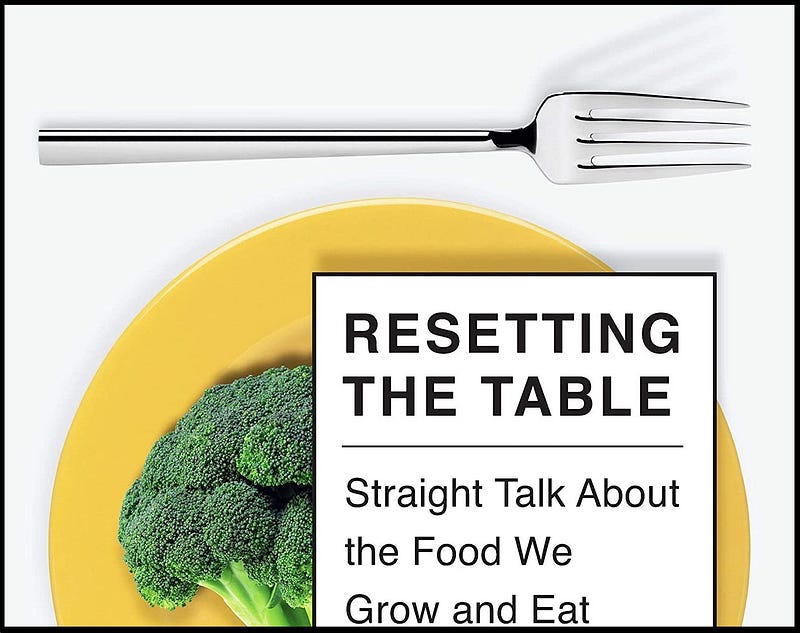
Full disclosure: I’m passionate about sustainable agriculture, as reflected in my proposed blueprint for priorities as part of the upcoming 2023 U.S. Farm Bill. So obviously I went into reading this book harboring many biases. And I fully admit I’ve retained most of those biases.
I had hoped Robert Paarlberg’s Resetting the Table: Straight Talk About the Food We Grow and Eat would be a moderate take on how we can move the needle to transform U.S. agriculture in realistic or achievable ways. As a Harvard professor and researcher, via his academic undertakings, he certainly does a high quantity of exploration into data or theories related to agriculture and environmentalism alike.
Instead, while this particular book of Paarlberg’s makes some worthwhile points and recommendations for improving American nutrition, he unfortunately appears to persist with a mostly stay-the-course outlook on U.S. agriculture’s problematic trajectory. His 276 pages were definitely a missed opportunity.
WHY YOU SHOULD READ THIS BOOK
You probably shouldn’t. At least, not if you’re looking for solutions beyond the obvious advice of “Eat healthier food” or “Be more ethical with your purchases.”
If anything, most of its chapters may leave you with an unfulfilled void in your stomach. And, if that motivates you to build on Paarlberg’s commentary and do more of your own research…maybe that’s a good thing?
STYLE / FORMAT
Paarlberg structures eight main chapters focusing on various areas within the realm of food policy. He includes a lot of well-researched quotations and data compilations. He offers us some knowledgeable clarity based on his professional experiences. But his conclusions leave a lot to be desired.
A formal Introduction precedes the eight main chapters of his book.
Introduction
Paarlberg begins by praising the intentions and efforts of many local farmers but insists it’s unrealistic to bring many of their farming techniques to scale. He maintains that industrial farming per se is less of a culprit to our health and environment than is the human neglect of components such as income/class, nutritional awareness, scientific innovation, and time management. In response to health-consciousness embraced by locavores and slow food activists, Paarlberg embraces an alternative of ecomodernism.
Chapter 1 — titled “Testing the Case Against Industrial Farming,” Paarlberg narrates how American nutrition improved throughout the 1960s and 1970s — but then quickly escalated to become a culture of overconsuming grains, proteins, sugars, and salts. By contrast, fruits, vegetables, dairy, and natural oils are too often neglected within our agricultural production. His main point is that the U.S. federal government props up prices of wheat, corn, and sugar due to lobbyists resisting change (especially against imposing new rules for nutritional standards through SNAP). He argues that the excess of cheap and unhealthy foods is due to cost-cutting measures by Big Food (junk food industries) and people’s taste preferences. Yet, he doesn’t acknowledge the very real presence of “food deserts.”
Paarlberg makes a valid point in his criticism of the 2018 Farm Bill for failing to cut wasteful farm subsidies that enrich wealthy farmers while food prices are driven up for consumers; yet, he fails to allude to a practical alternative that should replace those subsidies. However, to his credit, the author spotlights John Nidlinger, an Indiana farmer whose growing and harvesting of corn serves as a model for precision agriculture. Nidlinger’s usage of GPS-aided “smart machines” cuts down on runoff, waste, or contamination from both water and nitrogen.
Paarlberg emphasizes how Big Agriculture accounts for only 7% of U.S. farms, which, in turn, produce 81% of our crops. The remaining 93% fall under the umbrella of “lifestyle farms,” consisting of retirement farms, hobby farms, specialty farms, part-time farms, commuter farms, and agritourism farms.
Chapter 2 — titled “Food Swamp Nation,” he takes aim at the marketing gimmicks designed to boost “junk foods” formulated with sugars, salts, and fats that induce our cravings. Paarlberg argues that “food swamps” are a bigger problem, statistically, than “food deserts” when it comes to being a predictor of obesity (yet, he once again ignores the issue of how to eliminate “food deserts”). Many food scientists calibrate product ingredients in order to induce dopamine levels, especially directed at Black youth and teenagers. He concludes that adding more fiber, whole grains, and protein while reducing sodium, trans fats, and added sugar content in these foods has only resulted in a limited benefit.
Paarlberg then goes on to endorse sugary beverage taxes, modeled after those adopted throughout Europe, Latin America, and Democratic-leaning American cities; yet, he advocates no specific solutions for offsetting or lessening consumer costs when grocers wish to be able to afford healthier options. The author acknowledges how online shipping has partially reduced impulse-buying, and he recommends other labeling techniques — such as color-coded nutrient-warnings on the front of product packaging, or, when food manufacturers refuse to be transparent, supermarkets voluntary shelf-tagging (e.g., the Guiding Stars program) their grocery items.
As far as restaurants, Paarlberg criticizes those fast food chains who use offsite-kitchens (“ghost kitchens”). Restaurant patrons, he says, are divided into four main categories: Basic Eaters, Experientialists, Quality Essentialists, and Progressives. Some fast food chains are offering more menu options that are gluten-free, paleo, or vegetarian; while the 2010 menu labeling law has been inconclusive in terms of its effectiveness, it’s a good sign that PHOs and sugary beverages are falling in consumption rates.
Chapter 3 — titled “The Limits of Local Food,” this is perhaps the most exasperating and short-sighted section of Paarlberg’s entire book. He criticizes the term “local” as having become an overly-ambiguous definition in terms of food policy, especially amidst the surge in foreign-grown produce imports. He writes off Community Supported Agriculture co-ops (CSAs) as being too nondiverse (aka White) and highly-educated or affluent. Then he goes on to praise Wendell Berry’s philosophies of rural frugality, even though Paarlberg himself seems to be, paradoxically, rejecting agrarian localism.
He spotlights Clark Farm, run by Andrew Rodgers of Carlisle, Massachusetts; Rodgers prefers to remain small scale because he doesn’t want to hire more crew, specialize in his crops, or increase his quantity of raised hens (since they’d generate more phosphorous runoff into nearby rivers). Despite his positive depiction of (and testimony from) Rodgers, Paarlberg proceeds to blast CSAs for lacking health coverage, retirement accounts, and participant continuity.
The author gives us a historical overview of the local-to-global shift in America’s food systems. He rightfully emphasizes how some processed foods can sometimes have health benefits, such as milk, flour, and cereal fortified with Vitamins A, C, D, & E, niacin, iron, or folic acid. Additionally, food processing has reduced the amount of spoilage and waste. Food processing facilities that are larger in size have the practical ability to detect contamination through the use of Hazard Analysis Critical Control Point (HACCP) systems.
By contrast, some vegetables from farmers’ markets can contain campylobacter; their poultry may be stricken with salmonella (as seen in the 2015 Norovirus outbreak at Chipotle restaurants). Concentrated Animal Feeding Operations (CAFOs) certainly deserve criticism for animal welfare violations, maintains Paarlberg, but not for any major food safety deficiencies. In fact, he shows us, backyard poultry farming creates salmonella outbreaks more often than confined/indoor animal ranches do.
But the author’s bias and cognitive dissonance rears its ugly head. In terms of food policy’s carbon footprint on the environment, Paarlberg claims that gas mileage for vehicles transporting food is less of a burden than the energy needed to heat greenhouses; but this assertion of his fails to take into account energy-efficiency research, supply-chain disruptions, or inflated spikes to fossil fuel prices. Then, he goes on to praise the mindsets of Wendell Berry and Michael Pollan — while turning right around and laying the blame on Millennials and Zoomers for choosing convenience over local farmers’ markets (incidentally, the same farmers’ markets whose usefulness Paarlberg himself just downplayed!).
He acknowledges that Democrats promote more agri-friendly policies than Republicans, but then simply shrugs his metaphorical shoulders at how Democrats have failed to sustain power in enough consecutive election cycles to make a prolonged difference. He tops it all off by throwing cold water on the concepts of urban agriculture (due to current production costs and their nonprofit/community-based focus) or the energy-efficiency and nutrient-content challenges faced by hydroponics and other indoor agricultural technologies.
Of course, Paarlberg conveniently sidesteps the reality of climate change — both in terms of growing temperatures as well as inoculation from destructive weather — as being crucial to why we must accelerate the development of viable alternatives to traditional outdoor field agriculture. It’s rather befuddling how, amidst Paarlberg’s overall brushing-aside of indoor agricultural concepts, he still praises some of the few examples that have managed to be profitable against the headwinds of Big Agriculture — such as Brooklyn Grange and AeroFarms. The fact that he cites the 2018 Farm Bill’s establishment/funding of an Office of Urban Agriculture & Innovative Production (which is still merely in its formative years) while arguing against these very innovations only underscores Paarlberg’s tone-deaf worldview.
Chapter 4 — titled “The Panic For Organic,” the author reasons that organic food is more expensive than its generic counterparts due to labor-intensive production expenses. However, he adds, there’s very spotty evidence that organic food contains superior nutrition or safety. In fact, carcinogens, microbes, and poisons can be found in many naturally-occurring foods when left untreated. As much as it gets derided by environmentalists, nitrogen fertilizer enabled the world to magnify its food production by more than 40% as the global population jumped. Paarlberg derides Rudolf Steiner’s culture of biodynamics, lamenting how it would later be co-opted by Albert Howard, Jerome Rodale, and Nazi leaders. By contrast, he praises Rachel Carson’s more practical advocacy of using agricultural chemicals in moderation.
His balanced approach, here, becomes tainted as Paarlberg takes a backhanded (and rather catty) dig at U.S. Congresswoman Chellie Pingree. He calls into question Pingree’s motives due to the fact that she’d lived on a back-to-the-land organic farm during the 1970s — but, in reality, Pingree has unilaterally done more to push pro-farmer legislative proposals than has perhaps any other member of the United States Congress in modern history. Paarlberg’s short-sightedness is disheartening, here; especially because he goes on to make a valid point about how Big Organic has become a monster in much the same way conventional Big Agriculture has. These “unclean hands” from some offenders of Big Organic include animal welfare violations, overuse of plastic containers or packaging, catastrophizing the risk of produce via analyses such as the “Dirty Dozen” (i.e. an annual assessment of the twelve crops stricken with the highest concentrations of farm pesticides), and being allowed to deceptively market themselves as “organic” while skirting around good-faith rules.
Chapter 5 — titled “Should Peasants Stay Poor?” the author slams purists who use alley-cropping and other forms of agroecology without weeding, pruning, irrigating, or dispatching pesticides. He praises dwarf wheat as a remedy for famine and lauds the Green Revolution of the mid-Twentieth Century for having extended this innovation to crops such as rice, maize, sorghum, millet, barley, and cassava. He makes a compelling case for ensuring that dwarf wheat seeds become more accessible to smaller farmers, seeing how they don’t require complex machinery.
Paarlberg critiques environmentalist Vandana Shiva’s misinterpretations of facts related to water overuse, chemical fertilizer overdependence, and lack of biodiversity. Vandana has made inaccurate claims while bashing the rise of India’s own Green Revolution. The author specifies how India’s success with the modern Green Revolution is in stark contrast to that of Latin America, where green practices have failed because of dominance by large landowners. He gives limited praise to the Aztecs and Mayans for innovating raised beds in conjunction with irrigation canals — but points out how this system isn’t conducive to every type of topography, along with the reality of lower populations that Aztecs/Mayans needed to feed, thousands of years ago.
Alas, for someone who champions moderation and balance, Paarlberg is frustratingly hostile toward agroecology as a whole. He cites Cuba’s failures in agroecology along with the U.N.’s inflated claims of positive results from this applied science. This is apparently based on his sentiments that the food sovereignty movement has become mostly reactionary as a response to capitalistic supermarkets, ubiquitous fertilizers, and anti-globalization from the World Trade Organization (WTO) and its allies. To his credit, Paarlberg at least offers an alternative through endorsing the hybrid environmental methodologies advanced by Gordon Conway and Jules Pretty.
Chapter 6 — titled “Rejecting Biotech Food,” is where the book begins to inch toward a slightly more positive direction. Paarlberg defends the GMO industry, chronicling how Irish scientist Mark Lyons shifted from being anti-GMO to pro-GMO. The anti-GMO stigma has expanded to genome editing. Reputational libel, arduous tracing requirements, and tangential controversies (such as “Mad Cow Disease”) have prevented GMOs from getting the chance to adequately make their case. Many African nations perpetuate famine because they buy into paranoia and refuse to consider GMO seeds for primary crops (e.g., maize). Parts of Africa often defer to flawed European standards when structuring much of their economic logic.
Pam Roland has done incredible work educating the public on the safety and benefits of many GMOs. Among innovations on the horizon are more precise Cluster Regularly Interspaced Short Palindromic Repeats (CRISPR, aka genome-editing, technology), which excises undesirable or unhealthy traits during the gene-editing of seeds and livestock. But, haphazardly, European organizations have denounced CRISPR while simultaneously ignoring the dangers of induced mutagenesis. Paarlberg reins in his own initial excitement for CRISPR by expressing caution when it comes to the future CRISPR-based “gene-drive” engineering of animals and insects, despite the hypothetical benefits.
Chapter 7 — titled “The Fate of Farm Animals,” Paarlberg compliments the innovation of indoor feeding of livestock, which has led to price stability, food security, and fewer greenhouse gas emissions throughout the decades. Hens, broiler chickens, pigs, and dairy cows have all been increasingly moved indoors by ranchers…with beef cattle as the one remaining livestock that primarily grazes outdoors. He commends indoor grazing for how it helps to reduce parasites and the predators who prey upon livestock.
Our collective responsibility, says Paarlberg, is to maintain an ethical framework where we avoid overbreeding or unduly-tight confinement. The author maintains that pasture and barnyard systems, such as Clark Farms in Massachusetts or Joel Salatin’s properties in Virginia, can only be done in small-scale fashion if we wish to protect our livestock from risks of the natural world. Paarlberg commends Mark & Phyllis Legan of Indiana’s Putnam County for emulating the Dutch practice of breeding pigs indoors with more space, group pens, and anaerobic manure treatment. In modeling the Legans’ success with sustainable pork, Paarlberg advocates for ranchers to consider switching to slower-growing birds to make poultry more sustainable.
Chapter 8 — this concluding chapter, titled “The Brave New Future of Food,” begins with the author imploring us to avoid Mao Zedang’s misguided “Great Leap Forward” that brought on famine throughout the Eastern Hemisphere. Paarlberg asks Americans to reduce their intake of meat and dairy products while increasing their consumption of plant-based proteins. Such lifestyle changes would promote human health and the preservation of land acreage; however, he rejects veganism in favor of a “planetary health diet.” He names Beyond Meat, Impossible Foods, Perfect Day (imitation dairy), Just Egg, and Maple Leaf Foods as brands that sell delicious meat substitutes. When it comes to the viability of biotech food: Paarlberg believes the money for costly Research & Development (R&D) will become available since mainstream food manufacturers are already investing in, and offering variations of, the aforementioned faux-meat companies.
Paarlberg thinks that some advocates of regenerative agriculture are overinflating claims that their methods are carbon-negative. He praises cell-cultured meats grown in laboratory settings as being on the rise, commercially. In that same vein, plant-based and cell-cultured fish/seafood varieties appear to be on the horizon, along with production via 3D food printers. For traditional outdoor field agriculture, the author endorses “smart” drip lines (or Variable Rate Irrigation, VRI for short) and UAV remote-sensing drones being utilized by massive farms, such as almond growers. He maintains that technological and capital assistance from Big Tech can help smaller farmers attain this precision agriculture, and Paarlberg finally gets around to debunking Wendell Berry’s vendetta against industrial agriculture.
For the book’s epilogue, Paarlberg throws in some softball criticism of commercial farms. He speaks to the elitism of various past politicians including Michael Dukakis, Teresa Heinz Kerry, Mike Conaway, Sonny Perdue, Hillary Clinton, and Donald Trump when confronting agricultural policy. The author faintly slaps the wrists of farmers who vote overwhelmingly for Republican candidates out of habit. But, ultimately, he claims the biggest change they need to support is dietary balance — once again citing solutions such as front-of-page nutrition labeling, front-of-shelf rating systems in grocery stores, overconsumption warnings on packaging, and statutory prohibitions on unhealthy commercial marketing that targets children.
The first half of the book is much more disappointing than the latter half. Paarlberg is both covertly and blatantly adversarial toward Community Supported Agriculture (CSAs), indoor planting/growing technologies, urban farms, the realities of food insecurity, and America’s younger generations. He leans very heavily on the emphases of portion control, clean eating, and continuing to rely on outdoor growing methods that have already proven to work — while turning a deaf ear to the perils that climate change and economic inflation threaten to present for these “tried-and-true” blueprints.
In Resetting’s second half, Paarlberg begins to offer some workable visions that could be elevated by relevant future innovations. I agree with him in his sentiments about finding balance when dealing with consensus-building related to modern food processing, fertilizers, GMOs, truth-in-advertising, indoor livestock, CRISPR technology, and biotech foods. Yet, considering all of the author’s passion for capital investment and R&D related to these areas — it baffles me how he can’t even seem to scrounge up some tentative complementary sentiments for the high-tech cultivation of homegrown produce.
Paarlberg’s holistic view of innovation is dismal, notwithstanding those methods that he endorses in his book’s second half. When I read his reproach of the goals within sustainable agriculture that are necessary to mitigate global/economic collapse, here is what I glean (assessed facetiously, with my paraphrasing) from his laundry-list of hobgoblins:
- No real solutions for cash-strapped Americans (including those who aren’t far enough below the poverty line to qualify for SNAP) to afford these healthier food choices
- No real solutions for bringing quality food products into impoverished areas of the United States
- We shouldn’t waste our time expanding CSAs because the ones that exist are generally too elitist, too small, and not culturally diverse enough…yet, somehow also “too diverse” in what they choose to grow
- It’s the fault of Millennials and Centennials (Gens Y & Z) for declining to shop, in large enough numbers, at the same CSAs that the author simultaneously dismisses…how they’re not spending the money they lack due to their cash-strapped existence
- We shouldn’t rely on greenhouses (or other indoor growing spaces) because we haven’t yet managed to reach optimal energy efficiency in terms of their operational costs
- Urban agriculture, as a massive undertaking, is a lost cause because we’ve failed to invest in the R&D or scientific breakthroughs that could otherwise make it successful
- Democrats can’t convince farmers to get on board with Democratic farm policy because Democrats are bad at messaging — while Republicans have basically hypnotized farmers into supporting them, and seem poised to continue doing so…which means we must embrace the status quo, in terms of innovation and policy reform, within the parameters of our ineffectual political system
- Climate change is real, but there is no viable technology to strengthen our agricultural sectors in the face of climate change…so, aside from improving our nutritional habits with the imaginary discretionary income that we don’t possess, we should mostly keep doing what we’ve been doing
- If biodynamics appeals to you, then you might as well join a cult
- Agroecology and regenerative agriculture are also snake-oil shams
- Lawmakers should stay far away from most of the legislation proposed by Chellie Pingree because she used to live on a dastardly organic farm — and her family still owns/runs one
- America should be more like Europe in terms of its marketing, food taxation, and regulation — even while scientists of Europe have shaky records when interpreting food science…and European costs-of-living are through the roof
Oooooh, earth-shattering wisdom, isn’t it?
In terms of shoring up our global food systems in preparation for a scary, uncertain future — Robert Paarlberg’s milquetoast, Pollyannaish mapping of food security falls maddeningly short.


