
Photography
My Secret Industrial Photo Safari
I enter the decommissioned smelter one Sunday morning in March 2004
I wrote this text in 2004, a few years before I decided to write the novel Fabrikken, about this very factory. It was a Sunday morning in March 2004 that I, with a beating heart and a camera in my hand, illegally entered the forbidden area of the closed factory and started walking around in there and taking pictures.
I repeated this stunt several times in the following years, and the result is, among other things, that I have a fairly extensive digital photo archive that shows various details — buildings, rooms, machines, etc. inside the disused factory.
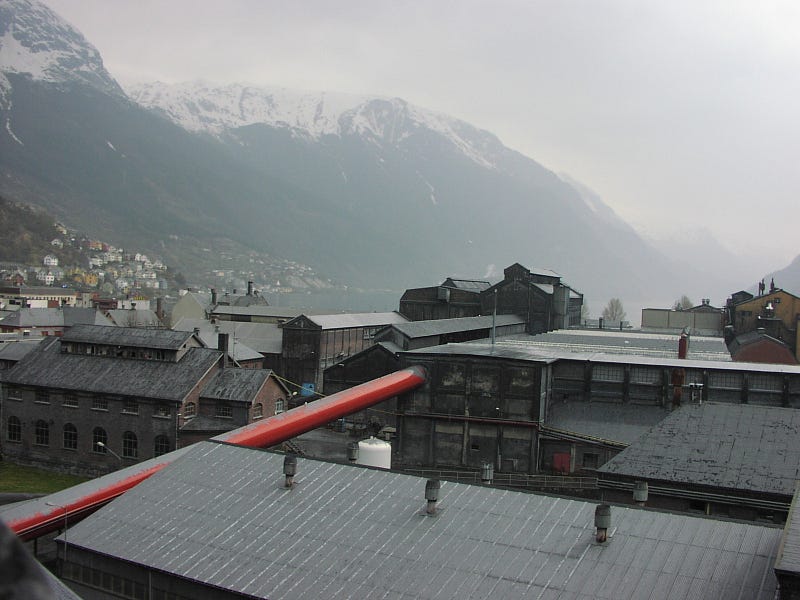
I leave my mother’s apartment one March morning in 2004. Trembling tension in my body, because I have been thinking about this for a while now, and I am determined to carry it out.
I go out into the street outside the block in Bygda, eastwards towards the Smelter and upwards in the street towards Nyland, until I come to the walkway on the left hand side, where I take off down past the swimming pool and the zinc blocks. I walk past the houses on Nyland Flatland past the limestone warehouse, thinking of the deaf shoemaker who once lived and worked there. It was at that time when I was still young and had a summer job at the taxi center in Odda.
Then I come past the Long Shop, the narrow gut of a room inside the building where there was once a grocery store. And I pass the house of the fishmonger, Vaagen, then I turn left down towards Hjøllo, down the hill towards the bridge and past the house of the fishmonger who in his time — maybe 45 years ago, bought the record-breaking salmon that my father fished one night in the river Opo. I think he paid well — according to the circumstances and according to my father’s ideas when it comes to money. But I think I think I thought he did not pay enough, in my opinion. Maybe I was a little mad about that. Without Vaagen having in any way learned about it. That I was mad at him, I mean.
I cross the new Hjøllo bridge. It is so nice and wide. Releases me well over where in the old days there was an iron bridge like the one that in its time helped people across the river at Vasstun. But enough about that. On the slope down to the river, where in my childhood days there was a rubbish dump for the shop of Elgar Olsen in Foreman’s House, who emptied unused betting coupons and other scrap in the Opo river, there is now above the bridge on the west side a prayer house, some sect or congregation which I can not remember the name of, which resides here. Probably with song and hallelujah and lots of fun.
I stroll as unnoticed as I can past a lady who comes from Hjøllo riverside, turn around and see that she is on her way up from the bridge towards Nyland Flatland. I go to the left at the end of the bridge down on the eastern bank of the river.
— Strange, I think afterwards, it’s just that. I must not be seen. No one must see me. I am an Odda citizen, a true Odda citizen, of the kind who should not offend a cat, who should not attract attention. Right?
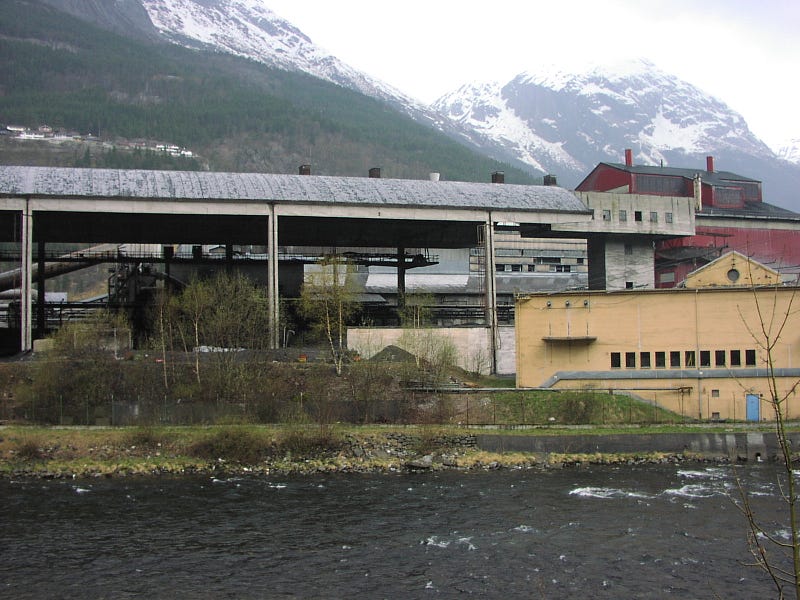
I walk along the river bank. Opo River is big, I see. Relatively large where she runs as always from south to north. Towards the mouth, out into the Sørfjord, all the way down there at the Odda Smelter import quay. On the other side of the river, the large, round roof towers over the limestone layer. The high fence that is to prevent unauthorized persons from entering the factory area sits on its casting edge every one meter down from Hjøllo Bridge. A shed has been built and is painted green, and testifies to thoughts of large-scale fishing in the Opo River, but it may well be past times, you ask me.
Above the oval limestone storage roof towers the top of the limestone kiln, and further north I see the red building for kilns 3 and 4, the two newest smelting kilns that were built in an attempt to save the smelter in Odda from bankruptcy.
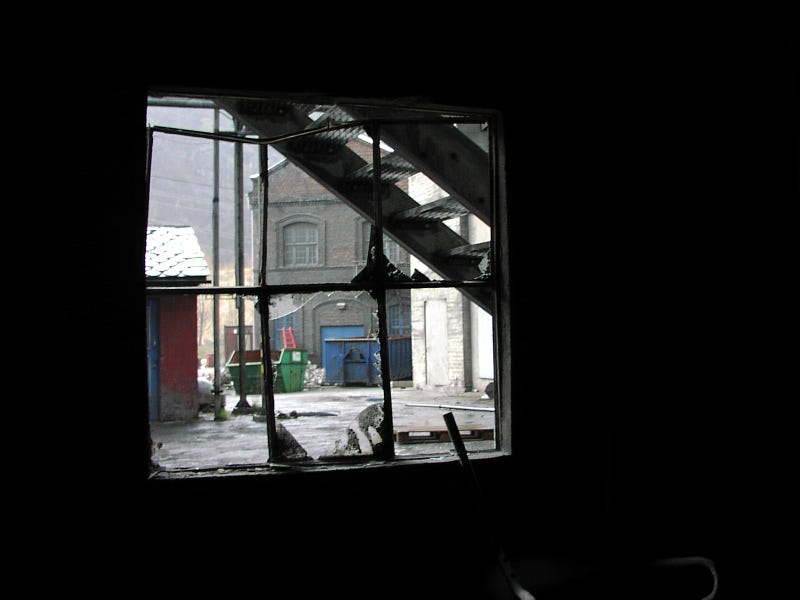
That’s a little weird. I think it’s a little weird. Now when the smelter is closed. Now when no one is employed there anymore. When no boss and no workers are on the payroll anymore. How is it there then?
I go further down. On the right bank of the river, in the sloping hills by the landfill at Hjøllo, which hides who knows what colossal environmental sins.
It’s awkward to walk there, because there is remnants of snow in the year-old grass, and I slip a couple of times in my bad shoes. I do not yet know how to get into the factory area, but I am determined.
It turns out that it is solved in the simplest way. Because by the bridge where the smelter in the old days had a railway and a small railway that transports waste from Odda-side to Hjøllo-side, there is a tree, a willow that gives me all the help I need to get where I want. So I hang the camera over my head and around my neck, I lift my left foot all I can up the gorge at the seal, I pull myself with my hands up, climb further up the railing on the bridge and get over.
Then I’m where I want to be. The crossing of the smelter bridge is a critical phase, but when I look around, I can not really see very many possible witnesses or people who can reveal me. No houses, no — or almost no — places where I have to expect people to look at the smelter bridge this Sunday morning in March.
I walk quickly over the bridge while I look with all my senses open towards the buildings inside this flat plain where the smelter almost a hundred years ago seized the finest agricultural and plot land in the tourist town of Odda, in the heart of Hardanger.
When I pass the large brick building by the bridge, I see that there is a car parked at the front door, and I understand that there are people here. — So early on a Sunday! But still. It’s just the way it is.
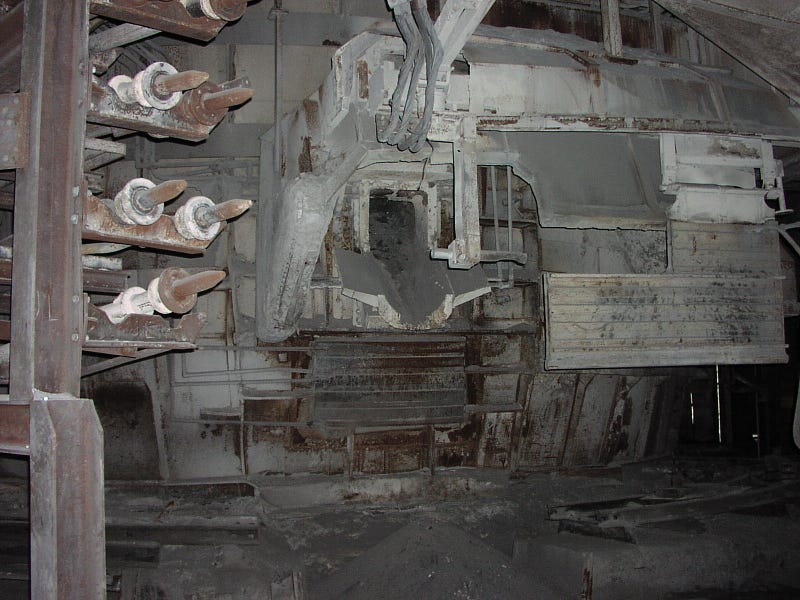
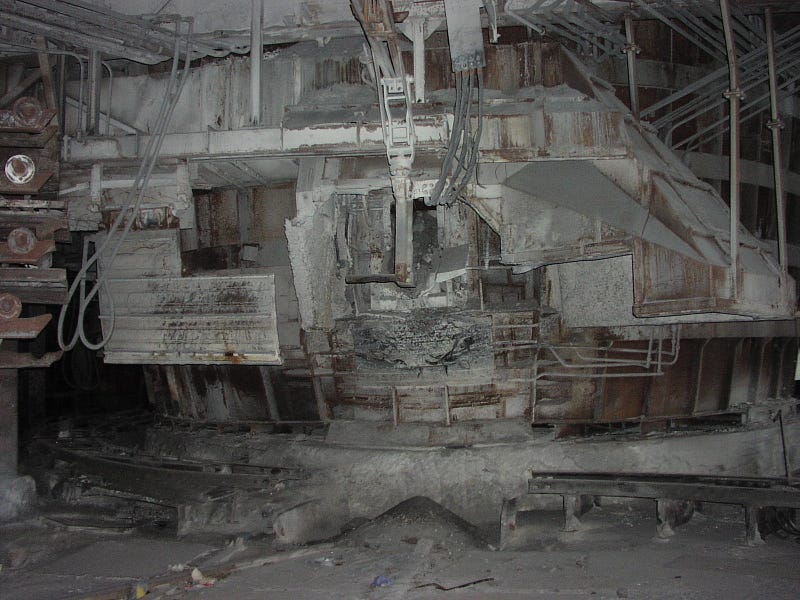
I get past quickly, and set off in a steady walk towards the furnace hall, which is my goal this day. Once inside, I stop and turn around. Looking around me inwards towards the dirty melting furnace, the huge belly that widens and is covered with a thick layer of dust, ghostly.
All rights reserved. © Øivind H. Solheim, author of novels, poetry, articles, essays, short fiction and experimental writings. Contact: [email protected].