
My Remarkable Experience From Six Months Of Meditational Practice
How I gained meditational momentum, inspired, and influenced by Dr. Mehmet
“I breathe, fast, move, and meditate daily for decades to sustainably improve my cellular, metabolic, immune, endocrine, neurological, and mental health.”
- Dr. Mehmet Yildiz -
Modern-day society has us by the throat.
Terrible time management, our Burgundian lifestyle, pile loads of work, late nights, negative environment, hypnotized by seasons, influenced by media,…
All of it makes it more difficult to breathe. Stress builds up.
You can’t think well. You are chronically tired.
Sickness starts to pop up occasionally.
Frankly, you’re energetically depleted.
Truly great!
Let me ask: “How long will you be able to last like this?”
Are you that person whose energy seems to be depleted before the end of your day?
I know what you mean, I’ve been there too, experienced it, and now it’s gone. Or let me say it differently, I’ve found a way to control it. Because it never really entirely disappears. Especially if the devastating influences are integrated into your most exposed environment.
To avoid those devastating impulses, there’s a tactic that can easily be blended into a daily routine.
I’d like to share with you my insights from a brief six-month period of meditation experience.
But first, I’ll let you into how I got started.
There’s someone I have followed since I came to Medium, one many on the platform know well. His name: “Dr. Mehmet Yildiz.”
Dr. Mehmet has meditated every eight hours for decades. He has read hundreds of scientific studies on the effects of meditation or overall mindfulness practices on the brain. By meditating from his early 20s, he’s a very early practicer of meditation. At least from those who I know.
So why not fuel your meditational approach with certain aspects he discovered? Indeed.
For me, this says it all already. Matter of fact, I’m trying to teach my kids to meditate straight away in the hope they become early practitioners too.
Not only Dr. Mehmet triggered me into meditation. He’s just one of the persons to deliver huge value to the concept through the experiences he shares. Also, notice how the famous 90s bodybuilder “Dorian Yates” shifted his life approach. He came back from a serious mental dip after winning six Mr. Olympia’s, which got me thinking…
One other element is my wife “Joyce” for instance. She doesn’t meditate. But she’s a Reiki master, and her Reiki lifestyle convinced me of possible energetic shifts. I’ll tell you something about it later.
“From my experience, exercise, fasting, and meditation can significantly change brain chemistry.”
- Dr. Mehmet Yildiz -
I admire Dr. Mehmet’s writings because of his broad range of knowledge, which sets him apart from just being an “expert.” He documents aspects combined from literature, different fields, and his experience. It’s somewhat in line with how I see the world, and that’s why I’m attracted to his tank of value. Daily exercising and fasting were already part of my life. Now also, meditation became part of my lifestyle.
If you have been following me for a longer time, perhaps you’ve come to the awareness of this phrase I live my life by:
When you start something new, ask yourself the question:
“Am I going to do and be able to do this for the rest of my life?”
Although, unlike Dr. Mehmet, my fasting regime involves two meals instead of one, some snacks, and I don’t water fast! I see life as a test that would be invaluable if we don’t share what we’ve learned through our unique perception of things.
Over the last year, when I don’t know what to read, I always seek a great post from Dr. Mehmet. Hereby he reinforced me to tool the meditational practice in my behavior. I was planning to blend meditation into my routine for a long time. Because of his readings, I think I’ve gained early momentum (Saving me some time to seek by gaining know-how in the early approach)
Dr. Mehmet said:
“When I was in a meditative state, my learning abilities were outstanding.”
I believe this man is from another planet, leading me to take meditation even more seriously. Sometimes I want to sit on another planet too, by myself, without arousal, just to recharge my state more often. It’s not that I want to escape per se, because spending time with my family often energizes me as well. But rather that it becomes an adaptive requirement in our present-day society. There’s just no hiding the fact that our present-day lifestyles require a certain adaptation to perform and keep performing well.
Some of the things to reap from consistent practices of meditation are:
- Increased well-being
- Individual development
- Overall health improvement
I would even dare to blend in enhanced recovery.
Some people like Dr. Mehmet intuitively understood the value of meditation at a young age. This, for me, was not the case. Practices like this seemed like a joke to me. Although, I was intrigued by the practices of “Shaolin monks” in the early days. My apologies, but this is just me being brutally honest. Today I see these things 180 degrees differently.
My reason for mediation
Recharge me more often and return to a balanced state as much as possible.
After gaining some understanding of chronobiology, Influencing my bio-clock became more important. Our clock is accelerated by chronic stress and age-related chronic diseases. Meditation influences the epigenetic clock positively, which is a biomarker of biological aging.
The importance of stress reduction for longevity is something that David Sinclair refers to in his book: “Lifespan.”
There’s no hiding the fact that physiological stress, bites. Implementing meditation is a great approach to counter the effects. Consistent practices seem to add positive behavior layers to your life.
More and more, I find that we are getting swallowed by everything surrounding us. Especially technological innovations and stressful environments emphasize stress. We are so used to being influenced, that we don’t even seem to notice. We’re pulled into a certain flow, and before we know it, we’re not even thinking, and most of us never regain a stable state.
I felt that I needed to blend this into my routine and see where it led me.
Think about it: Do you experience difficulty regaining a balanced state throughout your day?
I truly notice this when I distance myself for a few minutes in a low-to-non-arousal place. Suddenly you feel what you’ve been missing out on.
Among other beneficial neurophysiological outcomes, meditation significantly reduces stress levels.
When you consider blending meditation into your routine, please list a few reasons for yourself. It’ll keep you in the game easier and longer.
A simple start
The simplest trick to get started is closing your eyes and focusing on slow but deep nasal breathing. Most healthy individuals can get into a meditative state by consciously relaxing -mind and body. You could try breathing and visualization exercises.
Although, I discovered there’s a lot more involved.
My Meditational frequency
I started meditation with 10 minutes per day.
Soon I cranked up my rate already.
After reading some of Dr. Mehmet’s writings, I’ve increased my rate to twice or three times a day, ranging from 10–20 minutes per session. After about two to three months, I increased my rate of the practice.
The reason why has much to do with technology as well. Since I started to write online, there’s just no way to escape screens and hyperconnectedness. Whenever I can, I step back. Nevertheless, to sit and write on a computer, you still have to put some time in. There’s no way around it.
Because of my online engagement, I am more hyperconnected than a couple of years ago. Even though I maintain a reasonable daily activity level, I believe additional meditation is beneficial.
I try to perform meditation at designated timestamps, although I’m not always able to. When I don’t reach the fixed times, I still blend meditation at different times. Even if it’s only five minutes, I still try to perform the practice.
What a short burst of rest does subconsciously is largely underestimated because it’s so difficult to comprehend for us. You’ve got to have faith in it, and be willing to prioritize, just as going to bed on time.
My thoughts on meditation and sleep improvement
Mediation can act as a sleep improver. True!
However, there’s still something to take into account.
People who live a sedentary lifestyle already and who don’t sleep well will likely benefit more from increasing their N.E.A.T. (Nonexercise activity thermogenesis) than from practicing meditation straight away.
The association and relaxation factor
The association with sitting down and relaxing a couple of times throughout your day can induce sleep easier. Also, the closing eyelids could stimulate, and improve melatonin production. Meditation associated with your bedroom, for instance, could magnify the total effect.
Mediation is a good assistant for improving sleep in persons who experience chronic stress. Yet, consider what you do the hours prior to sleep. Why? Because when you trigger a stress effect at that point, this could erase the positive effects of meditation instantly. Here the relaxing effect of meditation can help you gain the upper hand.
Not everyone is the same, therefore, each of our situations could require different approaches. Remember, the things I mention here derived from my preparation and my early observations from my six-month habit of meditation.
Meditation and brainwaves
This is something I find very interesting because of two things:
- While pondering this post, I couldn’t help myself than to compare the meditative states I experienced with flow states
- One of my earlier posts was about flow states. I read about flow states in a “Tim Denning” post for the first time about a year ago here on Medium. Ever since I have felt the urge to write about it now and then. While researching meditation, I found a remarkable resemblance to flow states.
I believe in some cases, meditation can be seen as an instantly triggered flow state (depending on how & what you meditate on)
Last summer, I was on a forty-minute walk alone with our twin daughters. Walking increases your conductivity and gets us in flow easier. At this given time, my mind renders things super fast. I was pondering new posts, trying to seek value within previous podcasts I’ve been listening to. When I came home, I wrote another Medium post. It’s still a truly underestimated power among many creators. I thought the movement was the only thing elevating conductivity, yet often my meditational practices give me that same mental thrive state.
This was me about two months in meditation.
At this time my notion about meditation was just, sitting down with your eyes closed and focusing on nasal breathing. Which is just great enough to start with already. However, meditation seems to have flow resemblance aspects. From my experience, the increase in activity and conductivity allows me to tune into the higher gamma waves. Fast gamma waves can be increased in amplitude by meditation, or neurostimulation.
“Experiences happening in meditative states is like walking a balancing cord in flow.”
Flow is a meditative state, yet not all meditative states can be considered flow states.
I think we’ll need to ponder a bit more on this one.
Meanwhile, here are two other approaches to my meditation.
1. The inner meditation
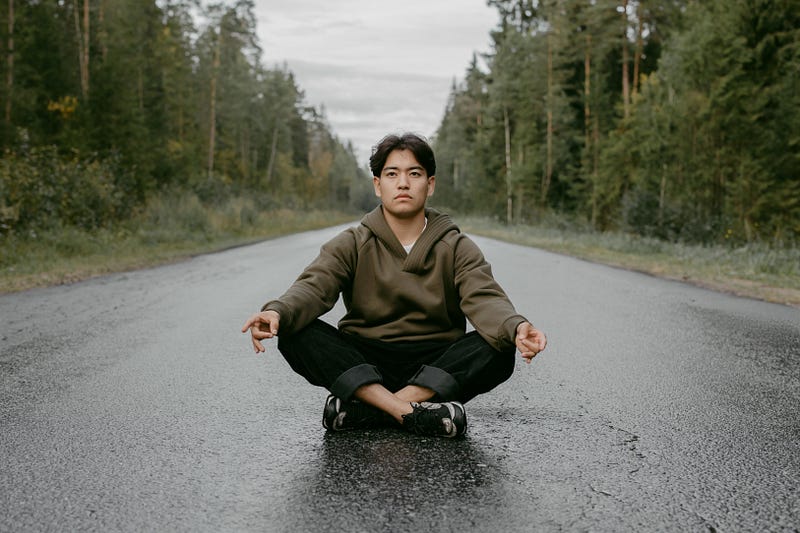
Sitting down with legs crossed, eyes closed, and slow nasal breath focus.
When I perform meditational practices while just sitting, the experience is a bit different. Sitting down, relaxing, and focusing on slow nasal breathing enables me to recharge myself to homeostasis. I see this more as a recovery method that gets me going on “thrive-modus” at a stable day phase, without experiencing a mental dip.
Here you want to focus on your inner self. It’s the most relaxing state to be in. One element that’s handy to know is :
Kundalini
Sometimes I read.
Before I start with something new, I try to know at least some of the fundaments of a given practice. It helps me to get into a new game more quickly. Sometimes I start by getting hands-on straight away and filling up knowledge gaps on the go. But this happens less frequently. It depends on how practical my new craft requires me to be.
In Hindu and yoga philosophy, Kundalini energy is the divine feminine energy, also known as shakti, goddess energy, or serpent energy. Think of it this way: It’s your internal energy, a current that flows true your spinal cord, following a “question mark-shaped” pathway. This pathway runs from your pituitary gland towards the ovary or testes.
Internal focus on that energy helps me to get more in touch with my inner self and reach meditative depth more rapidly.
A nifty attribute of my meditation
Something I blend into my meditational practices is back thinking. At first, when I start meditation, the first minute or so, I think back at what I did or learned the last couple of hours. These days, my thoughts are focussed on personal development. Therefore, I believe back thinking is a personal tactic that reinforces my ability to memorize.
2. The outer meditation
Here I focus on what’s around.
This works extremely well outside too. Meditation while sitting outside in natural sunlight is, in my opinion, the best thing you can do. For me, it magnifies the effect of meditation 10x. Natural sunlight increases your neurophysiological recovery tremendously. From what I sense, you regain homeostasis faster, especially when practiced shirtless.
More skin surface results in increased absorption. See it as more solar panels which generate more electricity. More skin surface will make it easier for your body to absorb more Vit D in your fat cells, in a short time. In this way, outside meditation could have an indirect, yet positive effect on your immune system. Also, the focus on nasal breathing could induce immune improvements.
Note: You don’t want to do this too long and not without sun protection of course, yet the effect feels great.
Outside practices will always have greater effects on your state than inside practices. Unfortunately, we can’t always go outside and reap the rewards of natural UV light.
What triggered my awareness of meditation, even more, was the recovery ability of my wife, who has been practicing Reiki for over 15 years. Joyce never sits down to meditate. It’s a mental practice built within the Reiki lifestyle over time.
A few times Joyce went into the hospital for surgery in the past, and twice she could stand up straight and go home, leaving doctors perplexed. It’s a huge indicator of how powerful our mind can control our internal state and activate and boost our healing ability.
I found that the contributing factor to this tends to be a happy and positive overall state of mind induced by willingness.
Benefits of meditation
“Like fasting and exercise, meditation initially puts significant stress on the pre-frontal cortex, reshaping the brain chemistry and circuitry in the long term for better performance.”
- Dr. Mehmet Yildiz -
I see meditation as an extension of our subconscious recovery, that reinforces the health benefits similar to the power of our sleep, yet during our conscious day.
It’s also an extremely easy practice to start with. Breathing, exercise, fasting, and meditation are the cheapest health-improving measures you can take.
Similar to great sleep performance, meditation is a long-term health investment. Therefore it’s worth considering to blend into your daily routine.
Dr. Mehmet reaped great rewards from performing meditational practices at an early age. Combined with what I experienced just now makes me want to teach my kids to meditate as early as possible. Hoping it benefits them over their lifespan.
Everyone experiences meditation slightly differently.
“From my experience, the effects and benefits of meditation can be felt intuitively.”
— Dr. Mehmet Yildiz -
Some associate meditation with religions and spiritual practices. Something I believe next to regaining physiological balance is that meditation allows us to tap into certain frequencies over great distances. My assumptions are based on a few small experiences from the past and some energetic perceptions. Yet, to understand more, I’ll need much more practice.
What I felt from my brief six-month period of meditation is:
- Reduction of my stress levels, because of improved breath control
- Feeling mentally refreshed to perform consistently well over the day
- Meditation made it easier to control my emotions. It seems to be effortless.
- I can sense that implementing meditation has already slightly improved my state of being
- Clearly, a reset of the neocortex is sensible. How can I tell? After a short meditational burst, my focus and alertness levels are seemingly back to where they were in the early mornings after exercise and a cold shower.
Meditation, for now, has made me thrive throughout my day, where I otherwise felt an early dip. In a way, it feels like I’m countering the circadian adenosine dip, without the influence of caffeine. As a matter of fact, more and more, I’m even building down my caffeine intake to see how this works out.
In the end, it boils down to regaining homeostasis. As a matter of fact, everything you do to regain homeostasis naturally will improve your state.
By performing some research prior to meditating. But also, by reading the experience of Dr. Mehmet, I feel that I’ve compressed a certain amount of meditational time. The blend seemed to have me leaped ahead in the experience of meditating, wherefore thanks!
Today I try to make meditation my second nature. I’m very excited to see how this evolves. There’s no denying the positive effect of meditation on healthy and growth-minded people.
Absorb, Read, Write, Sleep, Exercise, Thrive!
Thanks for reading this post!
This post doesn’t include health or medical advice. Merely a document of my perception and experience with mediation to provide valuable insights and induce awareness.
P.S.: I’m a firm believer in building a resilient mind, and I like to inspire by writing.
Some of my writings are about: Sleep & Dreams/Writing tips/Life lessons/Mental Health/Circadian Rhythm/Submarine Power Cables.
Want to get my posts in your inbox and read my content directly? Receive it here! If you like to experience Medium yourself, consider supporting me and thousands of other writers. Then Get your unlimited access here for 5$ per month.


