
HEALTH | CANCER
My Nineteen Days of Cancer
Some things women should know about uterine cancer
It was only a few weeks since the unexpected death of my 18-year-old son, Will, from suicide. I was still in excruciating pain from this loss. The weekend ahead held his birthday and Easter, the first major holiday since he died. We attended a family gathering, and I remembered how Will loved his cousins. I ached that he was not there to see them.
As we drove back home, an acute, overwhelming wave of grief swept over me, and I sobbed. I was getting over a cold and had a cough. The sobbing just exacerbated the cough. I sobbed, coughed, sobbed again, and felt miserable.
That evening I noticed just a small amount of bleeding. I almost ignored it, thinking that the sobbing and crying earlier in the day could have caused increased pressure in my abdomen that led to some minor bleeding from the uterus. Still, it was alarming to me since I had gone through menopause several years before and had not bled since then.
I called my gynecologist the next day, Monday, and had an appointment to see her the following day. I knew my doctor well. Her son had gone to school with my son, so she was very empathetic.
The doctor confirmed that blood was coming from my uterus. She explained that most of the time in postmenopausal women this is due to atrophy (thinning of the womb due to lack of estrogen) or womb polyps (benign overgrowths), and not something bad. I talked to several of my postmenopausal friends who also assured me that most of the time this is atrophy, which is easily treated and nothing to worry about.
In fact, womb atrophy and polyps are the most common causes of postmenopausal bleeding, accounting for about 70 percent of cases. Endometrial (uterine) cancer is a relatively uncommon cause, only about 10 percent of cases. The odds were in my favor.
A day later, I had a trans-vaginal ultrasound in my doctor’s office. As the ultrasound started, I heard a “swoosh, swoosh,” sounding like blood coursing through arteries. This would mean that the ultrasound detected something vascular, that is, something with a lot of blood circulation. Not a good sign.
Further, the look on the ultrasound technician’s face turned very somber and became more so throughout the ultrasound. She was in deep concentration as she took a lot of photos. Then, as I left the room, she said, “Good luck” without the hint of a smile, and her gaze followed me down the hall.
As the doctor reviewed my ultrasound, she said that the lining of my uterus was much thicker than it would be if this was just atrophy. Perhaps this was polyps, or “something bad.” She said, “It looks very vascular.” Again, I knew that was not good, and she knew that I knew that.
The uterine biopsy done in the office was painful (I nearly came off the table!). A day later, the pathology from it was read as benign. My gynecologist knew that I needed further workup, however, and she scheduled me for a procedure under anesthesia the next week, using a scope to look inside the uterus and get a more extensive biopsy of the lining of the uterus.
My doctor received the diagnosis the day after the procedure and, being especially sympathetic to my circumstances, she took the time to walk across the medical center to my office to talk to me about it in person. My husband and I had left town for the weekend, however. She called me while we were in the car and I learned that the pathology showed endometrial carcinoma, the most common form of uterine cancer.
It is estimated that there were 65,950 women diagnosed with and 12,500 women who died from uterine cancer in the U.S. in 2022. There are approximately 830,000 women living with uterine cancer in this country and the rate of this disease has been increasing since 2010. It is the most common cancer of the female reproductive tract — more common than ovarian and cervical cancer combined. It usually has a favorable prognosis, since about two-thirds of cases are diagnosed at an early stage. The lifetime risk of uterine cancer in the U.S. is estimated at 3.1 percent or about 1 in about 30 women. The average age at diagnosis is 60 years old.
Did I have risk factors for this disease? The major risk factor is excess exposure to estrogen without opposition by a progesterone agent. I had not taken any hormone therapy after menopause. Late menopause is another risk factor, due to the longer exposure to estrogen from menstrual cycles. But I had menopause before the average age.
Obesity is associated with increased risk because peripheral fat tissue converts naturally-produced androgens in the body to forms of estrogen. This obesity risk may explain why uterine cancer is more common in developed countries, and why uterine cancer is on the increase in the U.S. as the prevalence of obesity is increasing.
I had lost a substantial amount of weight in the last two years and was not obese. I did not have other associated risk factors such as lack of physical activity, having no children, diabetes, or hypertension. I did not know of any family history. Drinking coffee was a protective factor and I did that every morning.
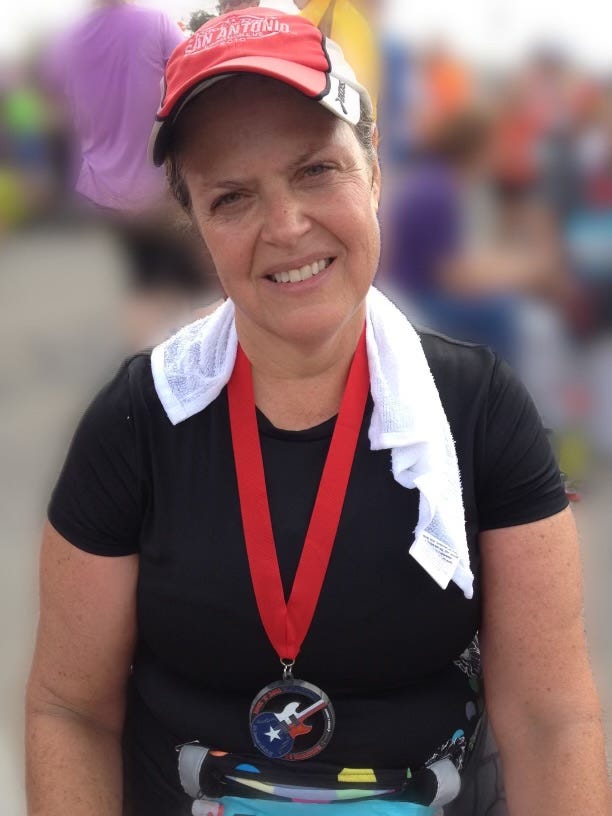
While I knew uterine cancer was a possibility, I was shocked and so was my husband. I was 55 years old and in good physical shape. In fact, the previous year I had done three sprint triathlons and two half-marathons. I did vigorous exercise regularly, including cycling, swimming, fast walking, and jogging.
I had been in deep grief which had the physiologic effects of being tired and stressed. Otherwise, I had felt well, although I did remember that the last week or so in cycling class I had felt more tired than usual.
As my gynecologic oncologist told me, I was not supposed to have this disease. But things needed to move ahead quickly. I was able to get an outpatient CT scan on a Saturday, the day after my diagnosis, to look for spread to other organs and that was negative. I saw the gyn-oncologist within four days of my diagnosis. He scheduled me for surgery that same week, seven days after my diagnosis.
I had a hysterectomy, removal of both ovaries and removal of 33 lymph nodes from the abdominal and pelvic areas to determine the stage of my disease.
It was six days until the pathology report came back. Those days of waiting were very hard. I was having pain from the surgery as well as anxiety from waiting for the pathology report. I was in a cold sweat when the doctor called me with the results. The cancer was at an early stage, IA, with less than 50 percent invasion through the uterine wall, and all 33 lymph nodes were negative. There were some cells in the abdominal fluid. My doctor told me it was not clear what that meant, but he was concerned.
He recommended follow-up hormone therapy with a progesterone (anti-estrogen) agent, megestrol, for two years. Unfortunately, this hormone therapy causes weight gain, but I was relieved that radiation, and/or chemotherapy were not needed. The surgery was likely curative and there was about an 85 percent chance of disease-free survival.
The diagnosis of “cancer” hit me in the face with my mortality. I was not elderly. I felt well. I exercised. I had no chronic diseases. I thought I was healthy. It was ironic that it was a year to the date from when I had done my first sprint triathlon to my surgery for cancer.
It was especially hard to deal with this diagnosis in the face of my son’s recent death. All the physical pain I had after surgery increased the psychic pain I had since my son’s death. But if there was a gift in this diagnosis, it was that it made me realize how much I wanted to live. I wanted to be with my husband and my living son, and I realized I had more work that I wanted to do. My work became very meaningful to me.
As I reflected on my cancer diagnosis and surgery, I realized how lucky I was. Because I was a physician, I knew that bleeding after menopause should be evaluated right away. The increased pressure in the abdomen that I had from the sobbing and coughing during my grief could have prompted earlier bleeding, leading to earlier detection. In this way, I thought of the early detection as a gift from my son, Will. A way that the terrible grief had led to something positive.
While the Pap smear is an excellent test for cervical cancer screening, it often does not detect uterine cancer. Generally, there is no screening test for uterine cancer, which makes going to the doctor with early symptoms more important.
There are plenty of stories of women that waited too long to go to their physician, and studies have shown that delays in evaluating bleeding are associated with later stages of gynecologic cancers. A major reason for the delay is the lack of awareness about the significance of abnormal vaginal bleeding. Other reasons for the delay include childcare responsibilities, transportation difficulties, and inability to take leave from work.
There are disparities in survival of uterine cancer. Survival (disease-free survival at five years) is related to the stage at diagnosis. The overall rate of survival is 81 percent, suggesting that most cases are detected at an early stage. Survival by race, however, shows an 84 percent survival for white women and a 60 percent survival for African American women, suggesting that African American women present at a later stage, for some of the reasons outlined above.
When women do present with bleeding, they may be told that it is “nothing to worry about” instead of having the appropriate workup. Such stories are found on Fran Dreschler’s web page, including Fran’s own story. The Uterine Cancer Awareness Network is an excellent resource for patient stories and information about this disease.
I was lucky that my gynecologist persisted with a full workup in a timely way, including my referral to a gyn-oncologist. I was also lucky that I had access to such a specialist because I was in a major metropolitan area with excellent health systems.
Finally, I was lucky I had healthcare access. Period. From the time of my first symptom to my surgical cure was only 19 days. If I include the six days I had to wait for my pathology results, it would have been 25 days. How many women would not even be able to get in to see their physician in 25 days, much less have curative surgery?
I’m glad I only had 19 days of cancer. I was fortunate to have a quick recovery. As of this month, I am 11 years cancer-free. I want other women to be aware that symptoms of abnormal vaginal bleeding are significant and need to be evaluated. And women should know they may need to advocate for themselves to get a complete workup.
Your support makes my writing on Medium possible. You can subscribe to emails when I publish a story or join Medium to directly support me and gain full access to all Medium stories. Best, Dr. Jan