
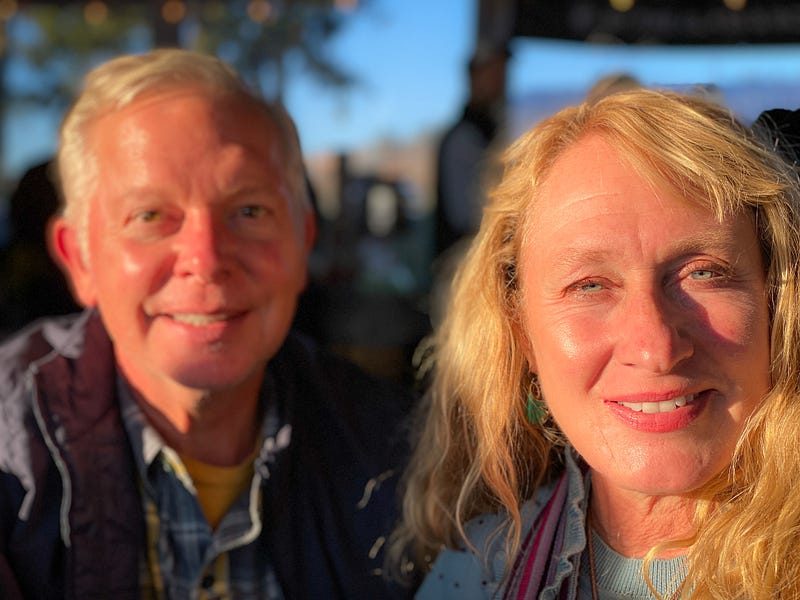
My Husband and I Tested Positive for COVID-19 Antibodies
What happens now? How will society deal with those who have already had the coronavirus?
“I am the canary in the coal mine…Nobody wants to be around me anymore, and I make people feel uncomfortable.” — Tom Hanks, Saturday Night Live
I feel like when I go back out into the world again next week, I will need a little sign to wear that says, “I’m not contagious anymore!” But I am not certain that it will appease people’s fear of being around me. I can see a little nervousness in my neighbors’ eyes and they always take a few steps back when they learn that we are recovering from the coronavirus.
My husband and I caught COVID-19 on our way home from the Dominican Republic on March 8th. We were amongst the early wave of people to fall prey to this crazy illness. We got sick right about the same time as Tom Hanks and Rita Wilson, although we didn’t know we had it yet when they made their announcement.
When we first started to feel unwell, we wondered, “Could we have the coronavirus?” But it just didn't even seem real yet. And it didn’t seem like it could possibly be happening to us!
At the fifteen-minute mark, the doctor came back from behind the reception desk, took one look at our tests and said, “Oh wow! You both have antibodies.”
But it was happening to us. We went from having fevers, aches, coughs, and throwing up to the full-fledged COVID assault. I spent days on end with a fever that kept wanting to return to 104.7° F. We lost our senses of taste and smell. And our chests felt like an alien force had taken them over and was squeezing all of the air out. For sixteen days, we battled this virus together. It felt like we were traveling in a foreign land without a guidebook, because so little was known about the virus and the symptoms at that time. You can read about it here:
But that was early March. Tests for the dreaded “Rona” were few and far between. Our doctors knew we had it. We knew we had it. The triage nurse we were referred to telephonically knew that we had it. But everyone said to just stay home and save the tests for people who might need to be put on ventilators. We also didn’t want to expose medical personnel, who are so vital to the fight against COVID-19 and who were (and still are) facing a dearth of protective equipment.
So, we bided our time, still isolating but getting stronger, coughing less and tasting and smelling a little more each day. And we hoped that the promised blood serum antibody test would soon become available.
The antibody test arrives, just in time for Easter
We were so excited to learn that actor Sean Penn had sponsored a testing site for both active COVID-19 cases and for the antibody test (which tells if you have had previous exposure to the virus) in the parking lot of the Westminster Mall.
Driving to the Westminster Mall to try to get tested was our first excursion out of the house in about a month. The Orange County, California, freeways were almost empty of cars. We knew in our heads that restaurants had closed and that the mall would not be open, but it was eery to see it with our own eyes.
We drove around the empty parking lot until we saw the white tents, which had been erected at the testing site. We kept driving towards what we thought was the back of the line, but it just kept going and going. We finally found the end but, alas, were turned away because the line-up of cars ahead of us was already five hours long. Even though we didn’t get tested that day, I am so grateful to Sean Penn for doing this public service for so many people.
My husband had been determined that our daughter and grandson were going to come over for Easter that weekend. I did not want to take the chance of exposing them yet, even though we had been symptom-free for almost two weeks at that point. When we couldn’t get the test, I insisted that we needed to come back early the next morning and queue up in line. He was dragging his feet. But he knew I was right.
In a weird twist of fate, that same afternoon, right after we got back home, a friend of ours told us that they knew a doctor up in LA who had some of the new blood serum antibody testing kits being used as part of the World Health Organization’s program called Solidarity II. This program was established to determine how many people have actually had the virus.
Since the COVID-19 test has been so hard to get (and because a lot of people get very mild cases and don’t realize that they’ve had it), the expectation of the WHO is that many more people have had the virus than have been tested for it. The data collected around the world from these tests will be pooled so that scientists can get a better idea of how widespread the virus truly is.
We called the doctor and she told us to come in the next day. We have a good friend (my husband’s law school roommate) who has some major health issues who was convinced that he had had the virus in February. We called him and told him about the tests. He was able to get an appointment right after ours.
The drive up to Los Angeles to get the test
We were weirdly nervous driving up LA to get the test. What if we hadn’t really had COVID-19? So many people we had spoken to in recent weeks were convinced that they, too, had the virus in February or even in January. But nobody else’s symptoms seemed to fall into the same pattern as ours did. And we knew that there had been a particularly bad flu going around this winter.
We pulled into the parking lot of the doctor’s office, and she met us (gloved and masked) in the foyer and ushered us in (after we had also donned masks). She asked us about our symptoms while she prepared the tests. She pricked my husband’s finger first and placed a few drops of blood on the kit (which looks a bit like a home pregnancy test) and set a timer for fifteen minutes before pricking my finger and getting my test started. Apparently, the test has to be read at exactly the fifteen-minute mark.
She continued to ask us questions and to fill out questionnaires from behind the reception desk while our tests were brewing. I had my eye on the test kits but wasn't sure how to read them. I could tell, though, that something was happening because purple lines were showing up.
At the fifteen-minute mark, the doctor came back from behind the reception desk, took one look at our tests and said, “Oh wow! You both have antibodies.”
Two types of COVID-19 antibodies
In response to the COVID-19 viral assault on our bodies, our bodies make two types of antibodies: short-term (or IgM) antibodies, which are created early in an immune response and whose levels usually quickly wane, and long term (or IgG) antibodies, whose levels rise more slowly after infection but usually persist longer. The COVID-19 blood serum test looks for both types.
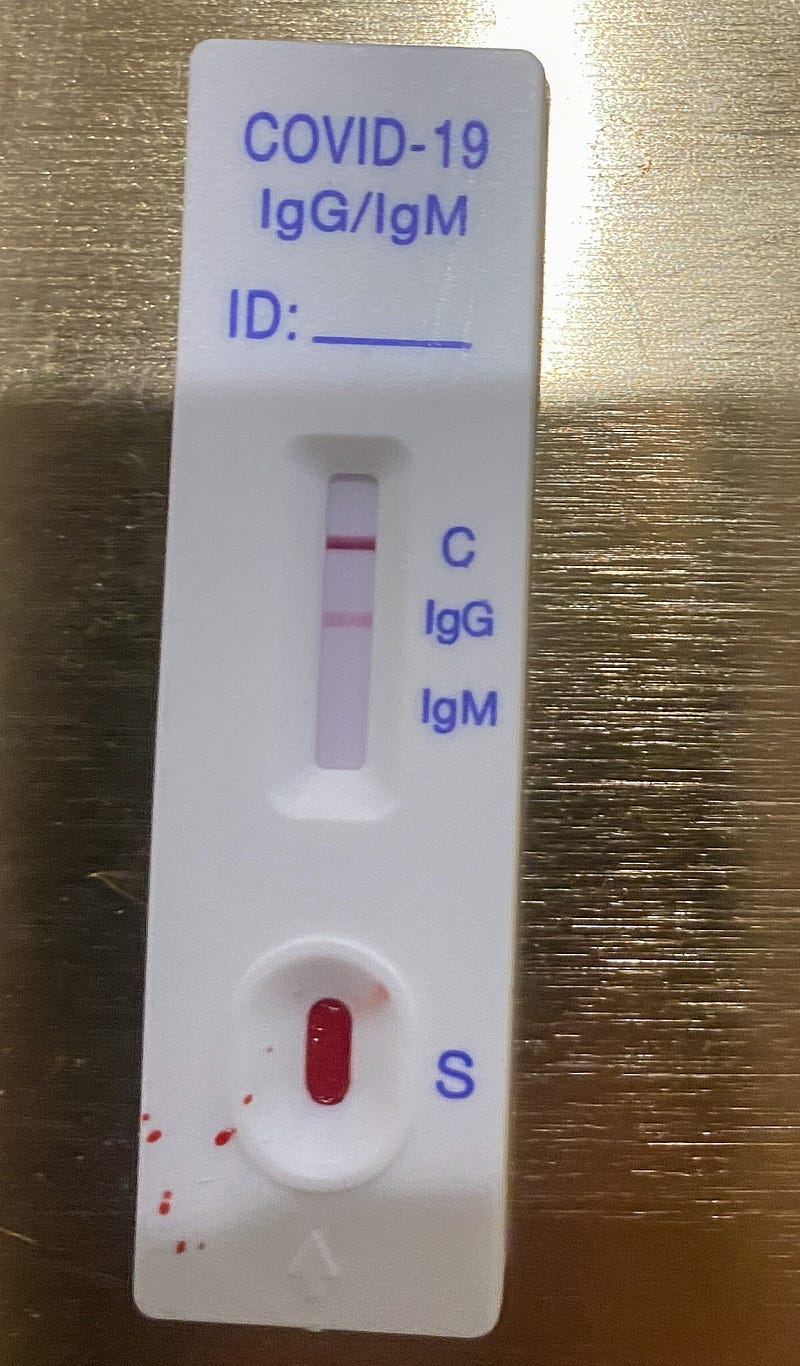
I, at what was now probably four weeks since when we first fell ill, only had the long-term antibodies. But my husband still had both short and long-term antibodies.
This actually made sense since I have a very over-active immune system. My immune response (which has led to me having both psoriatic arthritis and Guillain–Barré syndrome) was actually a little frightening when I was sick because it often is the body’s amplified response to the virus that can lead to pneumonia and the need to be put on a ventilator. I feel very fortunate to have escaped that fate. I was still taking Otezla, an immune-suppressing medication the first few days that I was sick, but was told to stop taking it, which I did.
While there are no solid answers yet on how long you are infectious after having COVID-19, the doctor told us that the presence of the short-term antibodies in my husband’s blood might mean he was still infectious. There is just no solid data on this yet though. She recommended that we continue to isolate for two more weeks, just to be safe.
So, Easter was cancelled. And here we still are, working at home, enjoying time with our kitties, spending time in the garden as the season shifts full-tilt into spring, and wondering what it will be like to re-emerge into society after our isolation period is over.
Why the antibody test is so important — so many false negatives with the nasal swab test
Unfortunately, our friend, who was absolutely certain that he had had COVID-19 a couple of weeks before we came down with it, tested negative for antibodies, which means that it is very unlikely that he had it. Our hearts sank when we heard the news, because (since he has some underlying health issues) we really wanted him to be on the “other side” of this virus.
But it was, nonetheless, really important information for him to know that he is still vulnerable and should still be isolating, especially because of his health issues.
Since our antibody test was done, several of our friends have told us that they were also certain that they had COVID-19 in January and February. I spoke to our doctor (who performed our antibody test) today, and she told me that she has seen a lot of people come in, absolutely certain that they would test positive because they were sick in January or February, but that they were all testing negative. It seems likely that the flu that went around during that time period has convinced a lot of people that they are now immune.
However, a couple of new studies are showing that the virus has already made its rounds through the populations of the Bay Area and Los Angeles to a much larger extent than anyone realized. Perhaps as much as 4.1%–4.5% of the population is testing positive for antibodies. This means that many people have had coronavirus without symptoms — or without feeling bad enough to seek a test. But it also means that more people have been silent carriers of the virus.
The antibody tests are a bit of a mixed bag, as far as accuracy goes. However, some of them have been approved by “Emergency Use Authorization” by the FDA. These kits are likely to get full FDA approval in the very near future. Ours was one of those kits. The accuracy of these kits seems to be a lot higher than the accuracy of the COVID-19 nasal swab tests, which have been under scrutiny for producing a lot of “false negatives.”
I actually received a message on Instagram today from someone who had read my first story, “My Husband and I Survived COVID-19.” He asked if we could speak on the phone, which we did. He had been sick for over two weeks and just wanted to ask me about our illness. His symptoms, including a loss of smell and taste and extreme chest tightness, sounded very much like ours, but he had received a negative COVID-19 nasal swab test. While I am not a doctor and could not advise him one way or the other, I agreed with him that it sounded like a likely “false negative” test. I suggested that he try to find somebody who could perform an antibody test.
Dr. Yukari Manabe, associate director of Global Health Research and Innovation at Johns Hopkins Medicine, estimates that 10 percent to 25 percent of nasal swab test results are false negatives. Possible reasons for the “false negatives” include: not testing people early enough in the illness (the viral load is highest in the nasal passages in the early days of symptoms); not testing the samples quickly enough (Abbott, one of the test makers, said that it recommends that samples be kept for no more than eight hours at about 60 to 85 degrees Fahrenheit, or refrigerated for 72 hours); and not getting the swab deep enough into the nasal cavity.
I think that the recent availability of the antibody tests will likely change the course of this pandemic. A little more knowledge about who has already has had COVID-19 will shift the course of the future.
Do I still need to wear a mask at the grocery store?
The next question, then, is — what happens to those of us who have already had COVID-19? Do we need to wear masks at the grocery store even though we can’t get anyone sick anymore? Will we terrorize people if we don’t at least play the roles we are socially expected to play right now? Can I get my teeth cleaned? Or my hair cut? Can my housekeeper come clean my house? Is there any way that we could still go on the vacation that we have already planned (and paid for) this summer? Can I teach yoga in-person again?
As Tom Hanks said in his Saturday Night Live monologue, people seem to be a little afraid to be near us right now. And we will be respectful of that. But once our isolation period is done, we will likely be some of the safest people to be around because we can’t be “silent carriers” anymore, at least that is what science seems to be saying. But a lot of questions remain, among them — how long will our immunity last? We don’t know the answers. But I am really looking forward to finally getting out of the house to pick up some some take-out Roma D’Italia!
Thank you for reading. I hope that our story provides a little bit of hope during this topsy-turvy time.
You might also enjoy these stories about our recovery:
Or:
Or a little meditation to help provide a bit of calm during the storm:
Erika Burkhalter is a yogi, neurophilosopher, cat-mom, photographer, and lover of travel and nature, spreading her love and amazement for Mother Earth’s glories, one photo, poem or story at a time. (MS Neuropsychology, MA Yoga Studies). Erika is also an editor for Mindfully Speaking.
Story and photos ©Erika Burkhalter. All rights reserved.


