
My Foe and Friend Had Crossed the River
A soldier’s tale
I have seen Him in the watch-fires of a hundred circling camps; They have builded Him an altar in the evening dews and damps; I can read His righteous sentence by the dim and flaring lamps, His day is marching on. — Battle Hymn of the Republic
There were two soldiers, just boys nineteen and seventeen. One carried a rifle for the 1st Missouri Brigade of the Confederacy, the other for the Union Army’s 47th Indiana Regiment. Those two privates came face-to-face in combat on three separate occasions: White Branch of Ingram Creek, Champion Hill, and the Siege of Vicksburg. Both survived those battles and the war; otherwise, you wouldn’t be reading this. They were my great grandfathers.
My brother Gary, while doing research for a biography he was writing about Daniel McKnight — the southerner and my paternal great grandfather — came across an old newspaper account of William Aspinwall, my maternal great grandfather. Interviewed by a reporter years after the war, Bill Aspinwall gave a poignant recount of his experience at Champion Hill, Mississippi where the combined casualty count was 7,141 killed and wounded.
I can only speculate on what motivated the boys to join their respective war efforts. Perhaps they embraced a cause each from their own perspective. But neither owned slaves nor came from families that did. They were just two dirt poor farm boys caught up in the incitement and chaos of conflicting politics, the bloody destiny of a nation. Regardless of the side on which they fought, I consider both to be Americans. They’re a part of the legacy and history of our nation, both the good and the bad, the ugly and sublime.
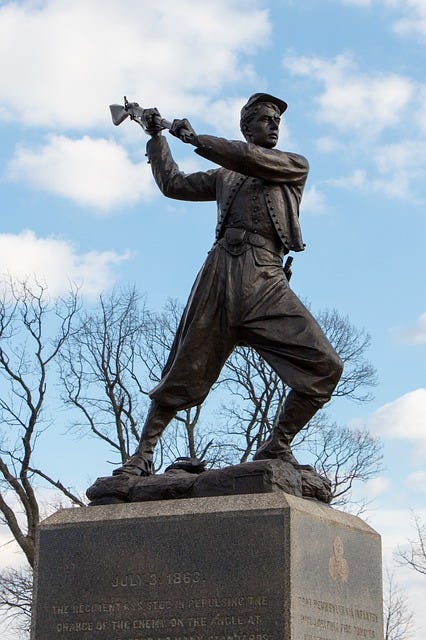
This poignant story expresses the tragic humanness, horror, and heartbreak of both sides. Those statues of Civil War soldiers being ripped down across America by a malignantly ignorant mob, represent the great grandfathers of all of us, black or white. History is history; how we feel about it can’t change it. Ignoring lessons from it, dooms us to repeat it.
I don’t have the exact date or newspaper in which this first appeared. All I know is that it was published in Indiana in the early 20th Century.
My Foe and Friend Had Crossed the River as told by William Aspinwall, Co. H, 47th Indiana
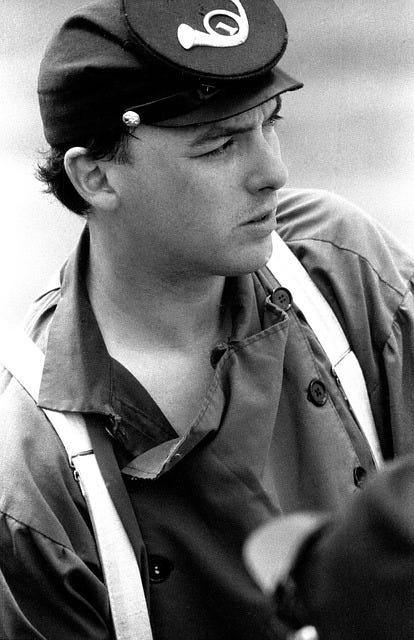
The last words I remember hearing before being shot were uttered by some of our officers who were begging our men to fall back as the rebels were flanking us. As I had my gun up to my shoulder three buck shots, coming from the right flank, struck me in the right shoulder. My arm fell helpless by my side, and not more than a second afterward a Minie ball plowed across the top of my head cutting the scalp and chipping the skull, and cutting the hair across the head as neatly as it could have been done with a sharp pair of shears. I fell to the ground and our orderly sergeant, J.W. Whitmore, said I bounced around like a chicken with its head cut off. John E. Sturgis, one of our sergeants…says he saw five of us boys of our company all wallowing around together in our own blood like stuck hogs.
When I came to my senses, I was inside the rebel line, the bullets falling around me like hail. It was some little time before I could make out my surroundings. A Confederate officer came and sat down on a little bank of earth beside me. He looked at the wound in my head and said,
“My boy, I am afraid you are done for.”
He gave me a drink of water out of his canteen, raising my head very gently with one hand, so I could drink. He asked me what state I was from. I replied, “Indiana.” I will never forget his kindness.
After he left me, I got up and started towards our lines, passing the retreating Johnnies, and almost rubbing clothes with them…prison being constantly in my mind, I preferred death to going there. I succeeded in getting into our lines and finding my captain, who got me in an ambulance, and I was taken to the hospital which was in a corn field. The wounded were made as comfortable as possible under shades made by driving forked poles out from the woods in the ground across which poles were laid and these covered with brush. By this means the boys were protected from the hot sun.
There were rows of the wounded with aisles between, and the surgeons worked on their rude dissecting tables in these aisles. What horrible sights and what pitiful cries and groans. I never want to experience it again…I merely walked through the hospital and after that I was content to stay on the outside, for I could not endure to witness the misery of my comrades. Many a noble boy of my regiment would never see mother or home again; their bones were to be left on the battleground of Champion Hill.
In the evening some of my comrades brought me blankets, doing without themselves, and made me a bed in a fence corner outside of the hospital. In a little while a Confederate soldier came along. He had been shot somewhere in the bowels and was in great pain. I said,
“Here, partner, I will share my bed with you.” And he laid down beside me.
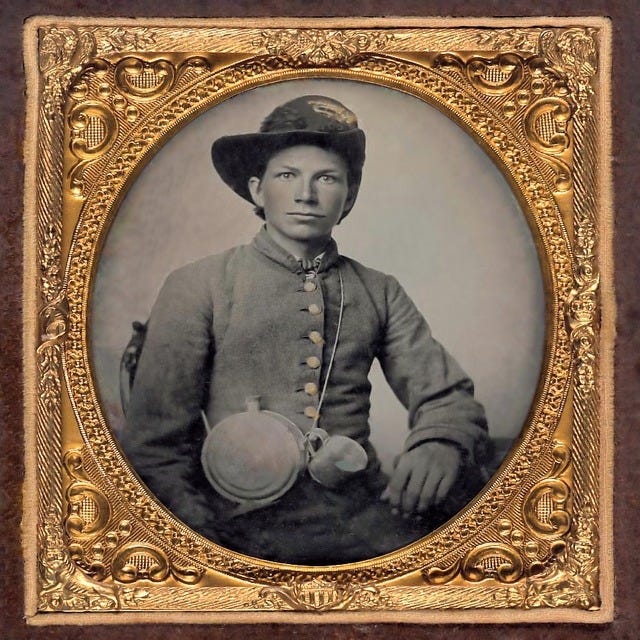
He told me that he was from Savannah, Georgia, and that he could not get well. He wanted me to write to his wife and children and gave me a card with their address. I was to tell them that I had seen him and what had become of their beloved husband and father. Being weak and exhausted from the loss of blood, I dozed off to sleep and left him talking to me. In a little while I awoke and spoke to him two or three times, but he did not answer.
I put my hand over on his face; he was cold in death. My foe and friend had crossed the river.
I laid there with him until daylight, then found a sergeant who dressed my wounds and a comrade who wrote two letters for me, one to my mother in Bluffton, Indiana, and one to this poor Confederate’s family.
I took the letter over to the Confederate hospital which was a short distance from ours in an adjoining cornfield. They had no brush sheds. The poor fellows were laying around between the corn rows and there was a large number of them. I found a Confederate officer and gave him the letter. He said I could rest assured that he would see to it that the dead soldier’s family got the letter and he complimented me on my kindness.
A number of ladies had assembled from the surrounding towns and country waiting on the Confederate wounded and they looked daggers at me, not a one of them spoke to me. They did not like the color of my blood-splattered uniform.
Here’s another piece I did for veterans:
I’d like to give you something
Click the image below to visit my website. When you join my readers’ group, I’ll send you a free ebook of my short stories collection, Skins Game.


