
My Favourite Fiction Reads of 2023
The top seven novels I read this year
I read more than 100 books each year. I read a mixture of psychology, neurodiversity, political sciences, parenting, and fiction. Even across the Fiction genre, I’ve branched out.
I used to avoid fantasy and sci-fi novels, I didn’t really enjoy them. I think I struggled with using my imagination, truthfully. In the past few years I’ve learned a lot about myself, and I’ve dramatically changed my routines and habits, including my reading habits.
I’ve made a concerted effort to be more open-minded and to genuinely try a book before deciding whether or not I like it.
This has allowed me to enjoy a lot of new-to-me books which I had previously assumed I wouldn’t like. Fantasy and sci-fi are some of my spouse’s favourites, so lucky for me, we have shelves upon shelves of books I haven’t read yet!
Below are my seven favourite fiction novels from 2023.
7) Babel, by R.F. Kuang
I am a language nerd. I love learning new languages, as well as studying the etymology of words. This book is historical fantasy. Babel blends some historical events with poignant personal stories, magic, and illustrates how language can be used both for good and for evil.
6) Anansi Boys, by Neil Gaiman
I chose to read Anansi Boys because I enjoyed American Gods so much. Similar to American Gods, this book is ridiculous, hilarious, and full of adventure. It’s a very entertaining read, put together with the masterful skill one would expect from Neil Gaiman.
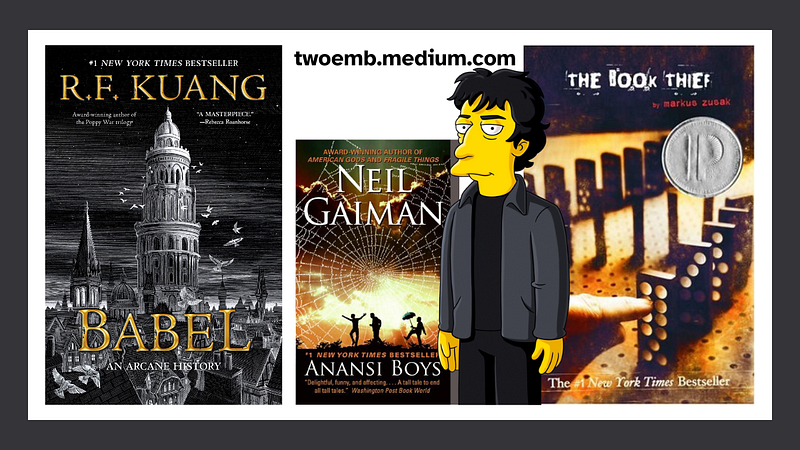
5) The Book Thief, by Markus Zusak
This book got me right in the feels. I made it all the way to the last chapter without crying, and then bam. Big, ugly cry. Be warned.
This book is set during the second world war, so it’s not surprising that it’s deeply sad. It is narrated from a third-person perspective, by none other than the “grim reaper” himself. He is snarky at the right times, and compassionate when humour would be inappropriate.
This book follows a young girl — The Book Thief — from the beginning of WWII through to her adulthood.
4) Demon Copperhead, by Barbara Kingsolver
I read The Poisonwood Bible by Barbara Kingsolver many years ago (by which I mean nearly 20 years ago) and absolutely loved it, so I was excited when I saw she had published a new novel.
Demon Copperhead is a modern-day David Copperfield. It’s a fictional story which speaks significant truths. The original David Copperfield was a commentary on child poverty, and Demon Copperhead shows we haven’t come very far from the 1850s.
3) A Thousand Ships, by Natalie Haynes
I chose A Thousand Ships after reading — and absolutely loving — both Circe and The Songs of Achilles by Madeline Miller. Miller’s work got me interested in learning more about Greek Mythology, and Haynes’ work did not disappoint.
A Thousand Ships tells the tale of the Trojan war from the perspective of the many important women who were involved.
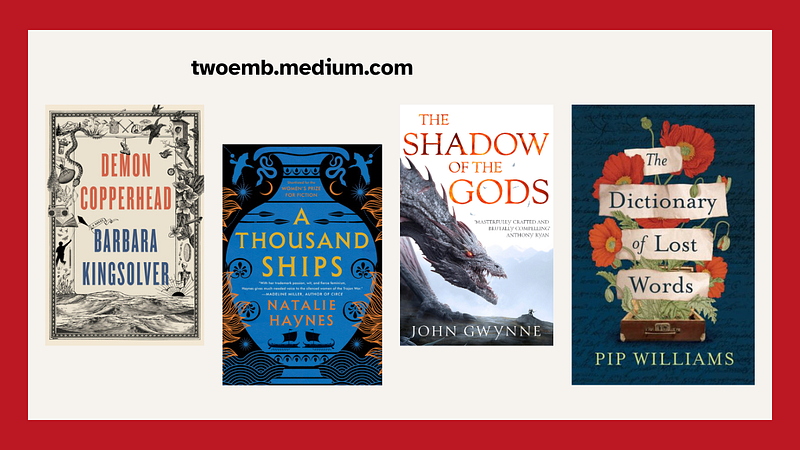
2) The Shadow of the Gods, by John Gwynne
This book was, to use a popular cliché, honestly riveting. It is inspired by Norse mythology, which Gwynne blends with elements of true Nordic Viking stories.
The Shadow of the Gods combines mythology, fantasy, adventure, and throws them all together in bloody battles. I loved it so much, I very quickly ordered the next book in the Bloodsworn series, The Hunger of the Gods, which was even better.
I eagerly await the release of #3 in this very exciting trilogy.
1) The Dictionary of Lost Words, by Pip Williams
Going back to a different century, The Dictionary of Lost Words is set in the 1900s — including before, during, and after the first world war.
I wanted to write an entire article on this book alone, it was so meaningful, but I couldn’t find the time. Or the words. Which would make sense in the context of this book.
Esme’s father works with other men writing the first Oxford dictionary. As Esme grows up, she starts to see how certain words are omitted, viewed as unimportant to the history and understanding of the English language.
What Esme discovers is that many of these words describe the experiences of women in the early twentieth century. Losing these words could mean losing the ability to understand and describe the experience of women during this era.
Williams draws incredible parallels with the women’s suffrage movement, the plight of bondmaids forced into servitude, and the power of language to influence and define perspective.
Related articles
Ways to support my work
You can leave a “tip” on Ko-Fi at https://Ko-Fi.com/NeurodiversityMB
Become a paid subscriber to my Substack publication
Check out my online store at https://NeurodiversityMB.ca/shop
Read and share my articles from twoemb.medium.com

Follow me on Goodreads at Goodreads.com/jillianlindsay