My Favourite Anthony Hopkins Performance: The Remains of the Day
Brilliant though he is in The Father, Mr. Stevens in Merchant-Ivory’s masterpiece remains my favourite Hopkins screen role.
Warning: Contains spoilers
Anthony Hopkins recently won his second Oscar for his stunning turn in The Father (2020). Much well-deserved praise ensued. Hopkins has always been a first-rate actor, from early supporting performances in the likes of The Lion in Winter (1968), through to excellent leads in the likes of The Bounty (1984), Shadowlands (1993), and of course, his most famous role, for which he also won an Oscar: The Silence of the Lambs (1991).
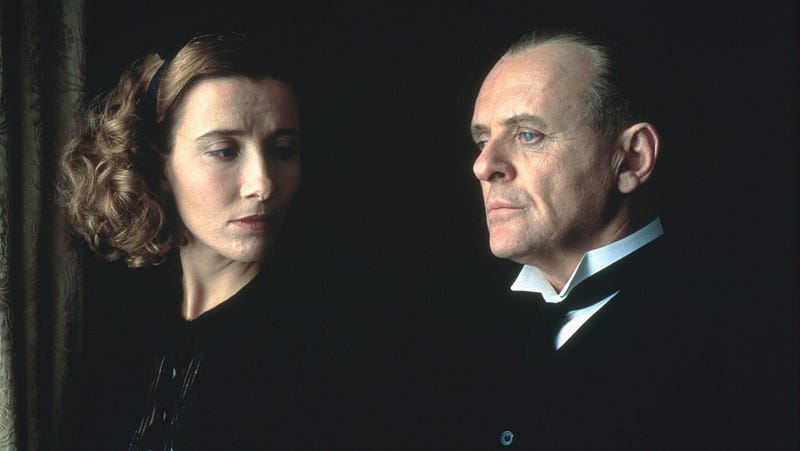
However, for me, Hopkins’s best-ever performance is in the greatest Merchant-Ivory film, The Remains of the Day (1993). As James Stevens, butler to Lord Darlington (Edward Fox) circa 1930s Britain, he is the living, breathing embodiment of the protagonist in Kazuo Ishiguro’s Booker prize-winning novel. I can’t imagine any other actor playing him with such elegant subtlety, nuance, and understated anguish, in which every stiff-upper-lip imbued look and gesture speaks volumes. Superlatives are meaningless when describing the way his quietly tragic character gets under the skin.
Indeed, the entire film gets under the skin in a remarkable, slow-burn manner. I first saw The Remains of the Day during the original run as a student in early 1994. I recall leaving the cinema utterly overwhelmed with what I had just experienced, yet the full impact hadn’t yet hit me. I spent the months afterward thinking over and over the events in the narrative, haunted by Hopkins’s remarkable performance. Ultimately, the lessons inherent in The Remains of the Day, both in the film and the equally brilliant novel (which I read after seeing the film), resonated so deeply that I believe they might have influenced the direction of my life. That they did is thanks in no small part to Hopkins.
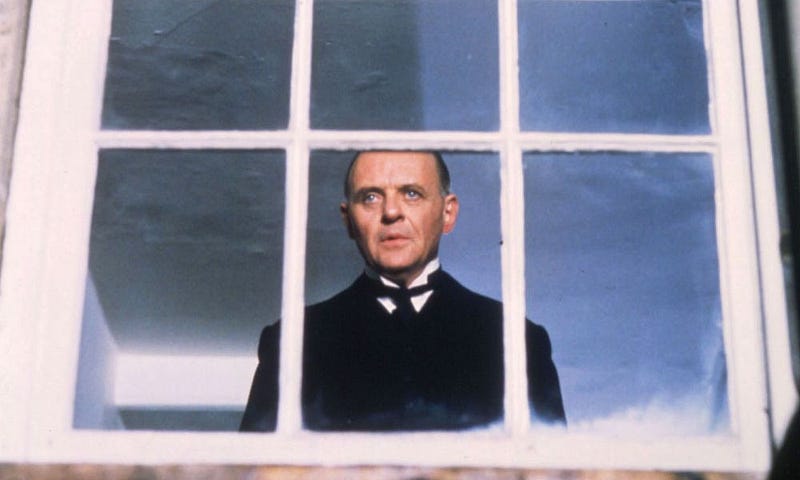
Mr. Stevens (as he is referred to throughout) is an immensely complex character; absurdly, almost comically repressed with a single-minded dedication to excellence in his service, and complete devotion to his master, believing him to be a person of superior moral standing. Unfortunately, Lord Darlington is hardly that. Rather, he is a well-meaning but deluded Nazi sympathiser, favouring appeasement with Germany to prevent the horrors of another world war.
Darlington’s ill-advised Teutonic flirtations and associations with fascist groups like the Blackshirts colour his judgment to such a degree that distressing anti-Semitism creeps into his thinking, though he later regrets some of his actions. The unfair dismissal of two Jewish refugee sisters on his staff, who are promptly sent back to Germany, is a case in point. That’s what you get for taking Mein Kampf seriously. Still, Mr. Stevens is either blind to this, or in denial, as he can’t bear to face the appalling possibility that maybe, just maybe, his master isn’t worth the devoted service in which he takes immense professional pride. Said pride consumes Mr. Stevens due to the shadow of his father’s instruction. His father’s influence is a hugely important aspect of the narrative — even more so in the novel — and as Mr. Stevens tells the housekeeper Miss Kenton (Emma Thompson), he can’t let him down, even in the face of bereavement. Duty must come first.
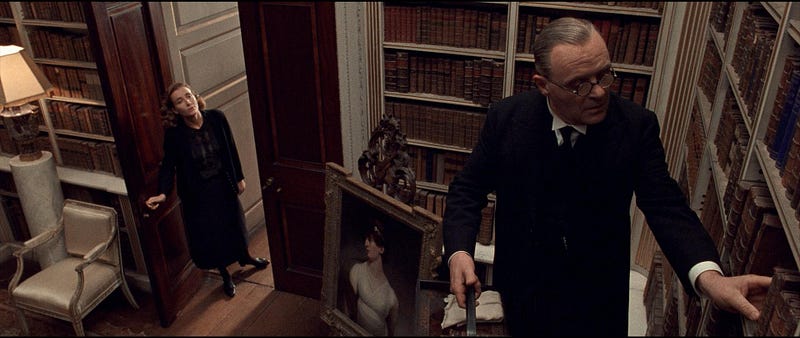
Speaking of Miss Kenton, the film opens in the 1950s, with Mr. Stevens taking a journey to the West Country to visit her. Flashbacks reveal how, over several years, they formed a close friendship that would have naturally blossomed into romance. Unfortunately, loyalty to his master caused Mr. Stevens to reject Miss Kenton’s delicate advances. History took its inevitable course, and Darlington’s involvement in peace-in-our-time appeasement contributed to the outbreak of World War II. Now Mr. Stevens realises his mistake and wants to make amends, but is it too late?
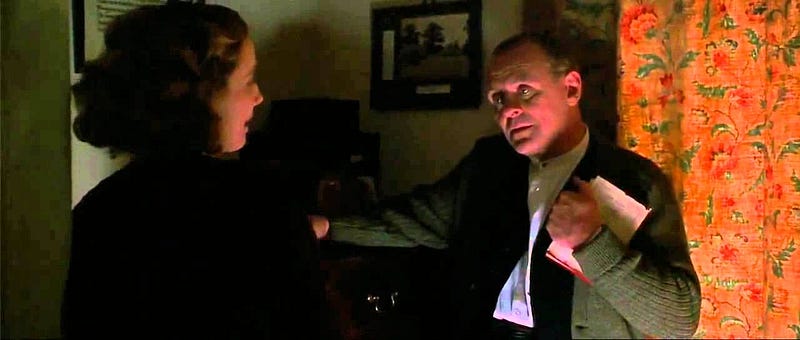
I should add a special mention for Emma Thompson here, who also, for my money, delivered a career-best performance in this film. Her interactions with Mr. Stevens are often hilariously funny, simply by the way Miss Kenton emphasises particular words to highlight the illogical stubbornness lying beneath his fastidious actions. Yet comedy gradually becomes tragedy in the way Mr. Stevens continually pushes her away, despite the transparent fact that he desperately loves her. In one truly agonising scene, where Miss Kenton catches Mr. Stevens reading a “sentimental old love story,” which he furtively tries to hide, she gets a brief glimpse into his soul before he firmly closes the door once more.
This is a lovely, lovely film; historically fascinating, dramatically engaging, and a masterclass in understated emotion. Writer Ruth Prawer Jhabvala and director James Ivory adapt Kazuo Ishiguro’s poignant novel with such profound brilliance that it is difficult to express in words. The story gently takes the audience from laughter to tears, culminating in one of the most quietly devastating finales I have ever seen.
The cinematography, music, editing, and art direction are immaculate, with the understated beauty of the English countryside that was so important in the book translating magnificently to film. I can only rave and rave again about Hopkins, and the equally brilliant Thompson, for their sterling performances. The supporting cast is also superb, including a pre-Four Weddings and a Funeral Hugh Grant and Christopher Reeve in one of his last roles before the accident that paralysed him. Reeve plays rich American Mr. Lewis and gets an important moment where he scathingly denounces Darlington and his ilk as “amateurs” in the face of their appeasement actions.
As for Grant, he plays Darlington’s godson Reginald Cardinal, and his offbeat interactions with Mr. Stevens form an amusing subplot. At one point, Mr. Stevens is asked by Darlington to inform Grant of the facts of life in view of his upcoming marriage. The awkward way he attempts this task, muttering about birds, bees, ducks, and geese, is laugh-out-loud hilarious.
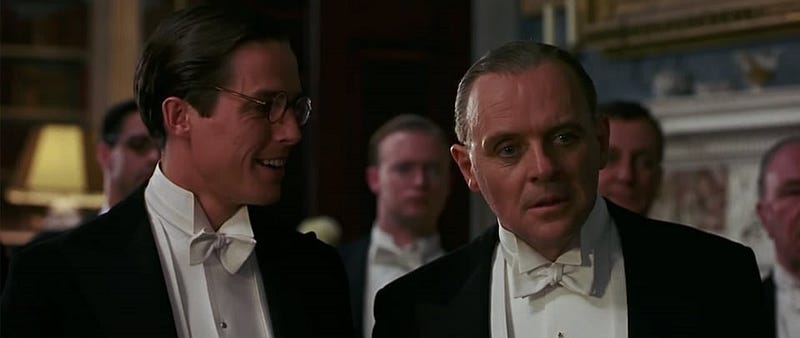
Less hilarious is a later scene where Reginald tries to confront Mr. Stevens about what Lord Darlington is really up to in his Nazi alliances. Less hilarious still is the way we learn of Reginald’s ultimate fate. The way Mr. Stevens casually drops the fact that he was killed in the war into small talk, in between ordering cake from a waitress in a café, speaks volumes of how desensitised people had become to death in the aftermath of World War II.
Effortlessly embracing themes of misguided loyalty, dignity, pride, wasted lives, and unrequited love, The Remains of the Day would be too much to bear if it weren’t for the film’s good-humoured understanding of the stiff-upper-lip British culture of the time. In fact, humour provides a vitally important counterpoint in the film. There are many amusing moments, which make the tragic part of the story all the more potent.
This isn’t an overblown Shakespearean tragedy or Greek tragedy (i.e., no one accidentally sleeps with their mother and gouges their eyes out), but the normal, mundane, everyday variety concerning the quiet private tragedy of wasted potential. The lesson in the story is subtle but vital: Do not let life pass you by. Be careful to whom you give your allegiance. Make the most of every opportunity because one day it will be too late.
All in all, The Remains of the Day is a remarkable film; an unforgettable parable of a man for whom idealism proves more devastating than cynicism. A man who loses himself by knowing his place. The fact that Anthony Hopkins failed to win at the Academy Awards that year remains one of Oscar’s greatest injustices.
Author’s note: I hope you enjoyed this article. For more about me and my writing, please click here.