Film Review — The Father
Anthony Hopkins’s celebrated performance towers over a film that fails to shake off its stage origins.
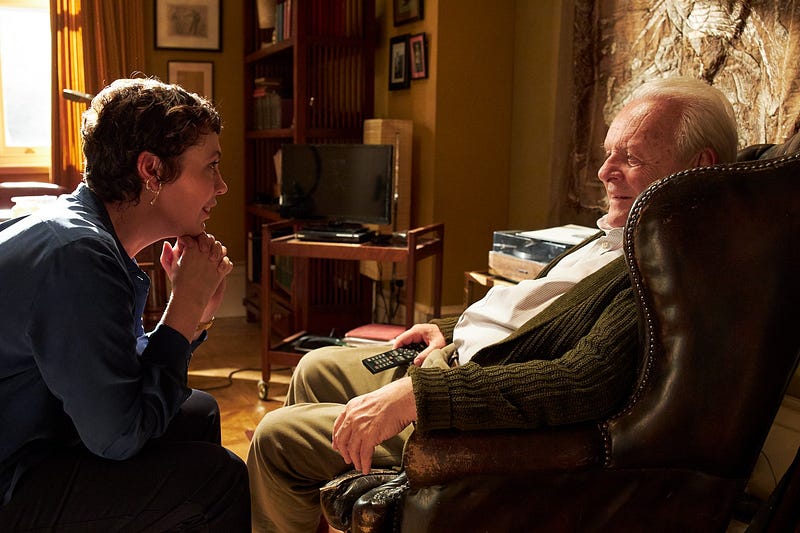
Describing Anthony Hopkins in The Father as brilliant is an exercise in redundancy. Words are pathetic. Inadequate. It is a performance to be savoured, cherished, and celebrated. Hopkins has been rightly rewarded with an Oscar.
What makes his turn as a man suffering from dementia even more remarkable is the way the story is told from his point of view. The audience experiences his confusion. His lapses in memory. His inability to correctly identify the people that keep appearing in his flat. The terrifying rug-pull of losing one’s ability to remember is laid bare, with merciless, claustrophobic precision. Given the limited locations, it would make a great stage play.
And therein lies a small problem. This is a stage play, written by Florian Zeller, adapted for the screen by Christopher Hampton and Zeller, and directed by Zeller. As a piece of cinema, The Father is rather flat and unremarkable. Yes, it has an incredible Hopkins performance. Yes, it features fine support from the likes of Olivia Colman, Mark Gatiss, Rufus Sewell, Olivia Williams, and Imogen Poots. I have no issue with the acting or the way the narrative unfolds. But I ended up wishing I’d seen it on stage, rather than on film.
All that said, the believability and sheer traumatic power of Hopkins’s performance steamrollers all other concerns. Doubtless, The Father will prove a major raw nerve for those who have lost relatives to dementia, or to those currently suffering in that respect. Or it could provide a measure of catharsis. But the film also raises awareness. Who knows? Perhaps it will end up doing some good. There has been a concerted campaign around the film in the UK, pressing for urgent reform to ensure dementia patients receive adequate care.
Yes, it is immensely upsetting, as it should be. Yes, although I’m glad I saw it, nothing would induce me to sit through it again. I felt much the same way about Michael Haneke’s equally brilliant dementia drama Amour, a few years ago. But the way the drama unfolds, with the jumbled timelines and confusion over characters, is undeniably compelling. For that reason, and obviously, for Hopkins, I would recommend being brave and giving this a watch.
This article was originally published at Simon Dillon Books. For more information about Simon Dillon on Medium, click here.


