My Favourite Animated Film: The Iron Giant
Brad Bird’s tale of a boy and his amnesiac giant space robot is a poignant, shamefully underrated gem.
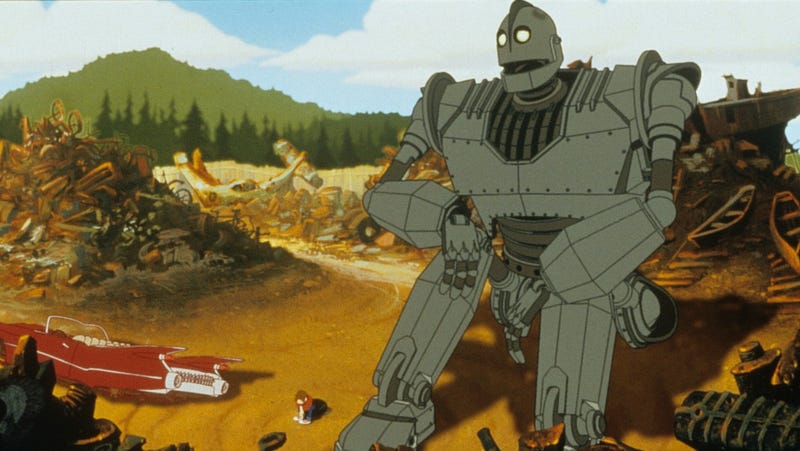
Brad Bird’s criminally underrated 1999 animated masterpiece The Iron Giant inexplicably bombed at the box office in 1999, despite excellent reviews. I saw it with my wife, during our honeymoon, at an otherwise deserted screening during the original release. I was blown away. Sixteen years later, I saw the rereleased extended “Signature Edition” with my wife and our two children, at a sadly similarly deserted cinema. This screening, along with multiple repeat viewings in the intervening years, confirmed it as my all-time favourite animated film (distinct from what I consider the “greatest” animated films; a very different discussion).
Very loosely based on Ted Hughes’s novel The Iron Man (which I also highly recommend), The Iron Giant is set in 1957 at the height of the Cold War, when paranoia about the Red Menace gripped America. After a gigantic robot crash lands in Maine, he is unable to recall who he is or why he is on Earth. The giant subsequently encounters lonely boy Hogarth, and a great friendship begins. Unfortunately, military-backed US government investigator Kent Mansley is also aware of the giant, and believing it could be Russian wants to shoot first and ask questions later.
Bird gets top marks since his direction here equals that of Spielberg. It’s no accident, or bad thing, that in places The Iron Giant reminds one of E.T. The Extra-Terrestrial. The superb 2D hand-drawn animation, presented in beautiful widescreen, really, really benefits from being seen at a cinema, if at all possible. Certain shots, such as the opening in space, or the giant’s menacing first appearance behind Hogarth in the top right-hand corner of the frame, or the wide-angle of the giant stomping away from the town having been warned that people aren’t ready to see him yet, simply do not have the same impact on television.
The vocal work is terrific, even from Jennifer Aniston, of whom I normally have an irrational dislike. She plays Hogarth’s widowed mother (it is hinted that Hogarth’s father died in the latter part of World War II). Vin Diesel is superb as the giant; his greatest role as far as I’m concerned. On top of that, the late Michael Kamen contributes a suitably stirring music score that enhances the laughter, thrills, and tears that ensue as the plot moves towards its inevitable, tragic climax.
In retrospect, perhaps certain factors might have caused the film to flop. Toy Story 2 and Tarzan, released at the same time, had much bigger marketing campaigns. The Iron Giant is a more subversive offering. It gently pokes fun at 1950s sci-fi B-movies (“Darn, a perfectly good brain wasted!”) and the Cold War propaganda of the time (the notorious “Duck and Cover” nuclear strike public information films). It also satirises McCarthyist Communist alarmism and condemns militaristic attitudes.
More importantly, the film contains an unfashionable, deeply committed pacifist message. When the giant is attacked by US troops, it reacts defensively, at one point turning itself into a killing machine straight out of The War of the Worlds. Consequently, despite being a tremendously heroic adventure, this is also a film that, for once, does not invite children to cheer at violence. Another unconventional element is that Hogarth is the teacher/mentor figure, not any adult or even the giant. He explains to the giant about morality, life, death, and the ability to choose good over evil.
NOTE: Spoilers follow.
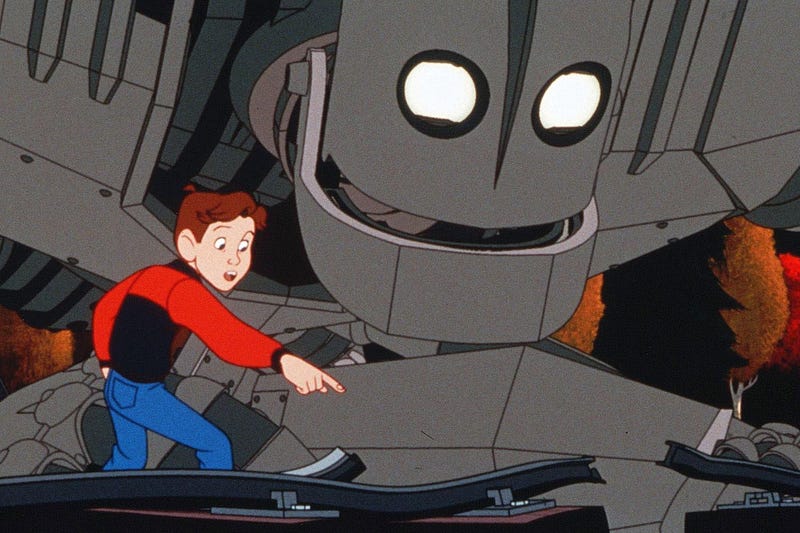
With regard to the latter point, the extended version (dubbed the Signature Edition) belongs on that very select list of longer cuts whereby the new scenes really do enhance the already brilliant original. The first of the two new scenes involves an additional exchange between Hogarth’s mother and Dean, the scrap dealer/modern artist with whom Hogarth conspires to keep the giant a secret, and with whom Hogarth’s mother eventually becomes romantically entangled. This scene merely paves the way a little more for the outcome of that particular subplot.
However, the second of the two new scenes is far more critical, in that it underscores the main theme of the story. The giant has a mysterious nightmare that hints at his hitherto unknown past. Ambiguity remains to a certain extent, but just enough information is revealed to give additional weight to his ultimate choices. The giant might have been designed as a planet conquering killing machine, he might have been sent for that purpose, but he is not obliged to fulfil that role. He can choose to be something else (for example, the giant poignantly decides he would rather emulate Superman).
Another excellent thing about The Iron Giant is the way it explores the potential both for great good and great evil within human nature. Despite initial terror at discovering a huge alien robot inside the forest, Hogarth conquers his fear and saves the giant from electrocution, thus initiating their friendship. By contrast, Kent Mansley’s continual tirades of cowardice and fear-mongering are corrosive, paranoid, and delusional to the point that he is prepared to recklessly order a nuclear strike on the giant, despite the fact that by that point the military has seen the giant is defensive only, reacting only when they fire on it.
This leads to the famous, tear-inducing “You stay, I go, no following” moment, whereby the giant takes on a Christ-like role and sacrifices himself to save everyone (even Mansley). For a family film, The Iron Giant could hardly grapple with weightier issues. It is brave, beautiful, and deeply moving. I know it’s a cliché to talk about great fun for all the family, but The Iron Giant really is one of the best films for people of all ages ever made.
This is a revised version of an article originally published at Simon Dillon Books. For more about me and my writing on Medium, please click here. For a list of my published novels and other works, please click here.


