
PHOTOGRAPHY, LIFE EXPERIENCE, CULTURE
My Ceaseless Companion Since Four Decades
The Deity of Knowledge, Learning and Wisdom
You must be wondering as why I am writing on a Hindu Goddess today! Well, here it is as to why.
The Backstory
I was barely 6 or 7-years old. The Fall set in. My school’s second-term assessment got over and the month-long autumn break was declared.
And as per the pre-booked itinerary, I was travelling with my family to Puri, a coastal town in the state of Odisha, India famous for the temple of Lord Jagannatha, sweets, stormy beaches, silver filigree ornamental work, etc.
It so happened that we were strolling in a popular market place buzzing in full throttle. And I was holding my father’s hand.
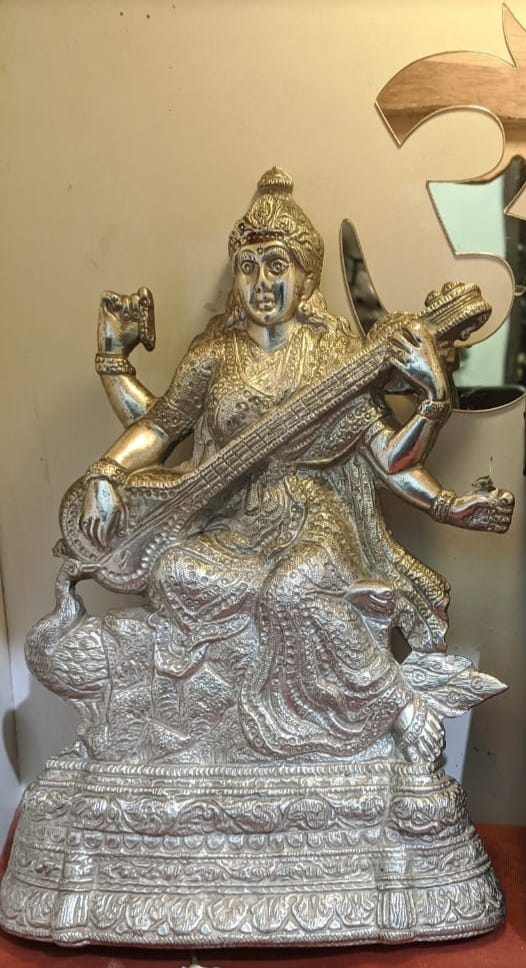
After a while, my father entered one silver jewellery showroom and suddenly surprised me gifting this Saraswati idol as a belated birthday present. I was elated with joy holding this 9-inch long idol weighing around 400 gm.
She was shining. Dipped in silver wash with minute intricate detailing, she seemed smiling. At me. I felt a ‘connect’. She still does! Since then, she has been my constant companion. Till now.
The Present
Not fully understanding the ritualistic tokenism taught since I was a little girl,
I pray to her when not in doubt. I pray to her when in doubt.
I pray to her in troubled times. I pray to her in happy times.
I pray to her when unsettled from within. I pray to her when settled from within.
I pray to her, every single day. In my own way.
Faith is the strength by which a shattered world shall emerge into the light- Helen Keller
The Goddess of Learning, Knowledge and Wisdom
While Athena is considered to be the Greek Goddess of knowledge, wisdom, crafts, civilization, and justice, Goddess Saraswati is regarded as the “the Hindu goddess of knowledge, music, art, speech, wisdom, and learning”.
She is known as Vidya ki Devi, the Goddess of Learning.
Goddess Saraswati is normally shown either with two or four hands. The idol I have has four hands holding four items with symbolic meanings respectively:
# Pustaka- Book- symbolizing Vedas representing all forms of eternal learning
# Mala- Rosary- representing the power of meditation, inner reflection
# Water pot- representing the purifying power to separate right from wrong
# Veena- Musical instrument- symbolizing all creative arts and sciences creating harmony
You can cite a mayura (peacock) beside the idol. It symbolizes “colorful splendor, the celebration of dance, and — as the devourer of snakes — the alchemical ability to transmute the serpent poison of self into the radiant plumage of enlightenment.”
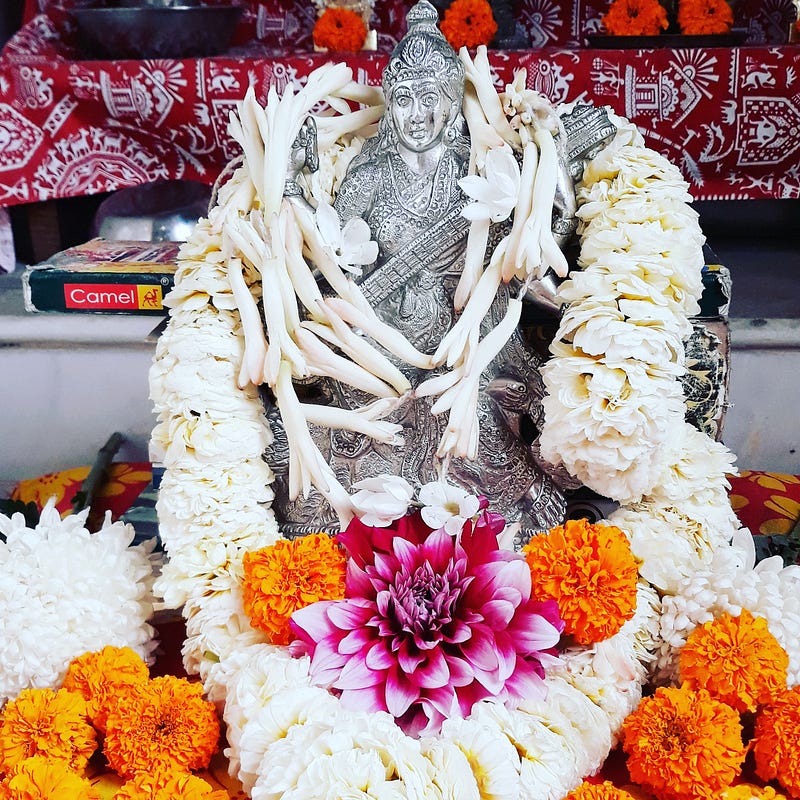
Satyam Jnanam, Anantam Brahma- Adi Shankaracharya
It means Satyam (Truth) Jnanam (Knowledge), Anantam (Limitless/Infinite) Brahma (Consciouness/Reality): Knowledge is Truth, and Reality is Infinite.
Nostalgia
Growing up in the eastern part of India, I fondly remember how we, the children of the locality, gleefully used to skip studies on Vasant Panchami Day.
The pandit (the learned man) assigned for the Puja would utter Saraswati stotra (hymn in praise of the goddess) and we would repeat after him with eyes closed and folded hands (like the way we exchange namaskar) standing in front of the idol seeking her blessings.
We used to get all occupied in uttering the mantra (sacred utterance) of Goddess Saraswati worshipping her in order to ‘please’ her so that we could come out in flying colors in examinations — be it studies, dance, music, recitation, or fine arts.
Faith consists in believing when it is beyond the power of reason to believe- Voltaire
And that would be followed by relishing prasadam (normally vegetarian food especially cooked for devotees after praise and thanksgiving to the deity).
Apart from Vasant Panchami (declaring onset of Spring season- in and around February), Goddess Saraswati is also worshipped in southern states of India during Ayudha Puja in Autumn, as a part of Ashwina Navaratri (in and around September/October).
Prayer of Goddess Saraswati (Saraswati Vandana)
Ya Kundendu Tusharahara Dhavala Ya Shubhra Vastravrita Ya Veena Varadanda Manditakara Ya Shveta Padmasana Ya Brahmachyuta Shankara Prabhritibhir Devaih Sada Pujita Sa Mam Pattu Saravatee Bhagavatee Nihshesha Jadyapaha
“Salutations to Devi Saraswati, Who is pure white like Jasmine, with the coolness of Moon, brightness of Snow and shine like the garland of Pearls; and Who is covered with pure white garments, Whose hands are adorned with Veena (a stringed musical instrument) and the boon-giving staff; and Who is seated on pure white Lotus, Who is always adored by Lord Brahma, Lord Acyuta (Lord Vishnu), Lord Shankara and other Devas, O Goddess Saraswati, please protect me and remove my ignorance completely.”
Some Interesting Facts about Goddess Saraswati Compiled from Various Sources
# Goddess Saraswati is considered to be the mother of all Vedas, the ultimate storehouse of all knowledge, wisdom and learning.
# About 4000 years ago in India, a river flew by the name of Saraswati. Now, it had dried up.
# In Budhhist iconography and Jainism too, Goddess Saraswati finds an important place.
# Goddess Saraswati has another form, Gayatri. Gayatri was so much attracted by the brilliance of Sun God, Surya that she dissolved herself to become the Gayatri Mantra dedicated to Surya.
# Goddess Saraswati is popularly known by another name, Vagdevi (Vag means oratory/spoken word and Devi means Goddess). Lord Brahma gave this name to her because she is considered to be the epitome of oratorical brilliance and sound.
Thank you so much JoAnn Ryan for considering and believing in my write-up to occupy a place in your beautiful publication, In Living Color.
A B-I-G shoutout to some amazing storytellers:
Jason Edmunds| Aimée Gramblin| Ian Hanson| Nancy Blackman| B.R. Shenoy| Mukundarajan V N| Vidya Sury, Collecting Smiles| Indra Raj Pathak| Pam Saraga| Sanat Kumar Chandravanshi| Tanay Verma| Aditya Mahale| Puneeth Ram| pockett dessert| Sandi Parsons| Anne Bonfert| Adrienne Beaumont| Ellie Jacobson| Ashley Broadwater| Jan Sebastian| Dr. Preeti Singh
You may drop by my profile. Love and luck to everyone. Cheers to Life!