
Muntin
Open your windows to this rejected word

Today’s New York Times Spelling Bee letters:
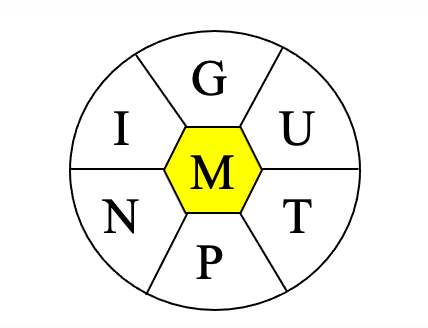
G, I, N, P, T, U, and center M (all words must include M).
Merriam-Webster says…
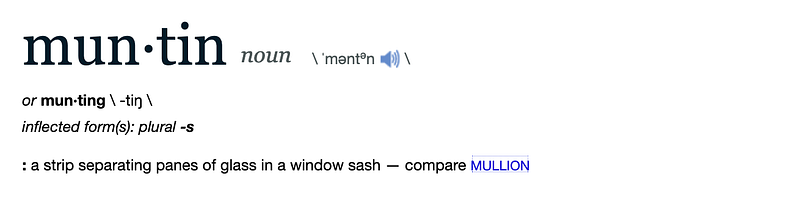
Silly little dictionary! Don’t you know that muntin can’t possibly be a word if the New York Times says it ain’t?
For further fascinating facts, check out the Spelling Bee Master.
What’s your favorite dord* from today’s puzzle?
My Two Cents
Slim pickins from today’s list of rejected words. Some of them don’t show in a dictionary search (gummi, mugg), while others are verbs (nimming, tumpin) which are harder to write about. But muntin was there for the taking, so it got tooken.
Strip bars
Our friends at Merriam-Webster explain that muntin is an alteration of the French word montant meaning “vertical dividing bar or timber”. And that French word is the present participle of monter, meaning “to rise”.
The strip of wood or metal that separates and holds panes of glass in a window is called a muntin in the U.S., and a muntin bar or glazing bar in Britain. Sometimes the term “sash bar” is thrown by fancy people. The other not-so-fancy people think the fancy people are talking about a Japanese raw fish locale and everyone gets confused.
So let’s avoid sash bar.
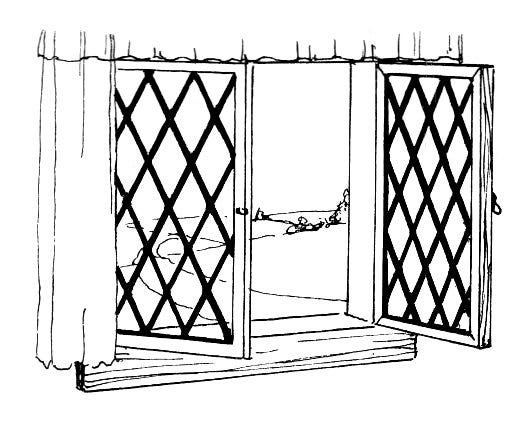
Muntins are not the exclusive domain of windows, and can also be used in doors and furniture — provided they have glass. Otherwise you’re just slapping some wood on top of more wood. Muntins have one simple job: to divide a single window casement, or sash (ohhhh, that’s why they’re called “sash bars”), into a grid system of small panes of glass. These are known as “lights” or “lites”. For example, in the illustration below the muntins are set into a lattice with diamond-shaped glass panes.
Wikipedia explains this:
“In wooden windows, a fillet is cut into the outer edge of the muntin to “stop” the pane of glass in the opening, and putty or thin strips of wood or metal are then used to hold the glass in place. The inner sides of wooden muntins are typically milled to traditional profiles. In the U.S., the thickness of window muntins has varied historically, ranging from very slim muntins in 19th century Greek revival buildings to thick muntins in 17th and early 18th century buildings.”
Wow! Who came up with the laborious process for making windows?
Well, until the 1850s, it was very costly to use large panes of glass. Smaller panes were less of a pain (bad pun intended), and so they were fit into grids to build the larger windows and doors. Many people thought it was more architecturally attractive to divide them into smaller panes. And these were probably the people who could not afford to purchase the large glass panes.
The dictionary definition tells us to compare muntin to mullion, so we will.
A mullion reasons to live
A mullion is a vertical thingamajig that divides a window or screen into portions — usually two. Sometimes a mullion has a purpose, and sometimes it’s just inserted for decorative purposes. When it’s used between windows, it serves as a support for their glazing. Its secondary purpose is structural, to support an arch or lintel above the window opening.
Here are two examples:

Mullions may be made of any material, but wood and aluminum are most commonly used. However, the brilliant I. M. Pei (the closest thing we had to someone whose name resembled the way Groot talks) used all-glass mullions in his design of JFK Airport’s Terminal 6, which opened in 1969. So, basically, he had glass separated by glass, which was unprecedented at the time. And probably seemed very cool.
Now, mullions are always vertical and should not be confused with the horizontal bars separating the top of a door from a window above it. That’s called a transom.
Transom or transom window is the U.S. term for a transom light, the window over this crosspiece. In Britain, however, the transom light is usually called a fanlight. It often has a semi-circular shape, especially when the window is segmented like the slats of a folding hand fan. One of the most famous examples, regularly seen on the news and in movies, is the main entrance of 10 Downing Street, London. That’s the official residence and office of the Prime Minister.

Thanks to their small size and the height at which they were placed, transom windows could be opened to provide cross-ventilation while maintaining security and privacy. They were common in homes, office buildings, schools, and other buildings before air conditioning became popular.
But how could you open and close the transom windows?. Simple, they had something called a transom operator, a wand assembly similar to what skylights today have.
Now, the transom has proved to be an interesting source of metaphors. The phrase “over the transom” refers to the submission of unsolicited manuscripts by authors. Picture a writer throwing a manuscript through the open transom over the door of the publisher’s office.
Now picture the obnoxious publisher throwing it back out. Or using it for kindle in his fireplace. The same phrase is used to describe the means by which confidential documents or information were delivered anonymously to someone who was not officially supposed to have them.
“Like pushing a piano through a transom” is an idiom used to describe something exceedingly difficult. It’s said Alice Roosevelt Longworth, the eldest child of President Theodore Roosevelt coined the phrase in relation to childbirth. So that must have been a pleasant experience for her…
In any case, despite our detailed architectural fawning today, the editors of the Spelling Bee puzzle closed their windows on the word muntin and declared it a dord.*
You can check out my previous entry on another dord* here:
*What the heck is a dord, you ask? Here’s the answer: