
Antinomian
They fought the law… and the law won?
Today’s New York Times Spelling Bee letters:
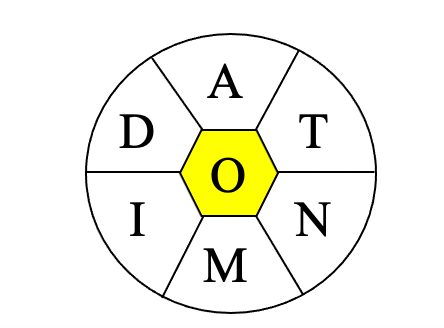
A, D, I, M, N, T, and center O (all words must include O).
Merriam-Webster says…
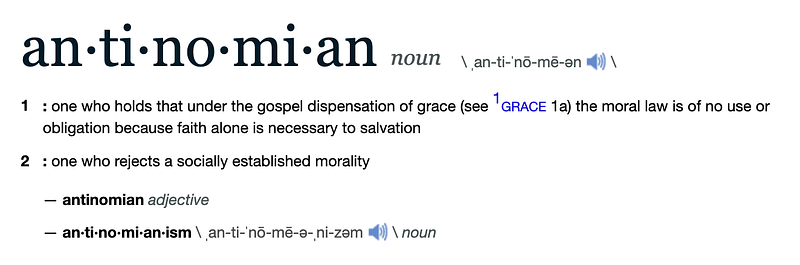
Silly little dictionary! Don’t you know that antinomian can’t possibly be a word if the New York Times says it ain’t?
For further fascinating facts, check out the Spelling Bee Master.
What’s your favorite dord* from today’s puzzle?
My Two Cents
Today’s Spelling Bee has six pangrams! So far I’ve found five of them. I think that ties the record for the number of pangrams I’ve seen since I started playing the game a few years ago.
In Spelling Bee lingo, a pangram refers to any word that contains all seven letters of the puzzle at least once. The rules of the game allow letters to be used more than once in words. So, in today’s puzzle, damnation is a pangram because it contains each of today’s letters (a, d, i, m, n, t, o) at least once, with the letters “a” and “n” appearing twice. (You’re allowed to repeat letters as many times as you want to create words.)
I won’t spoil the puzzle by listing any more of today’s pangrams. Damnation is also quite appropriate because by discussing antinomian, we’re talking about religion.
Religious anarchism
Technically, that could be one way to view antinomianism. The word antinomian comes from Medieval Latin antinomus, from the Latin anti- and the Greek nomos, meaning “law”.
Anarchy is defined as “absence or denial of any authority or established order”, and its etymology also goes back to Medieval Latin. The word anarchia was borrowed from the Greek, meaning “lack of a leader, lawlessness” And archos means “leader, chief”.
Particularly in some Christian belief systems — for example, the Reform movement — an antinomian is a person who takes the principle of salvation by faith and divine grace to the literal extreme conclusion of not having to follow any moral law contained in the Bible, including the basic Ten Commandments.
The very first Christians were Jews that followed the teachings of Jesus, who was born, lived, and died as a Jew. When I say that, what I mean is he followed and practiced the laws of Judaism (also called Mosaic Law, as they were given to Moses in the desert of Sinai). Now, Jesus was often at odds with the Pharisees, strictly observant Jews who are often (and probably correctly) portrayed as self-righteous.
Jesus had a more human-centric vision of Judaism, while Pharisees had a more God-centric vision. Judaism explicitly says that, with three exceptions, human life is always more important than obeying religious laws. Hmmm… I guess that means Jesus won that debate.
Now, at the beginning of Christianity, many converts were pagans who were not very interested in the laws of Moses or anyone else. The early Christian leaders, especially the apostles, had to address the issue of which Jewish laws still applied to the new covenant holders. Some of the big ones were abandoned quickly: kosher dietary rules, circumcision, and the strict Sabbath tenets.
Eventually, one of the key principles of many Christian groups became the idea that salvation was not a result of one’s following any specific laws, but rather that it came from divine grace and faith. In other words, simply believing in Christ was enough to grant any person salvation. That is because grace comes from God in the form of unmerited mercy as a result of the crucifixion of Jesus.
The concept of how grace is attained divides Catholics and Reformed Protestants. Sacraments — important rites such as Baptism and the Eucharist — are a cornerstone of Catholicism. Protestants don’t share this point of view.
And antinomians carry this to its logical extreme: if the only thing needed for salvation is God’s grace, then no matter what we do we will obtain salvation as long as we qualify for grace by believing in Jesus.
There’s a contradiction hidden in there, though. Truly believing in Jesus means following his example. And as you know, Jesus was sort of a socialist who fed the hungry for free, healed the sick without involving HMOs, and generally tried to do good things for those whose life was really crappy two thousand years ago. And there were plenty of people like that back then.
Interestingly, throughout history Reformed Protestants have been accused of being antinomian. But Martin Luther himself was against this distorted view of religion.
In short, to quote Romans 3:31, written by the Apostle Paul: “Do we then overthrow the law by this faith? By no means! On the contrary, we uphold the law.”
613 simple rules for dating my teenage Jewish daughter
Much like Meghan Trainor was all about that bass, Judaism is all about them rules.
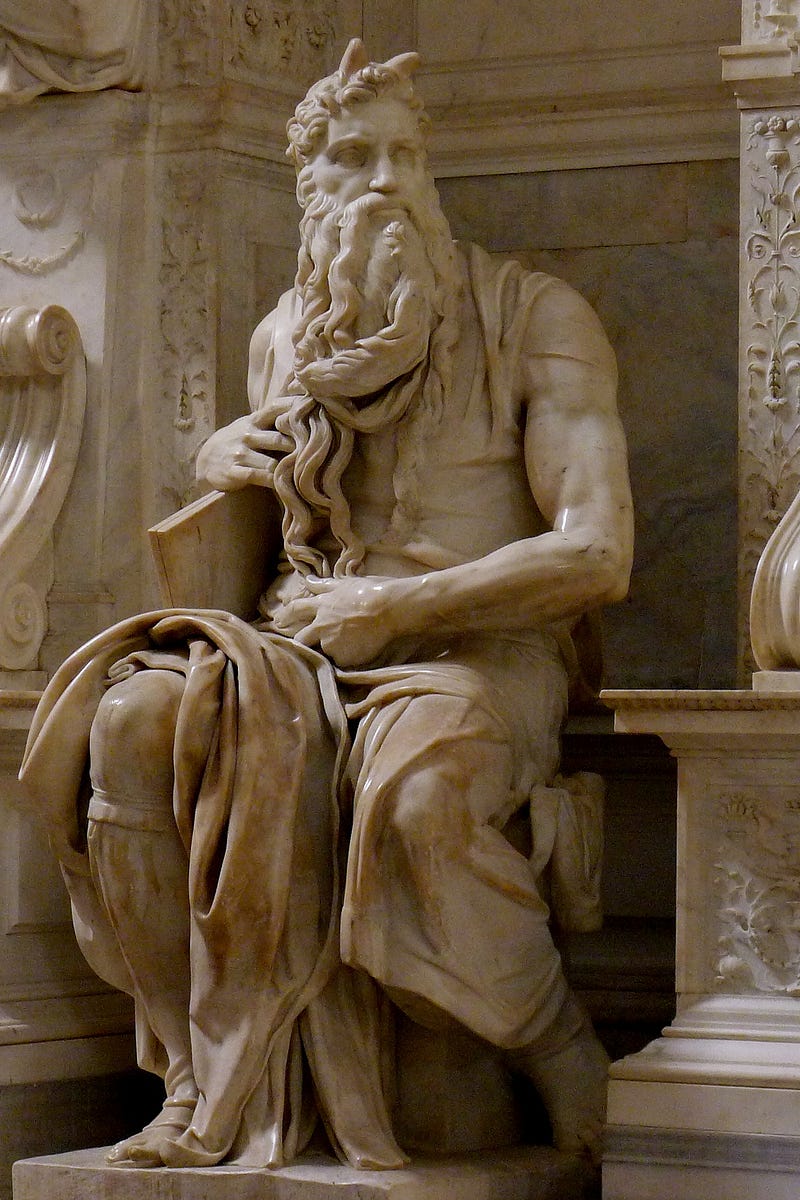
The photo at the top of the article is Michelangelo’s sculpture of Moses, housed in the church of San Pietro in Vincoli in Rome. There are two weird things about that Moses. One is the fact that he has horns. The other is that he looks uncannily like Charleton Heston in The Ten Commandments.
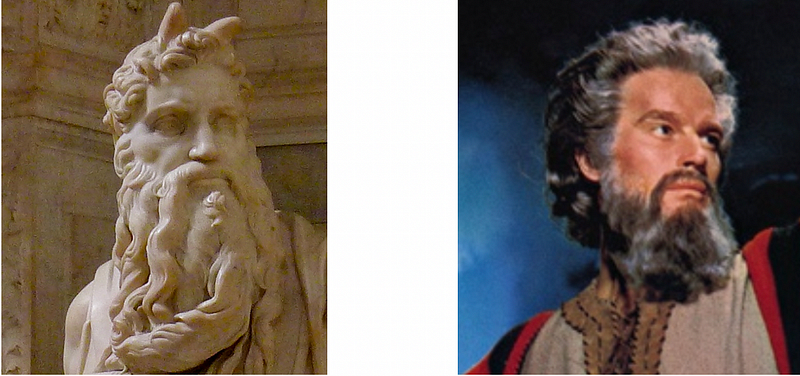
About the horns…
When Moses came down the second time from Mount Sinai — the actual mountain, not the hospital — his face was said to be “shining” or “emitting rays”. For that description, the original Hebrew text uses the term קָרַ֛ן, (qāran), based on the root, קָ֫רֶן (qeren), which often means “horn”.
Aha!
Michelangelo read the Latin Vulgate translation of the Bible, and in Exodus chapter 34 the Hebrew word was translated as cornuta (horned).
The result? Michelangelo made Moses look like his wife Zipporah had cheated on him while he was away for forty days — twice at that point!
As I mentioned before, Judaic laws are also known collectively as Mosaic Law. And boy, are there plenty of them. 613, to be precise. They can be categorized in two main groups: 248 positive commandments and 365 negative commandments.
Basically, a positive commandment is something you are required to do, for example, and colloquially speaking, “honor mom and dad”. A negative commandment is “don’t murder anyone”. By the way, the latter is one of the most famous mistranslations in history. The original Hebrew states “Thou shall not murder”, not “Thou shall not kill”. In Judaism, killing is allowed, for example, in self-defense. Murder, however, is strictly verboten. Unless you’re stoning someone for breaking the Sabbath in Jerusalem.
Now, although the most famous commandments are the Ten Moses brought down from the mountaintop, all 613 are also considered commandments. In Hebrew they are known as mitzvot. Some are to be followed daily, others weekly, still others only on certain religious holidays. So it’s not like every single day you’re stressing out about doing — or not doing — 613 specific things. In fact, there are many commandments that cannot be performed because they are related to the great Jerusalem Temple, which is no longer in existence.
One would think the negative mitzvot are the easiest ones to follow. Then again, there’s that one mentioning murder, which so many people break every single day. Not to mention stealing, raping, and coveting. We do a lot of coveting in our society. Not just of our neighbor’s wife and donkey, but of their new car, their trip to France, their in-ground swimming pool built in violation of the laws of the neighborhood association…
The 613 mitzvot cover a lot of ground, and many are what you would expect to see for an orderly, civil society to function. But then there are some really interesting or curious ones:
▹ Not to gossip about others. (Leviticus 19:16)
▹ Not to perform acts of magic. (Deuteronomy 18:10) That means you, David Copperfield!
▹ Not to withhold food, clothing, and sexual relations from your wife. (Exodus 21:10) Interestingly, this does not work the other way around! You hear that, men?
▹ To rejoice on the three Festivals: Passover, Shavuot, and Sukkot. (Deuteronomy 16:14)
▹ Return a lost object. (Deuteronomy 22:1)
▹ Not to be a rebellious son. That means you, James Dean! Wait… scratch that, James Dean wasn’t Jewish!
As for non-Jews, according to Judaism they need to follow only the Seven Laws of Noah, considered universal moral laws.
Which brings us back to antinomians. They would even go as far as rejecting these seven basic laws.
Now, if anyone would benefit from being antinomians, it would certainly be a person of the Jewish faith. After all, you’d liberate yourself from 613 rules in one fell swoop.
Hmmm… something for me to think about? Nah, I’m not a rebel without a cause.
To conclude, I’ll use a very Jewish word: kvetch. That means “complain”.
And what am I kvetching about? The fact that, despite everything we’ve discussed today, the editors of the Spelling Bee puzzle decided that the word antinomian is a dord.*
You can check out my previous entry on another dord* here:
*What the heck is a dord, you ask? Here’s the answer: