
Moxa
The Spelling Bee was just burning to reject this word
Today’s New York Times Spelling Bee letters:
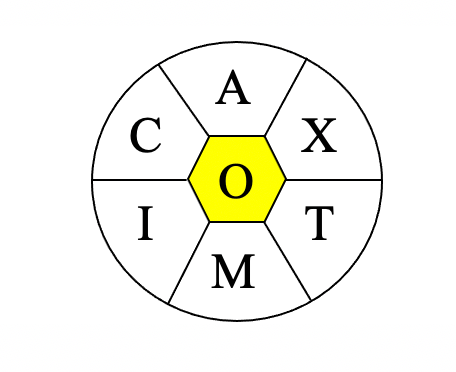
A, C, I, M, T, X, and center O (all words must include O)
Merriam-Webster says…
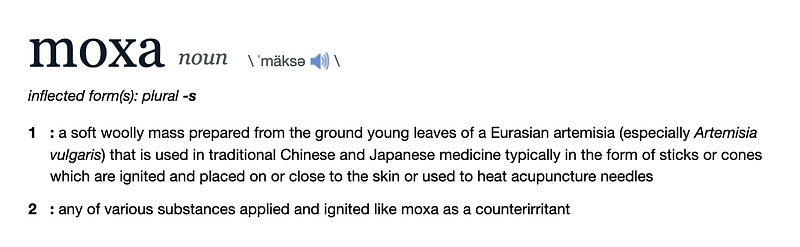
Silly little dictionary! Don’t you know that moxa can’t possibly be a word if the New York Times says it ain’t?
For further fascinating facts, check out the Spelling Bee Master.
What’s your favorite dord* from today’s puzzle?
My Two Cents
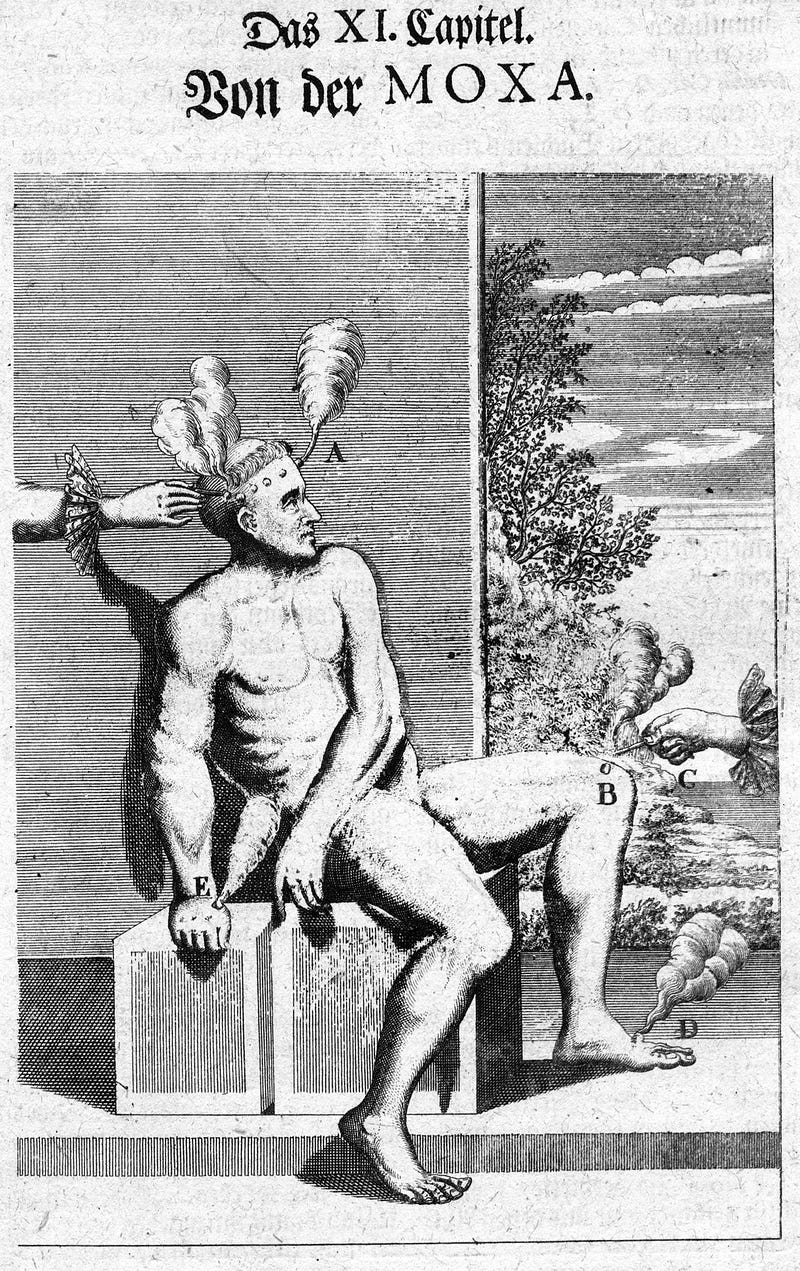
I hope the photo at the top of today’s column got your attention. (Please continue reading and remember to scroll down slowly.) The man in the illustration might seem like he has not just a foot odor problem, but also a stinky head and possibly a stinky liver. Or maybe those are thought bubbles coming from different parts of his body.
Which reminds me of this joke about an argument from the different parts of the body.
Smoke gets in your eyes
Moxibustion, also called moxa treatment, is a millenarian practice that is believed to have originated in China and then spread to Japan, Korea, and other parts of Asia. However, Korean folklore attributes moxibustion to the legendary emperor Dangun, founder of the first Korean kingdom.
The basic premise is that burning a dried plant known as the mugwort on certain points of the body can heal different ailments. Many of these body points are the same ones used in acupuncture, which some practitioners combine with moxa treatment.
That’s what the poor guy in the photo above is doing: receiving some intense moxibustion.
Here is another illustrated example:
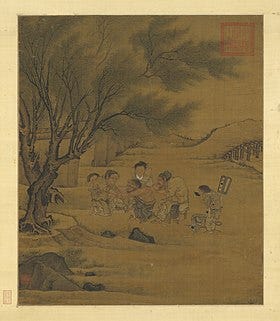
The description explains the painting shows “…a doctor conducting moxibustion on a patient, while three people are restraining the patient and the doctor’s assistant on the right is preparing a medicinal patch”.
The mugwort is first aged, then ground up. The ground mugwort can then be burned directly or shaped into small sticks or nubs. Here are some mugwort samples.
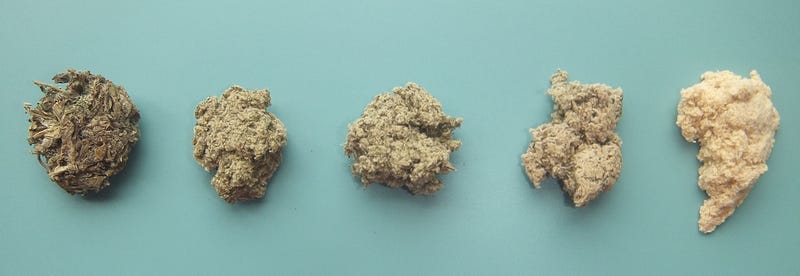
Yeah, I know. They look like antique wads of gum you may have found under your desk at school. Yeeechhh.
And here are some Korean mugwort nubs…
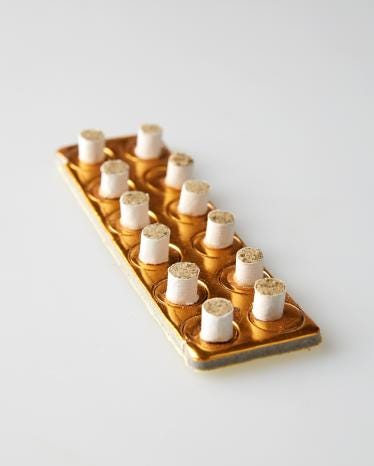
…that are placed thusly before being burned.
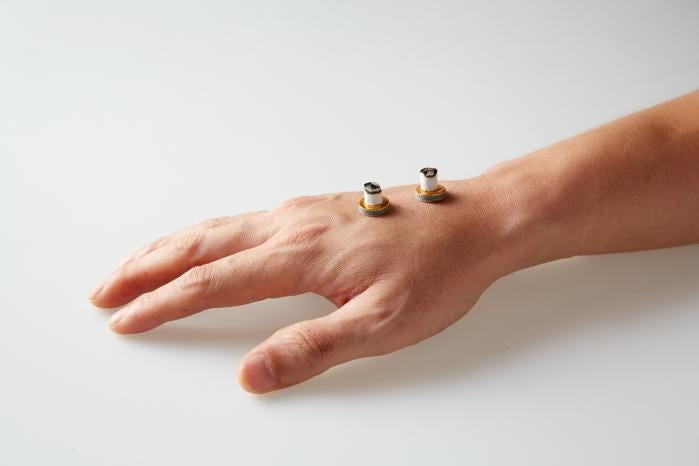
This is known as indirect moxibustion, since the moxa does not touch the skin itself. Another method is direct scarring, which is probably as scary as it sounds. A small cone of moxa is placed on the skin at an acupuncture point and is burned until the skin blisters, then scars after healing.
Wikipedia explains the following (supported by outside references and articles):
Practitioners use moxa to warm regions and meridian points with the intention of stimulating circulation through the points and inducing a smoother flow of blood and qi. Some believe it can treat conditions associated with the “cold” or “yang deficiencies” in Chinese Medicine… Practitioners claim moxibustion to be especially effective in the treatment of chronic problems, “deficient conditions” (weakness), and gerontology… Practitioners may use acupuncture needles made of various materials in combination with moxa, depending on the direction of qi flow they wish to stimulate.
However, most scientific research into the healing properties of moxa has been low quality or has found limited evidence of its effectiveness.
Here is the first page of Effects of Moxa on hemoglobin and RBC count, published in 1927 and written by Japanese physician and moxibustion practitioner Shimetarō Hara.
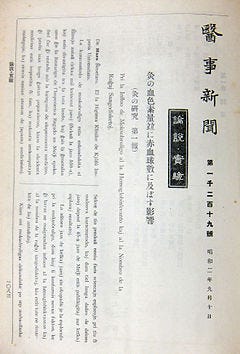
Yeah, it’s hard to read because the print is tiny, the page is sideways (there was a very strong wind blowing when Wolfgang Michel took the photo), and the language is Esperanto.
Here’s the thing: Shimetarō Hara lived to be 108 years old — he died in 1991. Not only that, he worked as a doctor until he was 104.
So maybe there is something to this moxa treatment after all…
This herb sounds familiar…
The origin of the word moxa is somewhat debated. One theory is that Hermann Buschoff, a Dutch pastor and author of the first western book on moxibustion, spelled the Japanese word mogusa as moxa. Later authors combined that with the Latin word combustio (“burning”) to create moxibustion.
But what exactly is this mugwort I’ve been blabbing about?
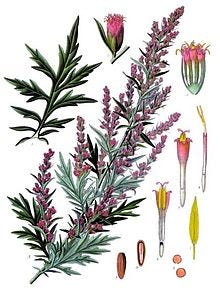
Mugwort is the term used for a variety of nice-smelling plants in the genus Artemisia. Here are a few of its species: Artemisia absinthium, Artemisia dracunculus, Artemisia vulgaris. This last one is known as the “common mugwort” and used as a culinary herb. Here is a pretty illustration by Franz (we’re on a first-name basis).
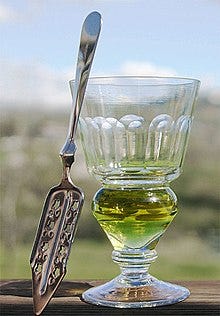
Artemisia absinthium goes by wormwood and has been traditionally used to make Absinthe, an anise-flavored spirit rumored to be dangerously addictive, psychoactive, and hallucinogenic.
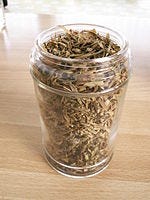
Artemisia dracunculus is probably in your kitchen. Right now. But don’t panic, it’s just the herb known as tarragon.
So, to repeat the bad pun I started off with at the top of today’s article, I can that the editors of the Spelling Bee were burning to let us know that the word moxa is a dord.*
You can check out my previous entry on another dord* here:
*What the heck is a dord, you ask? Here’s the answer: