
Motte
A castle layout… and a rhetorical move
Today’s New York Times Spelling Bee letters:
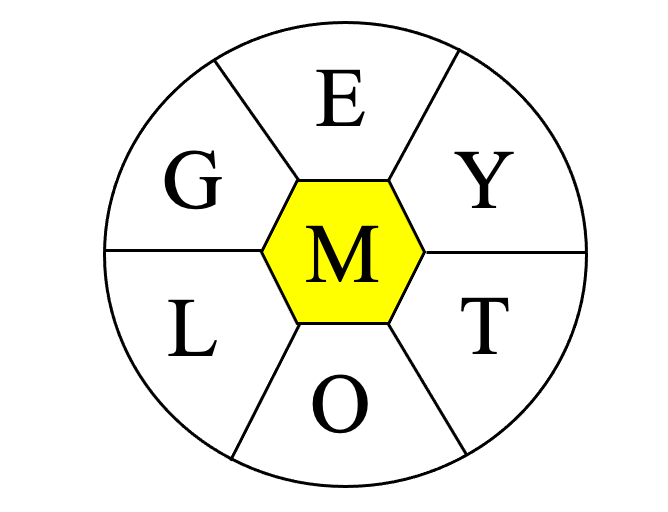
E, G, L, O, T, Y, and center M (all words must include M)
Merriam-Webster says…

Silly little dictionary! Don’t you know that motte can’t possibly be a word if The New York Times says it ain’t?
For a complete list of rejected words, check out the Spelling Bee Master.
What’s your favorite dord* from today’s puzzle?
My Two Cents
One of the great joys in writing this column is the daily learning experience. I always seem to come out of my research with a new and interesting fact, even when I’m dealing with material with which I’m already familiar.
Today was wonderful because I discovered something I knew nothing about. I’m a big fan of rhetoric —in the sense of “the art of speaking or writing effectively”, which I don’t claim to be skilled in— and argument fallacies, especially the informal ones we use and hear on a daily basis.
I don’t have a lot of social media presence, and that is by design. This column’s Twitter account is used exclusively to distribute my articles via that platform (and Medium might be considered social media by many). I’m not on Facebook, Instagram, TikTok, Pinterest, Snapchat, or LinkedIn.
I joined WhatsApp in 2015, and that provided an interesting lesson in online debates. At the beginning I was very enthusiastic about debating with people and exchanging ideas. The past seven years have provided ample fodder for that, as Trump was elected, Covid-19 bloomed, Russia invaded the Ukraine, and politics in the U.S. –-and the rest of the world–– became even more polarized than they had already been. WhatsApp is just as fertile ground for the same fake news and false information that circulates on other social media feeds.
After a while… well, okay, after a few years, I realized my efforts were largely futile. People tend to believe what they want to believe, all evidence to the contrary be damned. Terms like “cognitive dissonance”, “echo chamber”, and “selective exposure” have become widely known by the general population. Even when it’s seemingly harmless stuff, like the error-riddled life story of KFC founder Colonel Sanders, people don’t care. They like the inspirational message, they explain. Who cares if the information was embellished… or even made up? (I referenced the Colonel Sanders story because just this morning someone posted in one of my WhatsApp chats. I didn’t bother to correct him.)
All this ruminating runaround is due to the fact that today I found out about a argument fallacy I was not aware existed. The image at the top of today’s column provides a hint. Read on to find out more.
The castle design
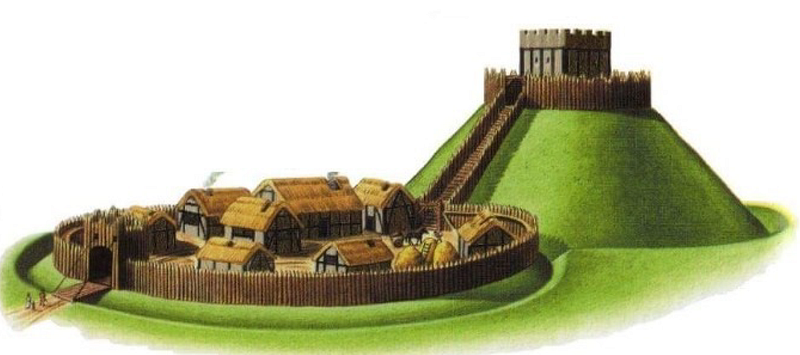
Our friends at Merriam-Webster tell us the motte was borrowed from the French word , itself from the Old French mote, motte, meaning “mound”. (Today the term means “clump of earth” in French.) This is the same root of the English word moat, also related to castles.
In European castle designs, mottes were raised areas with flat tops upon which the keeps, or fortified towers, were built to serve as both a defense and a refuge in case the lower portion of the castle, or bailey, came under attack. This combined structure became known as a motte-and-bailey castle. It was one of the earliest fortification designs and appeared around the 10th and 11th centuries in Normandy, in the north part of what is modern France. From there it spread across Europe and was exported to England and Wales.
The online Britannica explains this:
The motte-and-bailey castle consisted of an elevated mound of earth, called the motte, which was crowned with a timber palisade and surrounded by a defensive ditch that also separated the motte from a palisaded outer compound, called the bailey. Access to the motte was by means of an elevated bridge across the ditch from the bailey. The earliest motte-and-bailey castles were built where the ground was suitable and timber available, these factors apparently taking precedence over considerations such as proximity to arable land or trade routes. Later on, as feudal social and economic relationships became more entrenched, castles were sited more for economic, tactical, and strategic advantage and were built of imported stone.
The idea behind this design was that people would live their daily lives in and around the bailey, and head to the motte in the event of an attack. Think of the motte as a bomb shelter-slash-command center.
Below is the motte-and-bailey Launceston Castle in England.
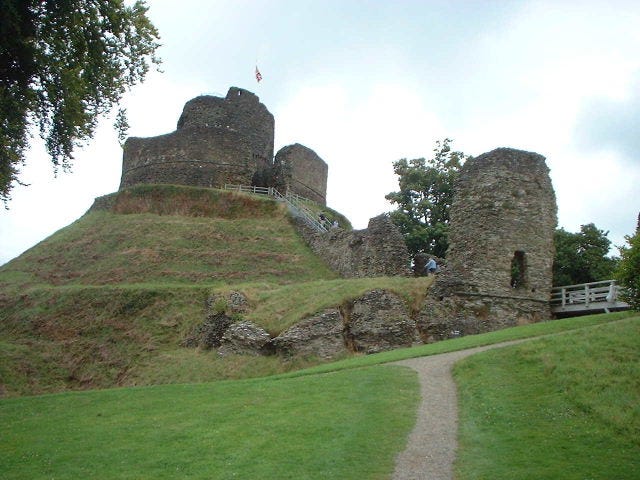
A more famous example is Windsor Castle, originally built as a motte and bailey.
My regular readers ––all five of them–– know that I shameless plug other Silly Little Dictionary! articles whenever I can to maximize the number of times I can earn those all-important 13 cents. With that in mind, if you want to read about baileys (both with a lowercase b and an uppercase B), click here.
If not, please keep scrolling down slowly.
The argument fallacy
The dictionary defines fallacy as “an often plausible argument using false or invalid inference” or “a false or mistaken idea”. Fallacies can be classified as formal or informal.
Formal fallacies belong to the realm of standard logic and deductive reasoning in which valid inferences can be drawn from conclusions that follow their premises logically. For example:
- If it is raining, there are clouds in the sky. (First Premise)
- It is raining. (Second Premise)
- Thus, there are clouds in the sky. (Conclusion, or Consequent)
Note that the first premise establishes a logical arrow in one direction only: if it rains, you will look up and see clouds. This is important, because a formal fallacy of the above example could be:
- If it is raining, there are clouds in the sky.
- There are clouds in the sky.
- It is raining.
This is known as “affirming the consequent”. Basically, you are switching the direction in which the arrow of logic points in item 1. If item 1 said “If there are clouds in the sky, then it is raining”, Item 3 could be a correct conclusion based on the information in item 2.
Informal fallacies are errors of reasoning outside the “form” of the argument. Generally speaking, they have more to do with the content itself. One well-known and often used argumentative fallacy is the ad hominen (“against the man”) attack, in which a person criticizes the one doing the arguing instead of the arguments themselves. This if often seen in political debates and courtroom trials.
Another common informal fallacy is the straw man, in which a person attacks a non-existing argument they mentioned themselves in order to knock it down and appear to have settled the issue, which was not brought up by the original arguer. A famous case was Richard Nixon’s “Checkers speech”, in which he responded to accusations of illegally appropriated campaign funds for his personal use by talking about a cocker spaniel his family had received (named Checkers), and defiantly stating he would not return the dog.
Related to the straw man fallacy is the mott-and-bailey fallacy, or doctrine. This was coined by British philosopher Nicholas Shackel at the beginning of the 21st century to describe what can be called a “reverse straw man”. In this case, the person doing the arguing misrepresents their original controversial or indefensible argument (the bailey) by restating it as something easier to defend (the motte).
Or, as the popular meme template explains…
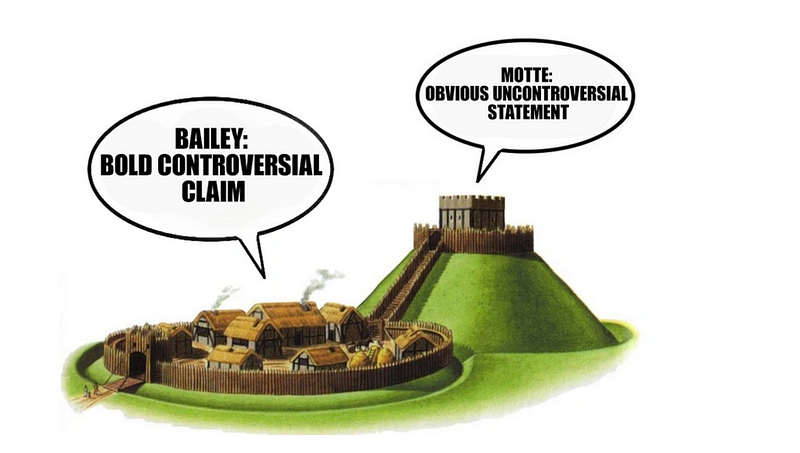
The key here is that the arguer is not retreating from their original position or changing their mind; they are simply rephrasing it as a proposition that will likely not be attacked or refuted. For example:
Bailey: Beer should be outlawed across the entire country for people of all ages. Counterargument: Responsible adults should be able to enjoy low-alcohol beverages. Motte: Drunk driving is terrible and has killed many people.
No one can question that last statement. When the person concedes the point, the arguer takes it to mean that their original point about outlawing beer is valid.
Stephen Johnson wrote a great article summarizing this informal fallacy.
If you prefer to watch a video, however, we’ve also got one for you:
Now you know. Next time you’re listening to a debate in which a person uses a reverse strawman argument, you can tell your friends you heard someone “try a bailey”. That’s right. You can’t say “motte-and-bailey”, unfortunately. And that’s because the editors of the Spelling Bee decided that motte is a dord*.
You can check out my previous entry on another dord* here:
*What the heck is a dord, you ask? Here’s the answer: