
Mother Is What I Do, Not What I Am
I love my child; I just don’t resonate much with that role
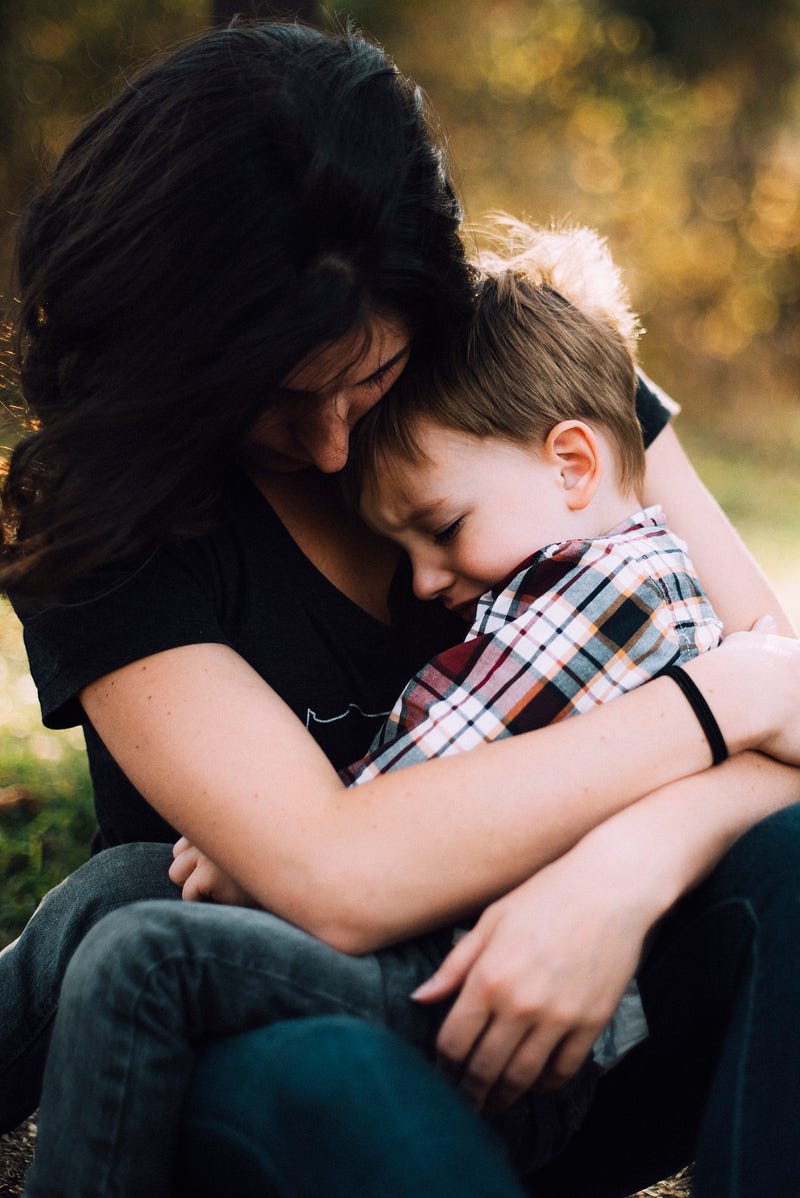
I am the mother of a nearly 21 year old son named Hugh. He’s on the autism spectrum and lives at home with me and my husband James. At this point in our journey together as mother and child, mother is a verb. It’s what I do. I don’t identify much with it as who I am. I love my son with all my heart. In fact, I’ve sacrificed a good bit of my life to ensuring that his can be better, but at this juncture, my identity is primarily in other places — being a woman, and a writer, to name just a few. Being a mother is still in the top 6 or 7 aspects of my identity, and if you look like you might be considering hurting Hugh, you will see a Mama Bear come front and center, with teeth and claws bared. But I’ve given so much to motherhood, and it’s given so comparatively little to me, I just don’t resonate with that role like some people do.
Women are expected to get their fulfillment from this role of motherhood, but not only does this limit women (even the ones who find it very fulfilling), it underestimates them. I have many, many friends who are mothers of children of various ages, some young adults like Hugh and some of elementary school children. I also have several friends who have chosen to never have children. They’ve spent their entire adult lives having that choice questioned, by not only family but strangers. Because even today, motherhood is widely considered the primary reason that women are on earth.
“A majority of adults, 63 percent, continue to believe that being a mother is the most important job for a woman in today’s world. This figure is virtually unchanged from last year and has remained constant over the past several years. Twenty-four percent disagree, and 13 percent are not sure,” Rasmussen said.”
Since Hugh is non-verbal, has high levels of anxiety and OCD, and he’s prone to seizures, it’s likely that he will never live alone or support himself. He is a sweet guy, when he’s not totally anxious and in control mode to try to manage that. James and I have accepted that we’ll probably always have him under our roof — operating at the equivalent level of parenting that is required of a very active 8 year old. It’s not that his IQ is that of an 8 year old — Hugh is incredibly smart, but none-the-less, his ability to self-navigate in the world is about on that level. We still supervise his showers because otherwise he’d forget to wash his hair and just stay in the warm water for hours at a time, enjoying the feel of it on his skin. Mercifully, we no longer have to supervise him in the bathroom, but that only ended about 2 years ago.
We love Hugh deeply. He is our only child and as hard as it’s been at times, having him in our lives has brought many gifts. We first learned how to step out of societally imposed boxes by being forced to do that with him, because that box of typical family life was not available to us. Our milestones have not been standard ones. Instead, we’ve celebrated the first time that he lied to us because not all autists are even capable of such a thing. We celebrated the first time he wrestled a friend in school when they were supposed to be sitting nicely — he has a friend; he’s initiating play.
We are more present to gratitude than many people, but it’s also taken a lot out of us both; particularly from me. As the stay-at-home parent who was always the point person on Hugh’s life, schooling, therapies, etc., my entire life was consumed with his care. Up until the time that he was about 7, I did nothing else but full-time mothering. James and I put our relationship and the rest of our lives together on the back burner and we both focused on Hugh.
Eventually, this wasn’t sustainable any longer. Fortunately, by this time Hugh was in a charter school that really embraced him and he was more stable. I still got weekly calls about various things that weren’t quite working or that needed my attention, and sometimes I had to drop what I was doing and come pick him up, but at least I had a little bit of breathing room. Good thing, because I was just about ready for the funny farm. James was and is a very involved and supportive dad, but I was the one on the front lines every day.
I then started to intentionally try to figure out how to put some of what I was giving out back in so as to keep myself from being depleted. James and I began refocusing more on our relationship as a couple, and I started doing a lot of personal growth work to figure out who I actually was and to get better coping skills. Although I started working part time from home doing something that I enjoy and otherwise expanded the parts of my life that are about things that nourish me, I still spent a great deal of time and effort on Hugh’s needs and care.
Don’t get me wrong; I am honored to have been able to do this for my son. It’s a bit like a sacred compact that I have agreed to fulfill and I take that very seriously, but it’s more like a job than a relationship. Parents typically give a bit more than children give back, particularly in younger years, but in my relationship with Hugh, I’d say I give 95% and he gives back 5%. That 5% is very sweet and I love it when we are laughing together or he spontaneously wants to hold my hand. He loves me very deeply also, but he just doesn’t have a lot of skills for conveying that. Mostly I give and he takes because that’s what he needs from me, and I take my job seriously.
A few years ago I went on a week long vacation with some of my college friends. Hugh and I had never been apart for that long before and he spent the entire week asking about me and obsessing about when I was coming home. Once I got back, he proceeded to ignore me and then had an anxiety-induced meltdown where he yelled at me for about 2 hours. We’ve worked a lot on his anxiety in various ways since then, and made some progress where that kind of thing doesn’t happen to that level any more. But although Hugh is in somebody else’s care during the day, I still spend a fair amount of time coordinating his therapies, activities, and managing his day to day life. We still have to put him to bed each night, because if we didn’t make sure he brushed his teeth and took away his electronics, he’d stay up all night and have nasty teeth. If we want to go somewhere without him, we need to find a sitter, since he can’t be left alone.
And like I said above, I’m happy to do that. It’s a sacred calling and I do it to the best of my ability. I am routinely told what a great mom I am. But, particularly the past few years when I’ve found out more and more about who I am beyond that, I feel like mothering is a role that I play and a job that I do. I take it seriously, but it’s not the lens that I look at myself through — at least not very often.
I would give my life for my son. In many ways, I already have. But in order to be able to continue to do that for the forseeable future, I embrace the other parts of myself and mother as a verb and less as a noun. I’ll always be Hugh’s mom. When he’s had a bad seizure, I find myself saying, “My baby, my baby.” It’s a completely primal connection that nothing can sever, but the cultural narrative that motherhood is the primary calling of women and the greatest source of their identity just doesn’t serve me or resonate for me.