
More Empty Proclamations From Another Minister of Education
All talk and no action, but in a fancy form

February 2023 update
Manitoba’s current Minister of Education, the Honourable Wayne Ewasko, has declared this week (February 6–10) Teacher and Education Staff Appreciation Week.
Once again, another empty proclamation, followed by zero meaningful action.

Inclusive Education Month
It’s supposed to be national inclusive education month in Canada. To mark the occasion, one might think politicians would use this opportunity to announce fantastic new projects and policies for improving accessibility and inclusion in our schools.
This would be a great time to announce specific funding for inclusion training for education staff, money to hire more clinicians and support staff, or at least bring back lunch programs and other programs that have stopped due to funding cuts.
Apparently not.
Apparently our politicians think inclusive education month is a great time to insult the intelligence of their constituents.
October 2021
Manitoba’s Education Minister, the Honourable Cliff Cullen, has officially declared October to be Dyslexia Awareness Month here in Manitoba.
Great! That means more resources for schools, and better supports for students, right?
…Right?
No?
Well, what does it mean, then?
Oh.
Nothing?
I don’t even have a web page for the proclamation; nor a copy of it in PDF, PNG, or even JPEG format.
Nothing but a tweet which appears to be a poorly-done photo taken in the minister’s office on someone’s cell phone.
They couldn’t even be bothered to take a quality picture so we could read it without squinting:
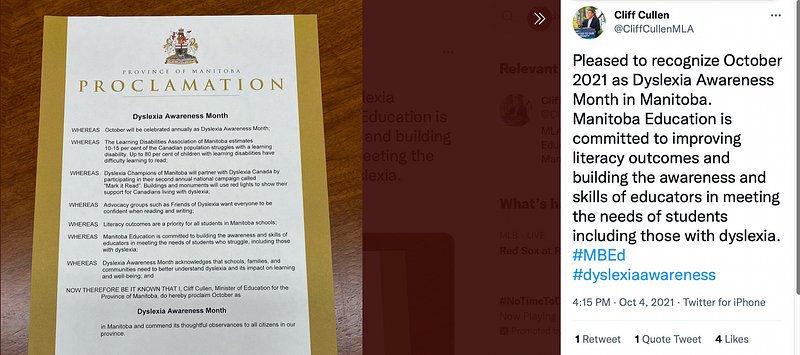
They’re very serious about this, as you can tell.
So you don’t have to squint, I’ll describe each of the proclamations.
Proclamation #1: Red lights
Seriously.
Some monuments and buildings will use red lights to show their support.
And that helps improve literacy how?
How will that help educate the public on the actual struggles of dyslexic people, furthering awareness and understanding of what dyslexia really is, and how it impacts peoples lives?
Proclamation #2: Confidence
They want everyone to be confident while reading.
Thanks for that.
And how are you going to accomplish this, exactly?
I have seen no action points, no policy changes, no ideas or suggestions at all about how we achieve this lovely but somewhat vague goal.
Proclamation #3: Literacy Outcomes Prioritized
Excellent, so more funding is going to schools, earmarked for reading programs?
No?
Better training for teachers to help them identify and support students with learning disabilities?
No?
Improved student assessment, and training for school psychologists and resource teachers, so they can learn and utilize more effective strategies for supporting dyslexic children?
Nope.
Okay, but here’s #4…
Proclamation #4
“Manitoba Education is committed to building the awareness and skills of educators in meeting the needs of students who struggle, including those with dyslexia.”
Great!
So, we’ll see increased funding for all students and additional resources for all schools, then?
Improved training for teachers so they know how to support neurodivergent students effectively?
Still no?
Only one proclamation left, I hope it’s a good one.
Proclamation #5
“Dyslexia Awareness Month acknowledges that schools, families, and communities need to better understand dyslexia and its impact on learning and well-being.”
Yes…. acknowledgement and a factual statement. Cool, cool.
Better understanding would be great, but guess how we achieve that?
Not with meaningless, empty proclamations posted on a Twitter feed, that’s for sure.
Improved understanding comes from funding for resources, training, and education.
And not just for the dyslexic students themselves.
Here’s the thing…
As a neurodivergent person with a neurodivergent child, I can tell you that the vast majority of our struggles don’t come from our divergent brains, they come from other people.
Namely people who are in positions of support, such as teachers and school administrators (and ministers of education), who know very little about divergent neurology.
What they do know tends to stem from stereotypes, misinformation, outdated information, and sometimes just plain ignorance.
I am not dyslexic and don’t want to speak for others, but as a neurodivergent person, and as an advocate for students with disabilities, I feel I can safely say that more interventions need to be aimed at the adults and professionals.
When children have knowledgeable, supportive adults in their lives, they are much more likely to be successful. Students can then be given the tools to develop strategies that work for their unique neurotype.
I think I can also safely say that parents of, and professionals who support, neurodivergent students and children with disabilities are sick and tired of political posturing. We are tired of useless proclamations that amount to absolutely nothing concrete and meaningful for children and students.
We want genuine, purposeful change.
Manitoba Education needs policy changes, increased funding, and improved training for professionals.
We need a Minister who will listen to the experts and take consequential action and not tweet out bad photos of pieces of paper containing vague, unhelpful statements.
Kthanksbye.
© Jillian Enright, Neurodiversity MB

P.S.
Oh, and Minister Cullen, did you know that October is also ADHD Awareness Month? Not to compete or complain — all neurotypes are important and deserve acknowledgement — but it would be nice if ADHD, Autism, and other neurotypes were acknowledged as well.
Just putting that out there.


