
Moonbow
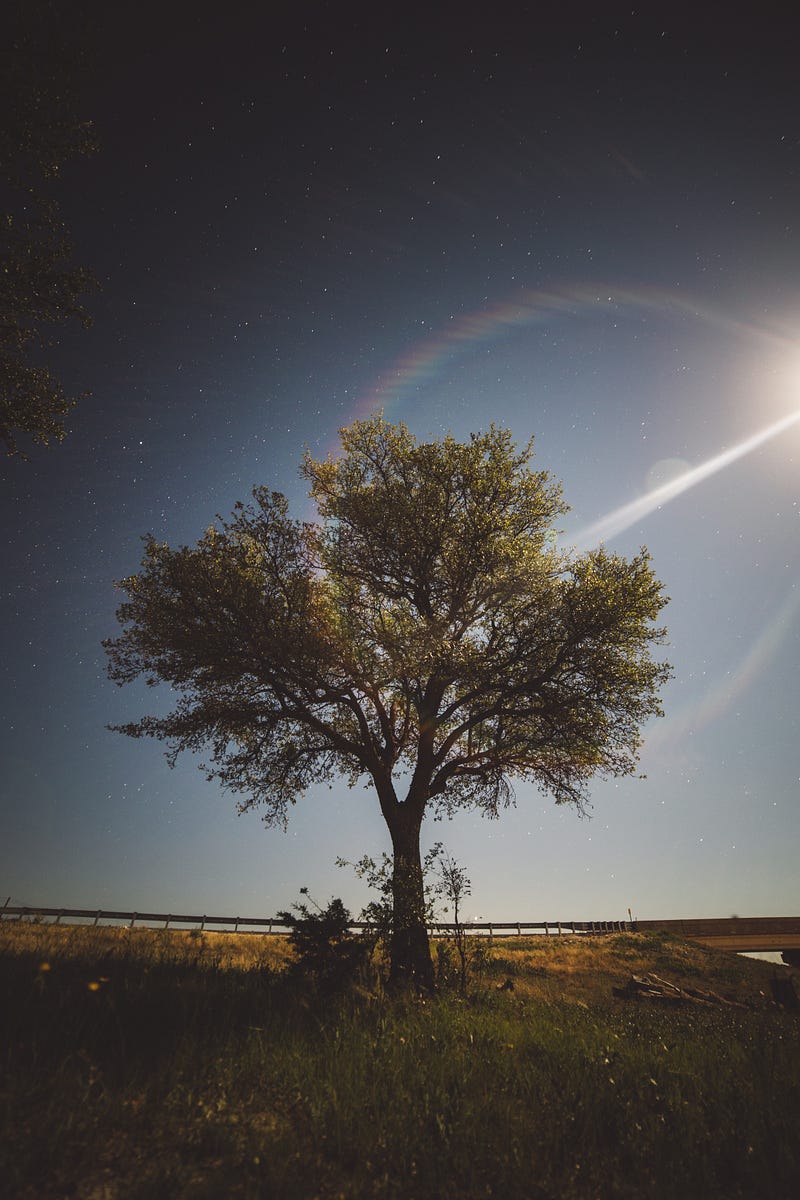
This nocturnal rainbow may not exist, per the Spelling Bee
Today’s New York Times Spelling Bee letters:
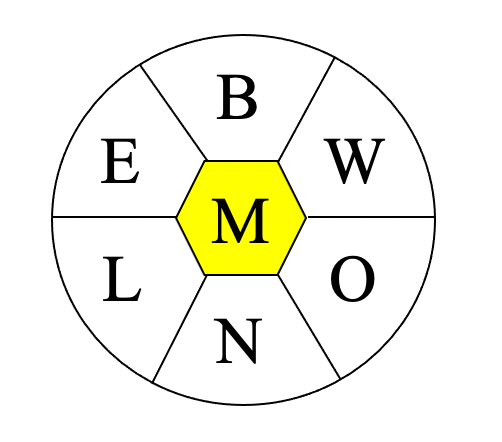
B, E, L, N, O, W, and center M (all words must include M)
Merriam-Webster says…

Silly little dictionary! Don’t you know moonbow can’t possibly be a word if the New York Times says it ain’t?
For further fascinating facts, check out the Spelling Bee Master.
What’s your favorite dord* from today’s puzzle?
My Two Cents
When playing the Spelling Bee, I usually do better the fewer words and points there are. By “do better” I mean getting to the ultimate prize: the Queen Bee logo. Like today. Spoiler alert if you’re an enthusiast who hasn’t finished today’s game and don’t like to know how many words and points there are in total: I’m discussing today’s game and showing a picture of my Queen Bee. You can skip to the first subtitle, where I start talking about our daily dord.*
But please, scroll down sloooooowly, so I can get those extra 3 cents from Medium.
In any given game, the Spelling Bee does provide a ranking of all the levels except Queen Bee.
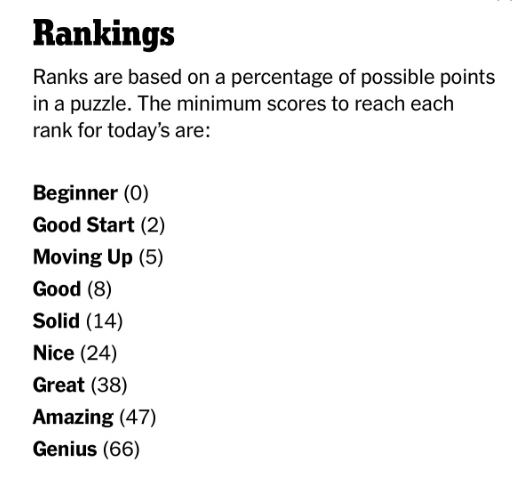
However, the Spelling Bee won’t tell you the top score (Queen Bee) or the maximum number of accepted words. Which makes sense, if you think about it. Because part of the challenge is seeing how many words you can find, not how many words the game tells you to find. Even if you are given the maximum number of points, you may be able to figure out or estimate how many words there are once you reach a certain level of points.
I’ve figured out — as I’m sure many players have, too — that “Genius” is about 70% of Queen Bee. So I can always estimate what the maximum game score is on a daily basis, give or take a few points. (For those who may be wondering, what I do is divide the Genius score by .70. In today’s case I that would give me 94.28, pretty close to the actual top score, as you can see below.
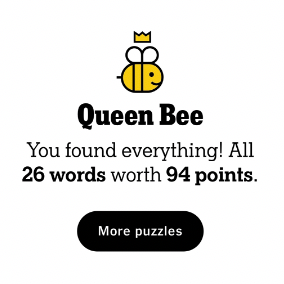
Above is my ultimate reward for today. That is the level above “Genius” in the rankings. I don’t get to this level very often, although I’ve improved a lot this year to about once or twice a month… I think. And I usually do so when the score is low. I enjoy the game a lot more when the Genius score is 150 or lower. High Genius scores above 200 are particularly annoying to me. My game has improved to the point where I can reach Genius almost every day, but I’m lazing about shooting for Queen Bee if I have to find another dozen words and 80 points, for example.
Pop philosophy
The origin of the word moonbow is self-explanatory: it’s a portmanteau of moon (as in our one and only natural satellite) and the second syllable of the word rainbow. Which raises — not begs — the question of why rainbows aren’t called sunbows. Fear not, Silly Little Dictionary is here to answer all your questions. Except “Who is the murderer in The Mousetrap?”, as it is a time-honored tradition not to reveal it.

Okay, so now we have another question: Why is a moonbow defined as “a rainbow formed by light from the moon” instead of “a sunbow formed by light from the moon”?
I have no clue.
Wait, you say. You just claimed Silly Little Dictionary is here to answer all our questions.
That is correct. Your questions. As in you, the reader. (Well, the three readers I have, anyway.) But the question just posited was asked by me, and I never claimed I could answer all of those.
So there.
Where were we? Oh, yeah, moonbow, sunbow, rainbow…
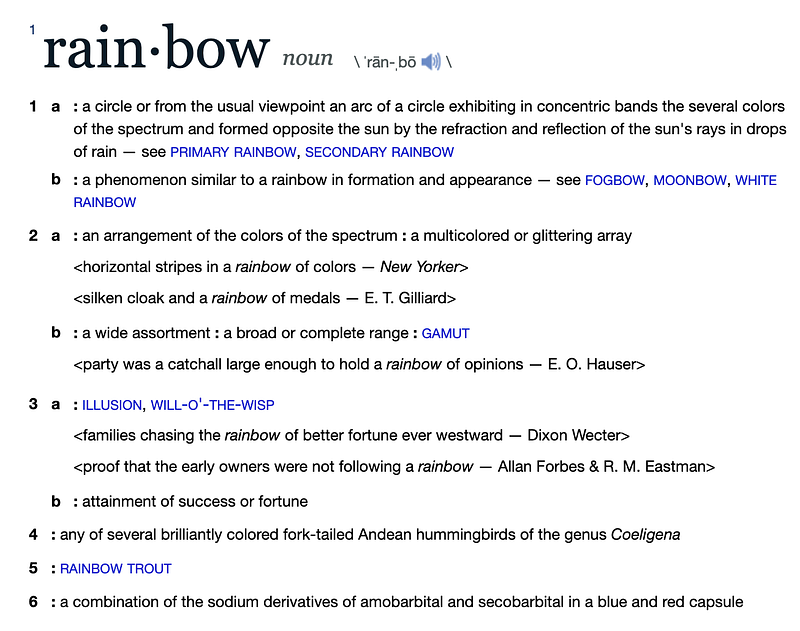
Wow! That’s certainly a lot more definitions than I was expecting. And that’s just for the noun. There’s also a rainbow adjective and a rainbow verb. Yes! You can rainbow to your heart’s content! Hooray!
Definition 1b mentions fogbow, so I just had to look that up.
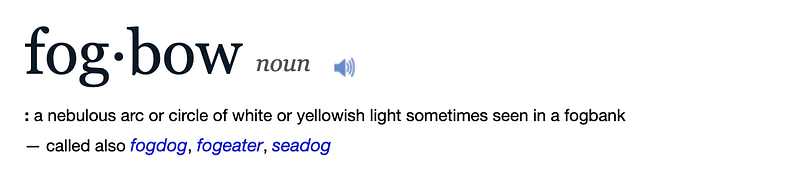
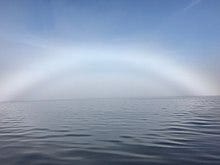
Fogbows are also known as “white rainbows” that occur during fog, not rain. I won’t spend too much time on fogbows, just in case they pop up as a dord* in a different Spelling Bee in the future. Bur here’s a picture of one in the Gulf of Mexico/Suwannee River.
In any case, the existential conundrum of why the moonbow crossed the road… I mean, why it was named “moonbow” will endure for future generations.
Moon river… of colors
Turns out moonbows are also called “white rainbows”… and also “feelybows”. The rules for its formation are the same as in a rainbow: there has to be light refracting in water droplets, and the source of light is always opposite to the bow when compared to the observer.
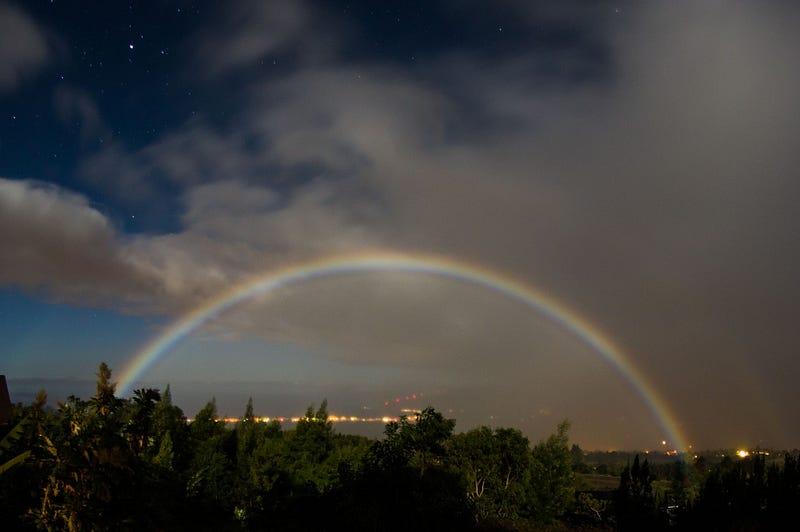
The source of light, in this case, is the Moon. Although, if you think about it, moonlight is actually just sunlight reflected off the Moon’s surface, which means that, technically speaking, moonbows are just regular rainbows with a more romantic name.
I guess we figured out the mystery after all.
Because the sunlight is reflected, it’s also not as bright. For that reason, moonbows are usually fainter than regular daylight rainbows. It’s also why the human eye has a harder time seeing all the colors — or any colors—which would explain the term “white rainbow”.
According to Wikipedia:
Moonbows are most easily viewed when the Moon is at or nearest to its brightest phase full moon. For moonbows to have the greatest prospect of appearing, the Moon must be low in the sky (at an elevation of less than 42 degrees, preferably lower) and must not be obscured by cloud. In addition, the night sky must be very dark. Since the sky is not completely dark on a rising/setting full moon, this means they can only be observed two to three hours before sunrise (a time with few observers), or two to three hours after sunset. And, of course, there must be water droplets (e.g. from rain or spray) opposite the Moon. This combination of requirements makes moonbows much rarer than rainbows produced by the daytime sunlight. Moonbows may also be visible when rain falls during full moonrise at extreme latitudes during the winter months when the prevalence of the hours of darkness gives more opportunity for the phenomenon to be observed.
Now, there are no references cited for this that I could check, so take it with a grain of salt.
The easiest and surest way of glimpsing a moonbow is to look for the ones induced by water spray, typically at waterfalls. In North America, these include the ones in Niagara Falls (U.S. and Canada), Yosemite National Park (California), and Cumberland Falls (Kentucky). Victoria Falls, in Africa on the border between Zambia and Zimbabwe is also widely known for spray moonbows, such as this one:
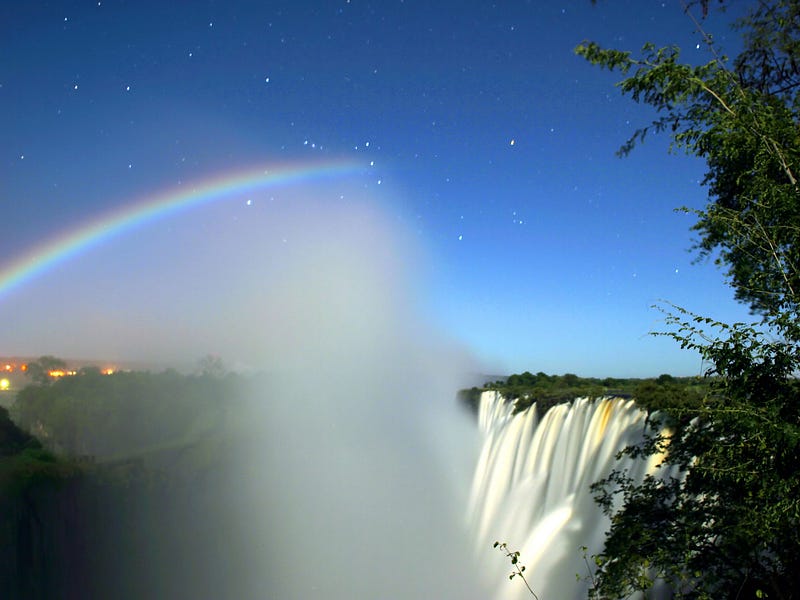
If you do happen to see a moonbow, though, just remember that it’s in optical illusion. After all, there is no such thing as a moonbow, because the editors of the Spelling Bee decided that this word is a dord*.
You can check out my previous entry on another dord* here:
*What the heck is a dord, you ask? Here’s the answer:


