
Money Talk Has a Lot in Common With Sex, Love, and Relationships
Don’t ignore taboo topics. Keep an open, vulnerable mind.

Up until a couple of years ago, when I’d get a critical response to my writing, I’d go on the defensive. Same thing when someone did something I didn’t like at work. In fact, I’d occasionally act like a total dick in response.
While there’s nothing wrong with standing your ground and expressing the way you feel, how you go about it matters.
When you lack self-awareness (this absolutely is the sweet spot of interpersonal communication), you don’t give the other person in the interaction or relationship what they need to feel heard and comfortable. The response you end up getting from them puts you in the same position.
I used to work in a bar.
I remember one super busy night, our wonderful events director stepped to the bar and placed an order for a round of drinks for people having a party she was in charge of on our courtyard. Given how slammed we were upfront, this wasn’t proper protocol. It would only slow us down.
So I looked at her and said:
Meghan, you can’t fucking do this. Put it in the queue.
Who’s right or wrong doesn’t matter one single bit in this situation.
Meghan was anxious. Meghan wanted her guests to be happy. I was anxious. I wanted the guests upfront to be happy. The opposite holds true. I wanted the party to go well, for the bar and Meghan. She wanted the flow of the bar upfront to run smoothly. We were experiencing similar feelings and emotions, and we had the same goals.
My reaction made the situation worse. In fact, there wasn’t even a situation. I created one. Meghan didn’t do what she did because of me. She did it because of what she was experiencing. If I was practicing self-awareness, I would have realized this and acted accordingly.
It would have been way easier for me to say, “No worries! I got you.” I could have knocked out Meghan’s round of drinks, which would have helped relieve her anxiety.
Instead, I acted out and ended up dealing with repercussions, including an uncomfortable talk with the owners of the bar and ongoing tension with Meghan.
I made my life harder by not helping make Meghan’s life easier.
Shortly after this happened, I went through a breakup. I spent a lot of time alone, reassessing the way I interact with others, be it co-workers, family, friends, potential and eventual girlfriends. I studied relationship dynamics. It all kept coming back to self-awareness.
The owners of the bar noticed my change in behavior and attitude. They asked me to be the general manager of what is an iconic craft cocktail bar in Los Angeles. It was an honor. And it only happened because I did the hard work on myself.
More importantly, Meghan and I get along super well now. I think she likes me! And I’m currently thinking about the baby gift I’m going to get her and her husband.
This reeducation greatly improved all aspects of my life, from money to love and sex to relationships.
It allowed me to develop a better understanding of myself.
This helped me be better with money (financial self-awareness).
It also equipped me with the tools necessary to get out of romantic relationships (or just stop at a first date) with women who I don’t belong with. Now I’m in a relationship that feels like nothing that has come before it.
We make sense. We’re on the same page. We communicate more openly, vulnerably, and effectively than I ever have in my life with another person. I think “guapa,” and I can go the distance.
Here’s the thing — all of this is intimately interconnected.
There’s an inextricable link between your relationship with money and your relationship with others. Failure to come to this conclusion does damage from personal finance and relationship perspectives. Or, at the very least, if you don’t make these connections, you make things even harder than they are to begin with in both of these crucial aspects of life.
I focus so heavily on this thought trajectory in my writing — and have been for several months — because I think it’s that important, and I don’t see many others doing it. At least not beyond the standard, be sure to have the money talk with your partner articles. While this work matters and often resonates, it doesn’t go far enough.
In this article, we further illustrate the theoretical and practical framework behind the narrative I’m crafting between personal finance and investing and sex, love, and relationships.
In a recent Data-Driven Investor article, I discussed the outcome of a speculative trade I executed and — depending on how you look at it — prematurely exited.
Here’s a response I received:
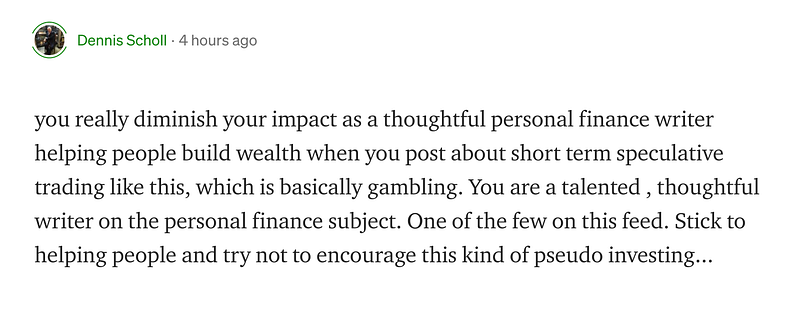
I don’t write articles in isolation. I write them as part of a holistic and comprehensive approach to money. Some articles hit the relatively boring components with little if any pizzazz. Like writing about stock options. At times, it works to bring something more personal and relatable into the mix to help make sense of the complicated.
For example —
However, more and more in recent months, I’m making the connection between money and love, money and relationships, money and partnerships, money and sex. Over the last month, this definitely has a lot to do with the relationship I’m so lucky to be in.
I have found that putting my personal life at the forefront of my writing helps make the often-intimidating subject of money more approachable. The more I share, the more my work resonates.
Tim Denning said it best in a recent tweet:
I’m glad there’s some white space so you can really let Tim’s words sink in.
They matter.
The article Dennis responded to had a minor amount of “personal touch,” relative to most of my other recent writing. However, it still conveyed a fair bit of the personal:
- I talked about my real-life experience.
- I wasn’t afraid to reveal that I blew the chance to make a quick $1,500.
- I admitted I failed.
- I tied my failure into the specific (options trading) and broader conversation (investing and personal finance).
I went to a place that’s taboo for a lot of people who read, write, and think about money.
Some people argue we shouldn’t talk about speculative trading — basically gambling for investors — at least not as part of a larger personal financial and investing conversation built around long-term discipline and a relatively conservative style.
People also exist who think we shouldn’t talk to kids about sex. Heck, large numbers of folks think we shouldn’t talk about sex, no matter how old you are and unless you’re doing it to make babies. A segment of this group probably doesn’t talk about sex at all. It’s little more than a utilitarian act!
There’s no difference between the two taboos. The two stigmas.
If you don’t talk about speculative trading. If you don’t educate people about it. If you don’t articulate your successes and failures. If you don’t place these successes and failures in the proper context within the larger discussion about investing, you’re setting people up to fail — maybe in an ugly way.
I have been buying stocks (and making mistakes) since I was a teenager. I’m still not certain about much.
From a personal finance perspective, I believe strongly in having a large cash cushion. In investing, I’m a big believer in dividend-paying stocks. However, there’s nothing — literally not one thing — I feel more strongly about than the dangers of speculative trading.
I constantly warn against trading penny stocks. I advocate buy-and-hold, income-oriented investing in solid dividend stocks.
I wasn’t born this way.
I got here because there’s one other thing I’m 100% certain about.
Maybe not all, but a meaningful number of investors will not be able to resist the urge. They will speculate. Chemicals fire in your brain that make it next to impossible for investors to resist the temptation to speculate. It’s easy to buy the dream they’re selling. A small amount of money for a huge reward. A low-priced stock. A hunch. Using margin leverage. Whatever. You’re gonna do it.
I did it. I still do it.
However, I’ve had the conversation with myself and others. Making a speculative move here and there — with a tiny percentage of my money — quenches my thirst. Abstinence would only make the thrill of speculation all the more difficult to resist.
Because I talk openly about speculative investing, I have a solid handle on how it functions. I can analyze the moves I made and why I made them. I learn something every single time I speculate — like once or twice a year.
When I fail, I move on.
When I “succeed,” I don’t get greedy.
If you’re not having these conversations, you’re doing yourself and others a disservice. You help people by honestly and directly addressing the things that can hurt them. You don’t ignore a pandemic because you don’t want people to “panic.”
Just the opposite.
You give them information. You level with them. You articulate the sobering reality. Armed with what they need to know, people make sound decisions and act in their own as well as the collective interest, especially when you provide thoughtful options and alternatives.
I approach money the way I approach relationships.
I talk to myself about money similarly to how I talk to myself about relationships.
I talk to others about money similarly to how I talk to others about relationships.
There’s probably nothing we close ourselves off about more than money, sex, love, and relationships. We act as if about these things. We don’t have real conversations with others about them. We refuse to put ourselves out there, to be vulnerable and truly communicate.
We refuse to talk about speculative trading; credit card and student loan debt; horrible stock trades; burping; farting; how much we miss, love, and see a future with someone; our most intimate and potentially embarrassing sexual fantasies.
Why do we refuse?
Because we’re insecure, we fear being judged. We fear presenting versions of ourselves we think the other person might reject. We fear they’ll laugh at us. We fear we’ll suffer embarrassment.
We fear the exact same things we should welcome into the discussion or relationship. Because if you get a reaction that makes you feel insecure, judged, rejected, ridiculed, or embarrassed, you know — right then and there — where you stand.
Should you really be in a conversation or, worse yet, a relationship with this person if that’s how they’re going to react? If you’re afraid to go there, you haven’t done the work — on yourself.
The work to be vulnerable and find enduring connections that don’t have due dates, that’ll stand the test of time, and enrich your life in ways you previously didn’t think were imaginable, let alone possible.
This article is for informational and entertainment purposes only. It should not be considered Financial or Legal Advice. Not all information will be accurate. Consult a financial professional before making any major financial decisions.