
Are You Financially Self-Aware?
How to take control of your spending and save more money

I sometimes experience difficulty coming up with article introductions. As I conducted research for this article, a Rochester Institute of Technology (RIT) class syllabus not only saved me, it provided the ideal intro:
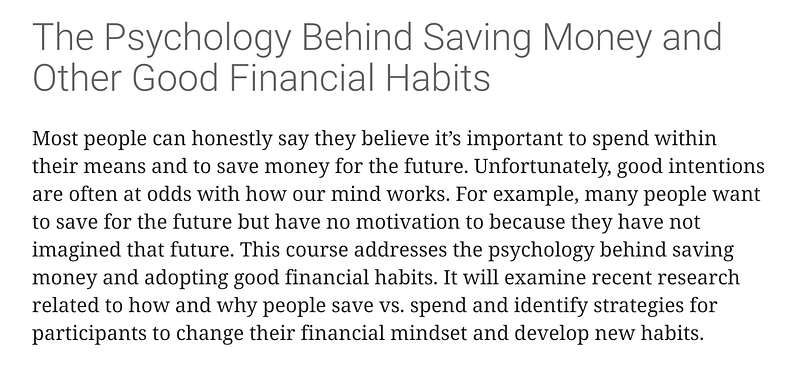
I want to take that class. It’s the stuff I eat, sleep, drink, and love to write about. So, in this article, we consider the psychological tug of war between spending and saving.
Are You Financially Self-Aware?
A 2019 study in Financial Planning Review coined the term “financial self‐awareness” and defined it as:
“…personal knowledge about one’s current financial assets, liabilities, and spending patterns.”
The study authors hypothesized that a high-level of financial self-awareness would predict positive outcomes in the following areas:
- financial satisfaction
- spending
- saving and investing
As anticipated, the more financially self-aware the respondent, the more likely they were to save and invest and not spend more than they earn. Simply having knowledge about your financial situation makes you more financially responsible. Appears obvious because it is. But there’s more to consider.
The research noted that most Americans do not have a clear picture of their basic financial situation. They don’t pay attention to their spending habits, let alone make it a priority to save and invest money. In fact, the researchers cite other work indicating financial apathy, particularly among financially vulnerable populations:
One potential challenge in increasing financial self‐awareness is consumers’ lack of interest. As Willis (2011) has observed, voluntary financial education is widely available today (often at no cost to the individual), yet it is undertaken by relatively few people. For instance, Brown and Gartner (2007) report on efforts by companies such as Target, US Bank, and Wells Fargo to encourage specific high‐risk groups to receive online financial education, even offering incentives to complete it. However, a small proportion of customers (ranging from less than 1% in the case of Target and US Bank, to about 6.5% for Wells Fargo) accepted the companies’ offers.
Obsession Over Apathy
The RIT syllabus claims “people want to save for the future,” but lack motivation “because they have not imagined that future.” This characterization gets deeper into the notion of financial self-awareness.
When we’re generally self-aware, we have not only knowledge, but an understanding of our personality, emotions, and behaviors. Self-aware people use this knowledge and understanding to foster healthier and more productive interactions and relationships. Focusing on finance, it follows that it’s not enough to know your financial situation, you must attain and maintain control over it.
The more I study my own financial successes and failures and observe others, the more I’m convinced most of us need to take personal finance to the extreme. It’s psychologically easy to make bad, in the moment, money decisions. Being consistent — consistently disciplined — that’s the hard part.
“I’m Not Sure If My Card Will Go Through”
I used to work in a bar. An astonishing number of guests have no idea how much money they have, have very little money to begin with, or both.
At least once a shift, a guest would hand over their debit card and tell me they were unsure if it would go through. One of three things usually happened:
- Decline. Guest scrambles to pull cash out of their pocket.
- Approved. Guest breathes sigh of relief.
- Declined. Guest makes quick transfer of funds in-app. Approved.
Too many guests divulged too much information — unsolicited — about their personal financial situations. Seemingly stable and gainfully employed individuals uncertain about how much money was in their checking account or, worse yet, running with barely a dime to their name. Yet, here they were crossing their fingers over an $8 charge for a pint of beer.
This raises the warranted question: How can you be okay spending $8 you don’t have or your last $8 on a pint of beer?
It’ll take more research to approach an answer. However, I bet it lies at the intersection of not imagining the future, lack of motivation to do so, a misguided desire to live in the present, and attendant financial apathy. When you reach this point of no return, you must regain control of your financial narrative.
Increasing Your Financial Self-Awareness (a.k.a. Spending Less, Saving More)
- Don’t live in the moment. This isn’t just for the financially downtrodden, distraught, and deviant. It applies to all of us. Psychologists and self-helpers want us to live in the moment. While this can produce positive results, it can lead to impulsive decisions. It’s easy to justify an $8 beer when you have $20 to your name in the spirit of living in the moment.
- Obsess over your budget. Yes. Obsess. When I didn’t have much money, things didn’t improve until I started checking my accounts dozens of times a day. It didn’t get better until I reviewed my budget strategy repeatedly, in my head and on paper, and obsessed over executing it. Now, in relatively good shape, I do the same. I constantly monitor my money and craft how I allocate it. In other words, I take it seriously.
- Think about how you feel. That $8 beer feels good in the moment. But how does it feel to have $12 left in your checking account when you walk out of the bar ($11 if you left a mediocre tip)? When I made poor money choices at the moment, I felt like a loser later. It even thrust me into bouts of depression. It wasn’t until I thought more about those feelings than the instant gratification that I changed my habits and stuck with it.
- Match spending with saving. If you must spend on things you don’t absolutely need, match it with savings. If you play any psychological trick on yourself (rationalization), make it this one. $8 for a beer, $8 goes into savings. $306 on that Airbnb, $306 goes into savings. Or maybe you do $4 and $153, respectively. It’s all about making saving as much of a priority, and preferably a bigger priority, than spending.
I skipped some of the basics: Write down every dollar that comes in and every dollar that goes out. Cut out needless spending. Reassess your housing and transportation costs. Eliminate debt. And so on. But I did this for a reason.
Even if you have personal finance 101 down, you still might be making costly mistakes. For me, these have usually been psychological mistakes.
I knew I was out spending money in restaurants and bars most nights prior to the pandemic. I knew I was spending a lot. I didn’t know it was an astonishing $1,600 more than it is now, but I knew it was too much. I just didn’t realize it was purely psychological. That I was living that life because I knew no other way to self-soothe, satisfy myself, and be social. The pandemic came along and changed that. The pandemic made me more financially self-aware.
It’s not enough to have knowledge about your money situation. It’s not enough to merely understand it. Strive to attach deeper meaning to why you do what you do with your money. Then do something radical to deal with it.
This article is for informational purposes only. It should not be considered Financial or Legal Advice. Not all information will be accurate. Consult a financial professional before making any major financial decisions.