
Misogynist Aristotle Viewed Women as Mutilated, Deformed Men
The sexist also believed women had lesser teeth than men.
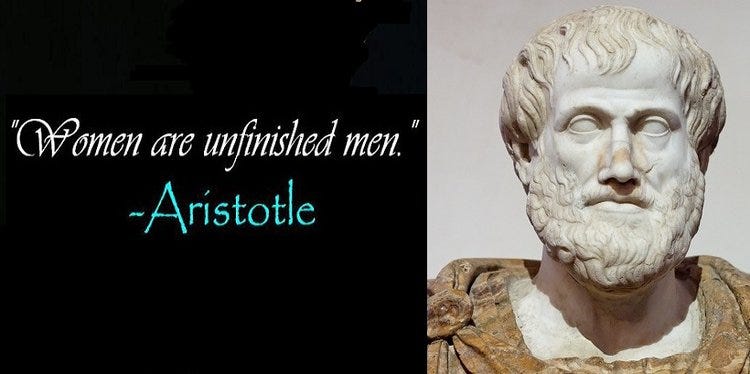
Aristotle’s baseless misogynist views make him a person with an imperfect mind, making it evident that even the wisest person of all times could have blind spots.
Literature reveals how the classical age philosophers took a deep dive into women’s nature, concluding some serious and disturbing remarks.
Ancient Greeks followed where each philosopher shared a varying viewpoint of the subject matter — Aristotle being most blunt and absurd. With his ideologies, Aristotle’s views went beyond sexism — he hardly thought women were humans.
Interestingly, the legend had thought he gave the scientific basis for the traditional belief in female inferiority, but he was mistaken. Let’s dive deeper into Aristotle’s sexisit views:
Women lack serious reasoning capability
Aristotle agreed that both men and women could reason but women, being subservient to men, were unable to
…control themselves physically and psychologically through the exercise of reason the way men can.
How did he come up with the absurd theory? Through the study of biology of sex. Giving biological reasoning, Aristotle concluded the role of each gender in the society. He believed only rational, active and strong people, which only “men,” should be given formal education and powerful positions.
Owning a pool of irrationality, imperfection, and weakness, women must resort to the domestic sphere, the private setting of the house.
Aristotle considered women incapable of abstract reasoning, and his sexist beliefs prevailed until the middle ages, doing all the damage to the gender for years.
Women are monstrous, deformed and immature
Interestingly, the father of several theories, for some odd reason, believed women had fewer teeth than men, which, according to him, testifies incompleteness.
There might be a possibility that he counted his wife’s teeth, and didn’t find the wisdom, thus generalized the statement for all the women. His real problem with women went far beyond the teeth.
In comparison to men, he termed women as “immature,” “deficient,” and even “monstrous.” Aristotle labeled women monstrous because, according to him, nature always aimed at perfection, and “deformed” women went beyond the ordinary course of nature. Anything less than perfect for him was monstrous.
Additionally, he described women as “deform[ed]” men. Well, why did he think women were mutilated versions of men?
He drew that inference by an illogical idea of the experiment — upon mutilating a boy, lopping off his testicles, one would never get bald, which makes him more feminized.
Women are biologically weak, less divine
Let’s dive into Aristotle’s broken biological theories. The guy thought men had hotter blood than women and a more vital role in reproduction than women.
Despite owning the privilege of giving birth, Aristotle stated women contribute only to the baby’s matter, not the form. According to Aristotle, women’s inability to produce semen makes them less divine, making them just the entities to contribute to the matter.
Interestingly, through this theory, Aristotle meant that only men possessed the essential ability to shape the kid.
He labeled women’s role as relatively minimal in the reproduction as they “simply” contributed the material while the father supplied the actual active force.
Some other blood boiling Aristotle’s view goes around developing a female body within her mother — it takes longer to develop than male. But after birth, it is women who reach perfection much sooner in everything.
Taking this fact as the basis of his argument, Aristotle stated that faster perfection to be women being weaker than men and every deformed thing needs more rapid perfection reaching state.
Johannes Morsink stated on Aristotle’s biological theories:
Aristotle failed to see that the connection between the ‘biological inferiority’ of a woman and her alleged social and political inferiority is not at all a straight- forward one…His biology was therefore sexist in that it had pernicious consequences which Aristotle failed to challenge.
Stepping beyond the limits of his observations, Aristotle extrapolated his incomplete, broken human anatomy knowledge for establishing a person’s capacity as a human being.
Women can not be a citizen
His patriarchal views were heavily reflected in his Politics, where he outlined the possibility of women not sharing even a citizen’s status.
Objecting to his teacher, Plato, about his suggestions in The Republic, about women owning an equal communal share, Aristotle expands how the idea will put the trouble to state. Like really? Aristotle did not think in terms of women’s rights; instead resisted such state-enforced sharing.
Women own a minimal role
Ethically, Aristotle established women needed males assistance in nearly everything — owing to their physical and intellectual weakness.
The man was the real master, the head of the house with real responsibilities and politically, a husband, as a constitutional requirement, rules over his wife.
My 2 cents:
Sadly, Aristotle’s lens of women sank deep into western thought, acting as a guide to formulate attitudes towards women. His influence made the misogynist views, to a great extent, entrenched in the culture of the west.
No matter how much modern society refutes Aristotle’s ideologies, like women lacking reasoning capabilities, numerous stereotypes still exist in education, politics, or work.
Interestingly, Aristotle’s biology is enough to earn him the title of the Most Acclaimed Misogynist, but some people do exist who would pass the idea too quickly in their heads.
Unfortunately, Aristotle promoted the ideas that benefited white aristocratic white men — like himself. His blatant degrading statements relating to women fashioned a philosophy that dominated several civilizations for centuries and is continuing to do so. Isn’t it terrifying how strong the words can be? Indeed.
More from the author:
References:


