avatarDark Energy Articles

Free AI web copilot to create summaries, insights and extended knowledge, download it at here

2187

Abstract

[of matter — ed. note] from our black hole. It’s really satisfying when you suddenly come across something orderly in the chaotic center of the Galaxy,” the researcher adds.</p></blockquote><h1 id="9751">40 years of observations of Galactic filaments</h1><p id="f5c9">In the 1980s, together with Mark Morris and Don Chance, Yusef-Zadeh determined that there are huge vertical filaments of matter at the center of the Milky Way. Last year, the discovery was made more specific — Yusef-Zadeh and his team showed that there are about a <b>thousand of these fibers</b>, much more than initially thought.</p><p id="f672">They are very long — as long as <b>150 light years each</b>. They are arranged perpendicular to the plane of the Galaxy, in pairs or larger clusters one next to the other. They have been likened to harp strings suspended in space.</p><p id="fa9d">The discovery of their horizontal counterparts came as quite a shock to the scientist. — We had always thought about vertical fibers and their origin,” says Yusef-Zadeh.</p><blockquote id="76d9"><p>“I never suspected that there might be other fibers in the center of the Galaxy: perpendicular to its plane”, he adds.</p></blockquote> <figure id="1861"> <div> <div> <img class="ratio" src="http://placehold.it/16x9"> <iframe class="" src="https://cdn.embedly.com/widgets/media.html?type=text%2Fhtml&amp;key=a19fcc184b9711e1b4764040d3dc5c07&amp;schema=twitter&amp;url=https%3A//twitter.com/rsciencejournal/status/1664993717093269505%3Fs%3D20&amp;image=https%3A//i.embed.ly/1/image%3Furl%3Dhttps%253A%252F%252Fabs.twimg.com%252Ferrors%252Flogo46x38.png%26key%3Da19fcc184b9711e1b4764040d3dc5c07" allowfullscreen="" frameborder="0" height="281" width="500"> </div> </div> </figure></iframe></div></div></figure><h1 id="dece">Two types of fibers in the center of the Milky Way</h1><p id="0efa">It is already known that these two types of fibers are very different from each other. Not only in number, length or position relative to the plane of the Galaxy, but also in other characteristics.</p><p id="544c">Vertical fibers have

Options

magnetic properties and consist of particles moving at speeds close to the speed of light. Horizontal ones appear to be made of heat-emitting matter concentrated in molecular clouds. Unlike the vertical ones — which are located around the entire nucleus — the horizontal “spokes” rudder only one side.</p><p id="ac6a">These all indicate that they were formed by different processes. The vertical ones can be associated with two large bubbles, emitting radio radiation. They are located near <b>Sagittarius A* black hole.</b> We also learned of their existence thanks to Prof. Yusef-Zadeh.</p><p id="8148">Where did the horizontal fibers come from? Yusef-Zadeh speculates that they are related to black hole activity. A few million years ago, there must have been a release of matter from its vicinity, which drifted away along the plane of the galaxy and began to react with the gases and dust there. Exactly what mechanism is responsible for this is not known so far.</p><blockquote id="44e2"><p>“The galaxy is full of structures that we don’t know and whose origin we can’t explain,” — Yusef-Zadeh says. — “We still have a great deal to learn,” the scientist concludes.</p></blockquote><div id="1eec" class="link-block"> <a href="https://readmedium.com/mysterious-stone-tomb-unearthed-in-japan-a-glimpse-into-the-past-9fe361052bd2"> <div> <div> <h2>Mysterious Stone Tomb Unearthed in Japan: A Glimpse into the Past</h2> <div><h3>In Japan’s Saga Prefecture, archaeologists have found a stone coffin from the Yayoi period. At about 2.3 meters long…</h3></div> <div><p>medium.com</p></div> </div> <div> <div style="background-image: url(https://miro.readmedium.com/v2/resize:fit:320/1*45QH3OrThbK96dTeFmOlNA.jpeg)"></div> </div> </div> </a> </div><p id="ddea"><b>Cool that you made it to the end of this article. I will be very pleased if you appreciate the effort of creating it and leave some claps here, or maybe even start following me. It would be nice if you also left a tip! Thank you!</b></p></article></body>

Milky Way’s Dark Secrets: Black Hole Unleashes Intriguing Fibers into the Cosmos

At the very center of our Galaxy, scientists have found something entirely new. These are hundreds of string-like structures that radially surround the black hole. They can only be seen with radio telescopes.
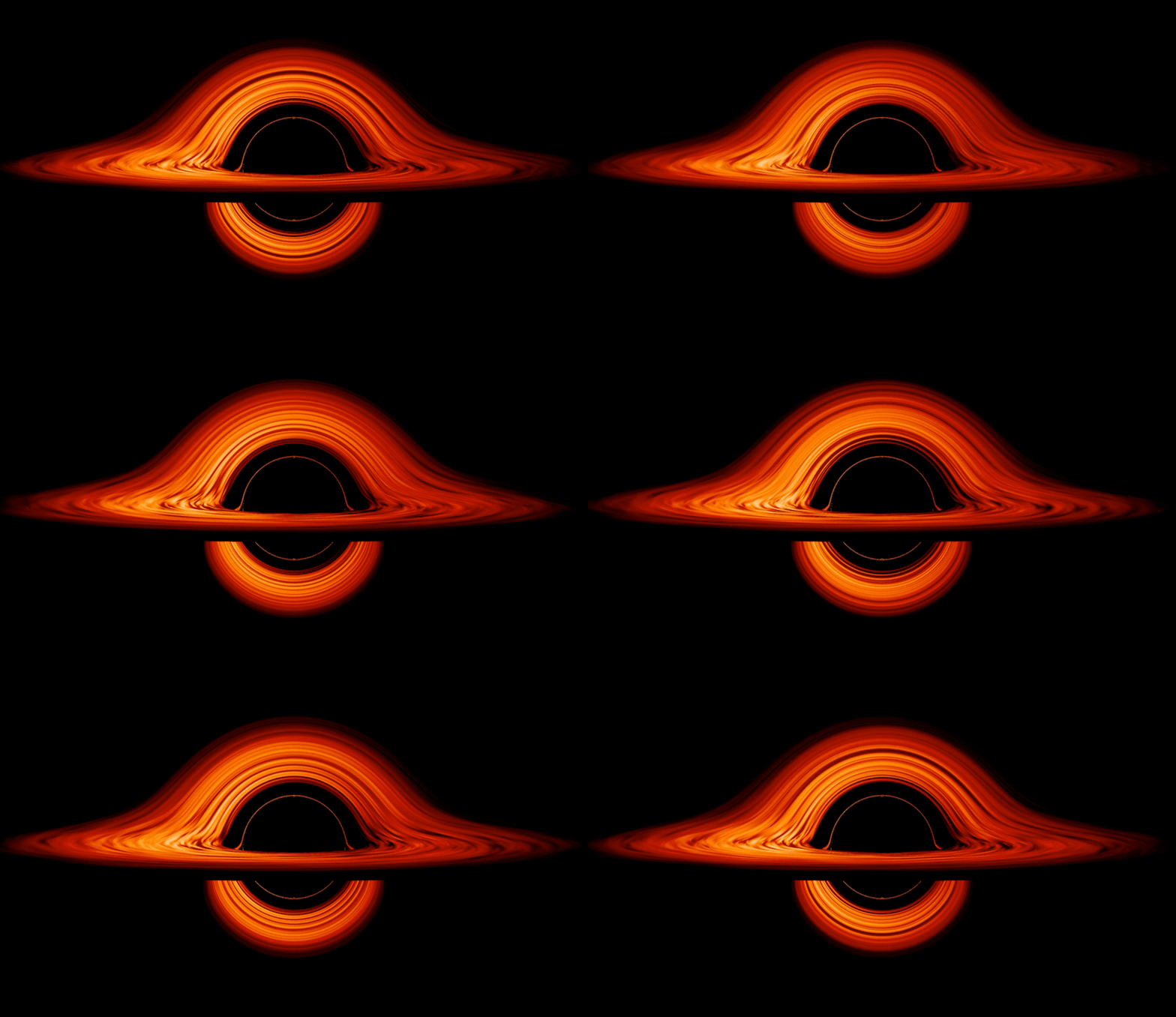
[Photo: Anthony wood, CC BY-SA 4.0, via Wikimedia Commons]

The fibers are 5–10 light years long. On the cosmic scale, that’s not much. For the distances in the Solar System — an enormous amount. Pluto is separated from the Sun by an average of 5.8 billion kilometers, or only 5.4 light hours.

The newly discovered structures are perpendicular to the plane of the Galaxy. Scientists estimated that they formed about 6 million years ago. In what way? Probably due to some kind of eruption of matter from the black hole’s immediate vicinity. However, what exactly this would be remains a mystery.

200 hours of sky observations

The new structures are described in a paper published in the scientific journal The Astrophysical Journal Letters. Its lead author is Professor Farhad Yusef-Zadeh of Northwestern University in Evanston. His team made the discovery thanks to an exceptionally long, 200-hour observation session. It was conducted with the help of the Earth’s most sensitive radio telescope, MeerKAT, operating in South Africa.

“It was a surprise when we suddenly discovered a whole new population of structures that run from the direction of the black hole,” says Yusef-Zadeh. — “I was stunned when I saw them. We did a lot of work to make sure we weren’t fooling ourselves.”

“It turned out that the fibers were not scattered randomly,” the scientist says. — “They seemed to be associated with some sort of outflow [of matter — ed. note] from our black hole. It’s really satisfying when you suddenly come across something orderly in the chaotic center of the Galaxy,” the researcher adds.

40 years of observations of Galactic filaments

In the 1980s, together with Mark Morris and Don Chance, Yusef-Zadeh determined that there are huge vertical filaments of matter at the center of the Milky Way. Last year, the discovery was made more specific — Yusef-Zadeh and his team showed that there are about a thousand of these fibers, much more than initially thought.

They are very long — as long as 150 light years each. They are arranged perpendicular to the plane of the Galaxy, in pairs or larger clusters one next to the other. They have been likened to harp strings suspended in space.

The discovery of their horizontal counterparts came as quite a shock to the scientist. — We had always thought about vertical fibers and their origin,” says Yusef-Zadeh.

“I never suspected that there might be other fibers in the center of the Galaxy: perpendicular to its plane”, he adds.

Two types of fibers in the center of the Milky Way

It is already known that these two types of fibers are very different from each other. Not only in number, length or position relative to the plane of the Galaxy, but also in other characteristics.

Vertical fibers have magnetic properties and consist of particles moving at speeds close to the speed of light. Horizontal ones appear to be made of heat-emitting matter concentrated in molecular clouds. Unlike the vertical ones — which are located around the entire nucleus — the horizontal “spokes” rudder only one side.

These all indicate that they were formed by different processes. The vertical ones can be associated with two large bubbles, emitting radio radiation. They are located near Sagittarius A* black hole. We also learned of their existence thanks to Prof. Yusef-Zadeh.

Where did the horizontal fibers come from? Yusef-Zadeh speculates that they are related to black hole activity. A few million years ago, there must have been a release of matter from its vicinity, which drifted away along the plane of the galaxy and began to react with the gases and dust there. Exactly what mechanism is responsible for this is not known so far.

“The galaxy is full of structures that we don’t know and whose origin we can’t explain,” — Yusef-Zadeh says. — “We still have a great deal to learn,” the scientist concludes.

Cool that you made it to the end of this article. I will be very pleased if you appreciate the effort of creating it and leave some claps here, or maybe even start following me. It would be nice if you also left a tip! Thank you!

Space
Science
Black Holes
Research
Life Lessons
Recommended from ReadMedium