
Microsoft kills Power BI Data Hub — It’s now OneLake Data Hub
Better Data Discovering, Managing and Sharing Possibilities

Microsoft is about to kill Power BI Data Hub to redesign and rename it into OneLake data hub.
Microsoft announced the introduction of Microsoft Fabric a few days ago, which also affects Power BI users and services. The data hub is already the central location for discovering, managing, and reusing data. With the introduction of Fabric, more data types will be available, and the OneLake Data Hub will be extended to support all Fabric data elements, including Data Warehouses, Data Lakehouses, their associated SQL endpoints, KQL databases, datamarts, and datasets[1][2].
As part of the Fabric release, the data hub will be renamed “OneLake Data Hub.” The OneLake data hub serves as an interface to all data in OneLake, allowing users to discover and manage their OneLake data effortlessly[1] — at least that’s what Microsoft is promissing.
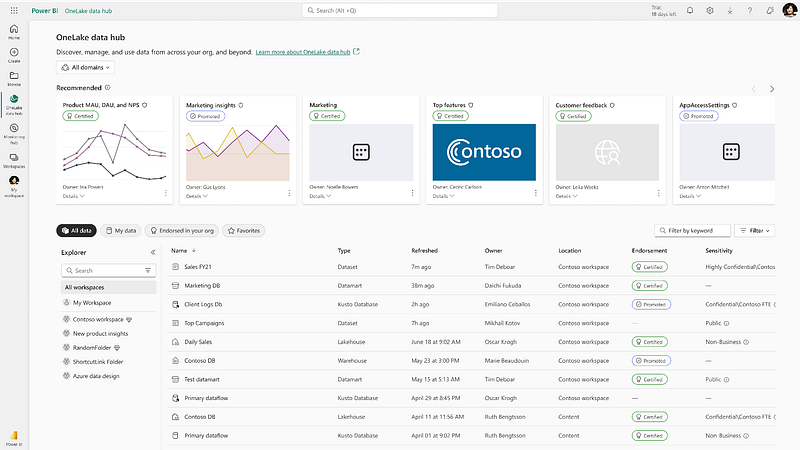
Through the new OneLake Data Hub Explorer users should quickly and easily find the right data while scrolling through the list of workspaces where they have data items. OneLake Data Hub Explorer is especially powerful for users accessing data across multiple workspaces, including those with ten or more workspaces. Explorer provides an intuitive and efficient way to browse and find data items, making it easier for users to work with large amounts of data and gain valuable insights. In the Explorer window, users can see all the workspaces where they have access to data, and clicking on a workspace name limits the data to that workspace only[1].
The introduction of Microsoft Fabric is therefore making its mark and is also causing plenty of changes in other services, including Power BI Data Hubs, which now has a new name and is also growing together with other services. This certainly makes sense, as it goes hand in hand with the trends Data Lakehouse, Data Hub and Data Driven Business. However, the fact that the name Data Hub is being replaced by One Lake Data Hub is a little interesting. From a technical point of view, Data Hubs and Lakes are definitely different technologies — so it’s probably more for marketing reasons.
Sources and Further Readings
[1] Mcirosoft, Power BI May 2023 Feature Summary (2023)
[2] Microsoft, Introducing Microsoft Fabric: Data analytics for the era of AI (2023)


