
What is Microsoft Fabric and why it’s a Big Deal
Microsoft’s new End-to-End Data and Analytics Platform

Microsoft just has unveiled Microsoft Fabric, a new type of end-to-end data and analytics platform built on the company’s OneLake Data Lake. The platform also will support integration with other cloud storage services, such as Amazon S3 and Google Cloud Platform in the near future. Competitor Google has presented BigLake about a year ago and offered a similar service. From a technical point of view, we are in the Data Lakehouse/Data Fabric area here.
The comprehensive offering includes integration tools, a Spark-based analytics platform, a real-time analytics tool and an enhanced Power BI that enables user-friendly visualization and AI-based analytics. In addition, Fabric includes a new no-code developer interface that allows users to monitor their data in real time and trigger actions and notifications based on incoming information[1][2].
I have already introduced the feature in another article about Power BI where the AI based solution is also supposed to simplify the creation of analyses and reports.
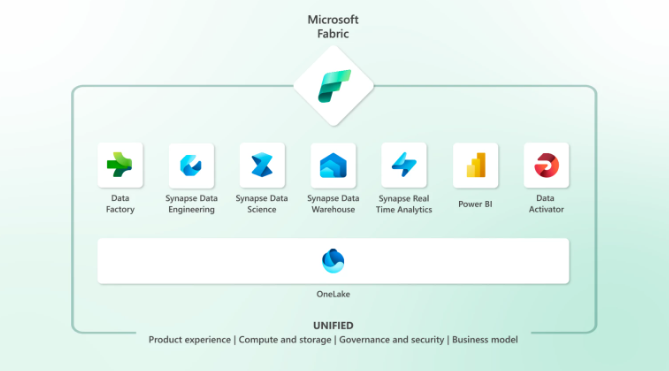
Through the tool, users experience several benefits such as easier and platform-independent data integration and analysis. Also the processing of data by ETL and ELT processes should be simplified, according to the motto Zero ETL that many of the large cloud providers go. In the area of data analysis, however, it is also possible to make suggestions and generate queries by entering text requests. Fabric, therefore comes with seven core workloads[1]:
- Data Factory: This provides more than 150 connectors to cloud and on-premises data sources, drag-and-drop experiences for data transformation, and the ability to orchestrate data pipelines.
- Synapse Data Engineering: This offers the possibility of good authoring experiences for Spark, instant start with live pools, and the ability to collaborate.
- Synapse Data Science: This provides an end-to-end workflow for data scientists to build sophisticated AI models.
- Synapse Data Warehousing: This provides a converged Data Lakehouse and Data Warehouse experience.
- Synapse Real-Time Analytics: This enables developers to work with data streaming in from the Internet of Things (IoT) devices, telemetry, logs, etc.
- Power BI in Fabric: This provides industry-leading visualization and AI-driven analytics that enable business analysts and business users to gain insights from data.
- Data Activator: This provides real-time detection and monitoring of data and can trigger notifications and actions when it finds specified patterns in data, all in a no-code experience.
It is important to note here that most of the features, which are quite fresh, are available in preview for the time being. That is not necessarily intended for productive use, but this should change shortly.
Sources and Further Readings
[1] Microsoft, Introducing Microsoft Fabric: Data analytics for the era of AI (2023)
[2] AppMaster, Microsoft stellt Fabric vor, eine umfassende Daten- und Analyseplattform für Multi-Cloud-Integration (2023)