
Microservices Design Patterns in Golang
In this article, I will introduce 12 microservices design patterns, including API Gateway, Aggregator, Async Messages, Service Registry and Discovery, Circuit Breaker, Bulkhead, Sidecar, CQRS, Saga, Event Source, Strangler Fig, and Chain of Responsibility.
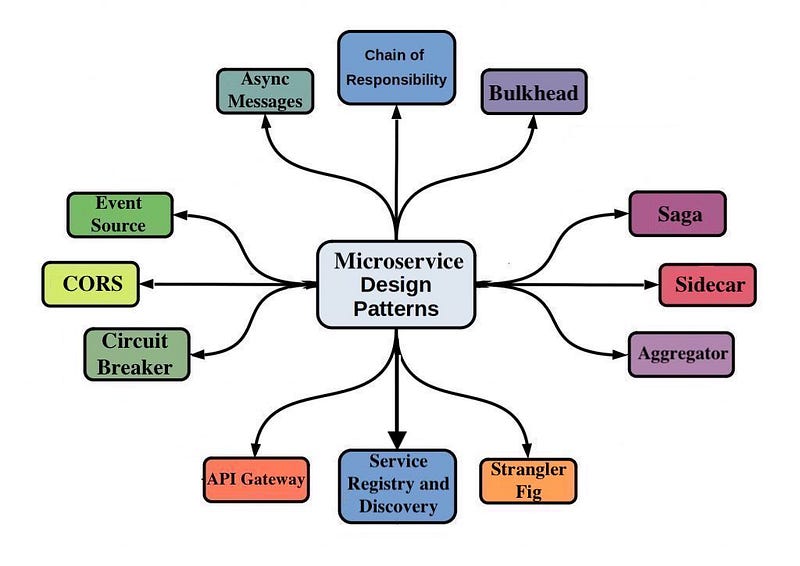
Golang is a popular language for building microservices due to its simplicity, performance, and strong support for concurrent programming. While there isn’t a specific set of microservice design patterns exclusive to Golang, you can implement many common microservice patterns in Go. Here are some widely used design patterns and practices for microservices:
1. Aggregator Pattern
In a microservices architecture, data is often distributed across multiple services. The aggregator pattern simplifies client interactions by collecting data from multiple services, processing it as needed, and returning a consolidated response to the client. This pattern can be used in conjunction with the API Gateway pattern or as a standalone service, depending on the use case. For more details please click here(Coming soon…)
2. API Gateway Pattern
The API Gateway acts as a single entry point for all client requests, providing a unified interface for multiple microservices. This pattern simplifies client interactions, enforces security and authentication, and performs request/response transformation. It can also aggregate data from multiple services before sending it to the client. For more details please click here(Coming soon…)
3. Async Messages Pattern
In a distributed system, services often need to communicate with each other. The asynchronous messaging pattern enables communication between services without requiring them to be available at the same time. This is done by sending messages through a message broker, which stores the messages and delivers them to the appropriate recipients when they are ready to process them. This pattern increases fault tolerance, reduces coupling between services, and allows for better scaling. For more details please click here(Coming soon…)
4. Service Registry and Discovery Pattern
In a microservices architecture, services need to discover and communicate with each other. A service registry maintains a list of available services and their instances. Services register with the registry on startup and query it to discover other services. This pattern enables dynamic scaling, load balancing, and fault tolerance. For more details please click here(Coming soon…)
5. Chain of Responsibility Pattern
This pattern creates a chain of processing objects, each of which is responsible for handling a specific type of request or operation. If an object in the chain cannot handle the request, it passes it to the next object in the chain. This decouples the sender of the request from its receiver, allowing for greater flexibility and extensibility in handling different types of requests or operations. This design pattern also belongs to the behaviour design. For more details please click here
6. Circuit Breaker Pattern
This pattern helps to prevent cascading failures in a distributed system. When a service repeatedly fails to respond or returns errors, the circuit breaker “trips” and stops sending requests to the failing service for a predefined period. This allows the failing service time to recover and avoids overloading it with requests. It is a mechanism for improving resilience by detecting and preventing repeated failures, allowing the system to recover gracefully. For more details please click here
7. Sidecar Pattern
A sidecar is a separate, lightweight service that runs alongside the main service, enhancing its functionality. It is a helper service that runs alongside a primary service and enhances its functionality, such as adding logging, monitoring, or security features. This pattern allows developers to focus on the core functionality of the main service while delegating cross-cutting concerns to sidecars. For more details please click here(Coming soon…)
8. Bulkhead Pattern
By isolating different parts of the system, the bulkhead pattern ensures that failures in one area do not impact others. This is achieved by creating separate “compartments” or “bulkheads” for different services or resources, limiting the blast radius of failures and improving fault tolerance. For more details please click here(Coming soon…)
9. CQRS (Command Query Responsibility Segregation) Pattern
This pattern separates the read and write operations in a system, and allows for better consistency, performance, and scalability. The write model processes commands and updates the data, while the read model answers queries and provides a consistent view of the data. For more details please click here(Coming soon…)
10. Event Source Pattern
Instead of storing the current state of a service, event sourcing stores a sequence of events that represent state changes. This pattern simplifies understanding, maintaining, and modifying the system and enables event replay, auditing, and debugging. For more details please click here(Coming soon…)
11. Saga Pattern
In a microservices architecture, managing distributed transactions can be challenging. The saga pattern addresses this by breaking a long-lived transaction into a series of local transactions. Each local transaction updates data within a single service and publishes an event. If a failure occurs, compensating transactions are executed to undo the previous steps and maintain data consistency. It is a way to manage distributed transactions across multiple services, maintaining data consistency and compensating for partial failures. For more details please click here(Coming soon…)
12. Strangler Fig Pattern
This pattern is used to migrate a monolithic system to a microservices architecture, the strangler fig pattern gradually replaces parts of the monolith with new microservices. As new functionality is developed or existing functionality is updated, it is built as a separate microservice. Traffic is redirected from the monolith to the new microservices until the monolith is eventually “strangled” and replaced entirely. For more details please click here(Coming soon…)

Conclusion
Microservice design patterns provide a set of proven solutions to common challenges in designing, implementing, and maintaining distributed systems. By adopting these patterns, developers can build scalable, reliable, and maintainable applications that effectively address the complexities of a microservices architecture.
All these above patterns cover various aspects of a microservices ecosystem, such as:
- Communication and data aggregation (API Gateway, Aggregator, Async Messages)
- Service discovery and load balancing (Service Registry and Discovery)
- Fault tolerance and resilience (Circuit Breaker, Bulkhead)
- Modularization and separation of concerns (Sidecar, CQRS)
- Distributed transaction management (Saga, Event Source)
- Incremental migration from monolithic systems (Strangler Fig)
- Handling and delegating requests (Chain of Responsibility)
By understanding and applying these patterns, developers can create a more robust and adaptable microservices architecture, leading to better overall application performance, resilience, and maintainability. It is important to carefully analyze the specific requirements of each project and choose the most suitable patterns, as not every pattern will apply to every situation.
Click here to go back to Design Patterns in Golang
To view Creational Design Patterns in Golang, please click here.
To View Structural Design Patterns in Golang, please click here.
To View Behavioural Design Patterns in Golang, please click here.
To View Concurrency Design Patterns in Golang, please click here.
To View Microservices Design Patterns in Golang, please click here.


