avatarDark Energy Articles

Free AI web copilot to create summaries, insights and extended knowledge, download it at here

2173

Abstract

mans</h1><p id="7488">Scientists who have sequenced the genome of the nuisance mite have discovered a surprising thing. The habitat of this mite — namely the human face — causes unusual changes in its genome, specific only to this species.</p><p id="5ce2">What kind of changes? First, they found that the genome of Demodex folliculorum was reduced to a minimum. This, according to the researchers, is a result of the fact that these mites live in an environment devoid of challenges. They have no natural enemies, competition or contact with other mites.</p><p id="47ee">Second, the researchers found that the nuisances move their legs with only three single cells that act as muscles. Third, that they produce a minimal amount of proteins — just the proteins they need to survive. Fourth, that they have lost the genes responsible for protection against UV radiation. And also the genes that allow them to produce melatonin.</p><p id="8e86">In humans, melatonin regulates the diurnal cycle. In small invertebrates, it is associated with mobility and with reproduction. Nematodes have coped differently with its absence — they use the melatonin they find on human skin.</p><figure id="9725"><img src="https://cdn-images-1.readmedium.com/v2/resize:fit:800/1*2ovTWdQcRXsw7HeT1TUecw.png"><figcaption>Demodex folliculorum — [Photo: © Palopoli et al.; licensee BioMed Central. 2014, <a href="https://creativecommons.org/licenses/by/4.0">CC BY 4.0</a>, via <a href="https://commons.wikimedia.org/wiki/File:Demodex_folliculorum_SEM_crop.jpg">Wikimedia Commons</a>]</figcaption></figure><h1 id="71ec">Do nematode mites survive?</h1><p id="9578">Studies have shown that the genetic pool of this mite is very small. Demodex have little chance of exchanging genes with other individuals of their species to whom they are not related. This could mean that they are on a straight path to extinction.</p><p id="bdc8">Interestingly, however, there is also a sign that symbiotic organisms are changing. Their nymph form — or last larval stage — contains a much larger number of body cells than the adult organism. According to scientists, this is an evolutionary step indicating that nemato

Options

des will soon be symbionts.</p><p id="6b74">If this is the case, what does a person gain from the continued presence of nuisances on their face? The study brings an answer to this question as well. For years, scientists believed that these mites have no anus at all and that all metabolic products remain in their body until the death of the individual. When this occurred, they would be released and cause skin diseases. However, it turned out that this was not true. Scientists have now discovered that nematodes do, however, have an anal opening.</p><blockquote id="69c4"><p>“Nematodes have been blamed for many things,” says zoologist Henk Braig of Bangor University and the National University of San Juan in Argentina, one of the paper’s authors. — “But the fact that they have long been associated with humans suggests that we may benefit from their presence.<b> For example, it may be the nematodes that keep our skin pores from clogging,” the scientist concludes.</b></p></blockquote><p id="809c"><i>Source: <a href="https://academic.oup.com/mbe/advance-article/doi/10.1093/molbev/msac125/6604544?login=false">Molecular Biology and Evolution</a></i></p><div id="2605" class="link-block"> <a href="https://readmedium.com/anaconda-the-mighty-one-from-the-swamp-what-is-the-lifestyle-of-the-worlds-largest-snake-6447da3135ef"> <div> <div> <h2>Anaconda — the mighty one from the swamp. What is the lifestyle of the world’s largest snake?</h2> <div><h3>Night. Only the eyes and nostrils protrude from the water. The rest of the body is hidden under the surface, just off…</h3></div> <div><p>medium.com</p></div> </div> <div> <div style="background-image: url(https://miro.readmedium.com/v2/resize:fit:320/1*eonOSHmyj1EYykQ3FGKSpQ.jpeg)"></div> </div> </div> </a> </div><p id="d06c"><b>Cool that you made it to the end of this article. I will be very pleased if you appreciate the effort of creating it and leave some claps here, or maybe even start following me. Thank you!</b></p></article></body>

Microscopic mites live on your face. They’re parasites, but they want to be your friend!

Scientists have sequenced the genome of a mite that lives exclusively on the human face. This creature has adapted so well to its host — us — that it has the potential to turn into a symbiotic organism, similar to the bacteria that live in the gut.
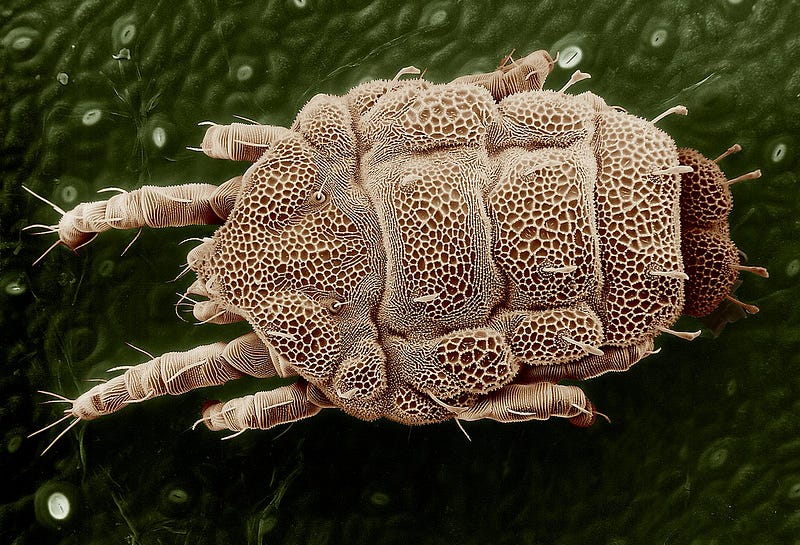
[Photo by Eric Erbe; digital colorization by Chris Pooley, Public domain, via Wikimedia Commons]

Our guts are the habitat of a large number of microscopic symbiotic organisms, mainly the bacteria that make up the intestinal microflora. However, they are not the only ones. Our skin, too, attracts creatures that feed on it to their benefit. Scientists have just discovered that one such creature turns from a parasite into a symbiont. They described their research in a paper published in the journal Molecular Biology and Evolution.

What creature are we talking about? It is the human demodex mite (Demodex folliculorum). It is a small mite, less than half a millimeter long. The termite has a very short lifespan of only two weeks. During this period, it is associated only with humans.

Where does the pest mite live?

Demodex folliculorum has chosen the human face as its habitat. And on it — hair follicles and sebaceous glands, inside which he hides during the day. At night it comes out to feed on the surface of the skin. There it acquires food (sebum and dead skin cells) and reproduces.

Mite copulation occurs on our hair. These mites have an extremely simple body structure. It is round and elongated, with limbs at one end. The position of the penis is unusual: the male has it in the upper part of his body, on his back. For copulation to be possible, it must be under the female.

The glories and shadows of feeding on humans

Scientists who have sequenced the genome of the nuisance mite have discovered a surprising thing. The habitat of this mite — namely the human face — causes unusual changes in its genome, specific only to this species.

What kind of changes? First, they found that the genome of Demodex folliculorum was reduced to a minimum. This, according to the researchers, is a result of the fact that these mites live in an environment devoid of challenges. They have no natural enemies, competition or contact with other mites.

Second, the researchers found that the nuisances move their legs with only three single cells that act as muscles. Third, that they produce a minimal amount of proteins — just the proteins they need to survive. Fourth, that they have lost the genes responsible for protection against UV radiation. And also the genes that allow them to produce melatonin.

In humans, melatonin regulates the diurnal cycle. In small invertebrates, it is associated with mobility and with reproduction. Nematodes have coped differently with its absence — they use the melatonin they find on human skin.
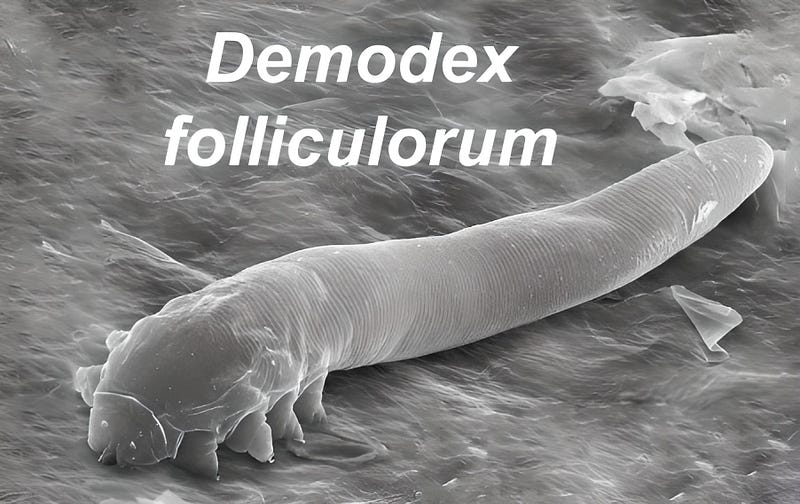
Demodex folliculorum — [Photo: © Palopoli et al.; licensee BioMed Central. 2014, CC BY 4.0, via Wikimedia Commons]

Do nematode mites survive?

Studies have shown that the genetic pool of this mite is very small. Demodex have little chance of exchanging genes with other individuals of their species to whom they are not related. This could mean that they are on a straight path to extinction.

Interestingly, however, there is also a sign that symbiotic organisms are changing. Their nymph form — or last larval stage — contains a much larger number of body cells than the adult organism. According to scientists, this is an evolutionary step indicating that nematodes will soon be symbionts.

If this is the case, what does a person gain from the continued presence of nuisances on their face? The study brings an answer to this question as well. For years, scientists believed that these mites have no anus at all and that all metabolic products remain in their body until the death of the individual. When this occurred, they would be released and cause skin diseases. However, it turned out that this was not true. Scientists have now discovered that nematodes do, however, have an anal opening.

“Nematodes have been blamed for many things,” says zoologist Henk Braig of Bangor University and the National University of San Juan in Argentina, one of the paper’s authors. — “But the fact that they have long been associated with humans suggests that we may benefit from their presence. For example, it may be the nematodes that keep our skin pores from clogging,” the scientist concludes.

Source: Molecular Biology and Evolution

Cool that you made it to the end of this article. I will be very pleased if you appreciate the effort of creating it and leave some claps here, or maybe even start following me. Thank you!

Nature
Science
Life
Health
Animals
Recommended from ReadMedium