
Anaconda — the mighty one from the swamp. What is the lifestyle of the world’s largest snake?
Night. Only the eyes and nostrils protrude from the water. The rest of the body is hidden under the surface, just off shore. The anaconda is waiting. When the thirsty animal approaches — it will throw itself, sink its teeth in and wrap its body so tightly that it will not be able to catch its breath. Then it drags the victim under the water and all trace of him disappears.
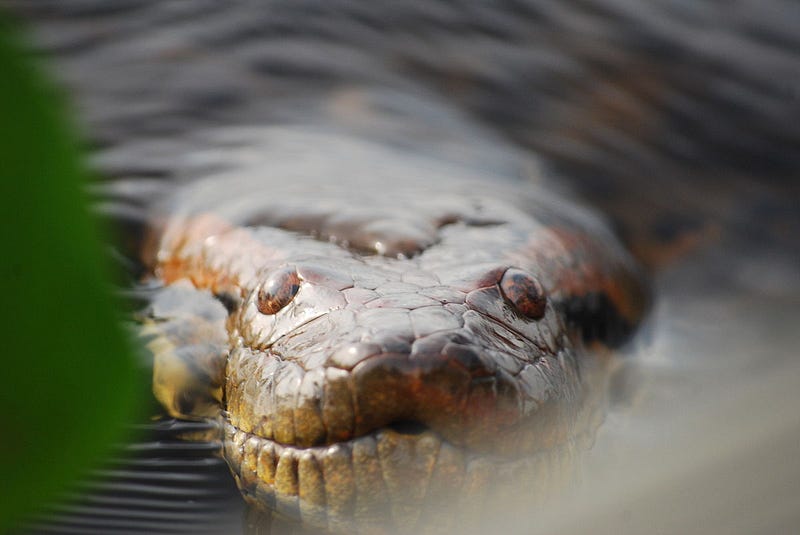

Anaconda is the biggest snake in the world
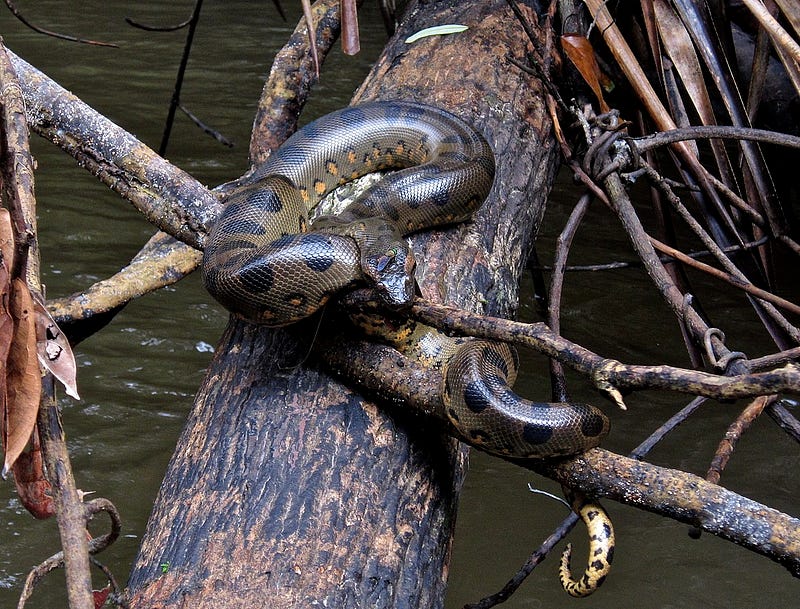
Since childhood, we are instilled with the idea that snakes are simply evil. Anyway, as the studies of evolutionary psychologists show, we have an instinctive fear of these creatures somewhere very deeply encoded. All the more so if it is the world’s largest snake: the South American green anaconda, also called giant (Eunectes murinus), of the strangler family.
The anaconda lives in the Amazon and Orinoco river basins. It is found in countries such as:
- Brazil,
- Colombia,
- Venezuela,
- Peru,
- Ecuador,
- Bolivia,
- Paraguay.
How big can an anaconda be? Myths about the size of anacondas abound. A Brazilian army officer claimed to have killed a 35-foot giant, but had to abandon its body in the jungle. British Colonel Fawcett allegedly killed a 19-foot anaconda. The snake was riddled with bullets, measured, then the soldiers went to rest. When they returned, it was gone. Fawcett fought fiercely for recognition of his record-breaking invisible trophy. Well, he didn’t even have a tape measure… The longest reliably measured individual reached 10 m, but on average anacondas measure about 5 m. This is slightly less than Asian reticulated pythons, but in terms of weight they are unbeatable. The most impressive individuals weigh 250 kg, and according to some sources even 500 kg!
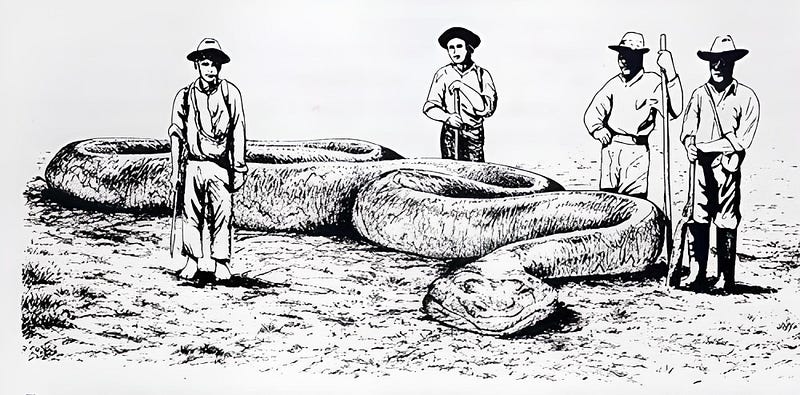

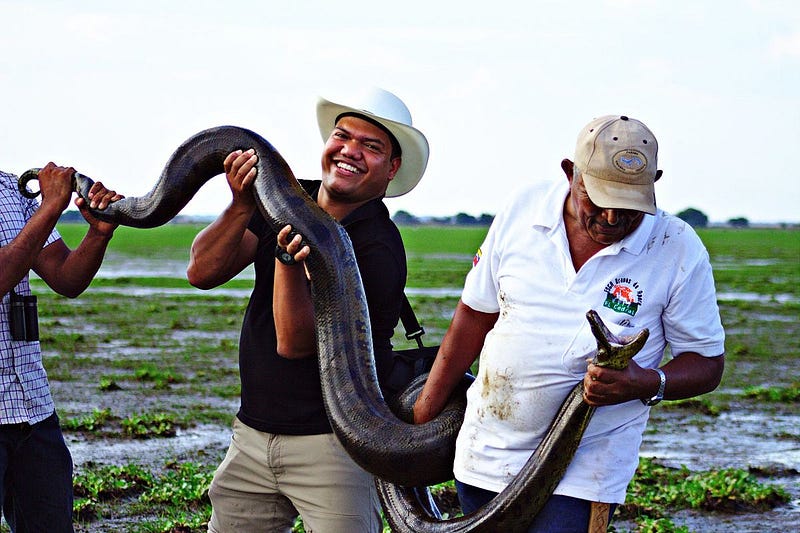
The anaconda can afford such a powerful body because of its aquatic lifestyle. Slow and sluggish on land, in the water it becomes agile and light, moving at speeds of up to 20 km / h. Without breathing it can lie on the bottom for 20 minutes, waiting for the right moment to attack.
_(8990193853).jpg)
Anaconda — hunting and digestion
The strength of such a sizeable muscle mass makes it possible to hunt even very large animals. The menu of an adult anaconda includes South American animals: tapirs, capybaras, deer, peccaries, and even caimans and jaguars! Basking in the sun after a meal must inspire terror. And if you also know more about its customs, you can safely say that it is a monster. Anaconda is not easy to meet during the day, and it is better not to meet at night. This is the time of its hunt. Most often it lurks in the water, by the shore, exposing only its eyes and nostrils placed high on its head.
It freezes in stillness and waits. The animal, which approaches the watering hole, does not perceive the danger. The attack is sudden. The snake throws itself at the victim and bites hard into its flesh. The bite can be painful, but — because the anaconda has no venom — not necessarily fatal. The anaconda then wraps itself around its prey and clamps down on it. It becomes increasingly difficult for the prey to get air, but it is unlikely to suffocate because a few moments after the attack it is already underwater, where death comes by drowning. Sometimes a strong grip crushes the internal organs and the animal dies from extensive wounds.
The prey is always consumed from the head. Its body slowly moves deep into the snake’s digestive tract. And when already the entire meal is stuffed into the abyssal stomach, the anaconda lies motionless for up to a dozen days. And digests, digests, digests. The whole organism submits to this activity. There is an invisible race against time. The anaconda has as much time as it is given by the bacteria, which would also like to take part in the feast.
When putrefactive processes occur faster than digestion, the snake is threatened with food poisoning. The spoiled remains of the dinner “monster” must return — otherwise the feast may end in his death. But if he successfully manages to consume his prey, all the animals in the neighborhood can breathe a sigh of relief. If they could inform themselves about the state of eating anaconda, certainly they would announce a carnival. After a solid meal, the snake fasts for a good few months. The record-holder from the zoo ate up to 2 years!
Cannibalism has also been observed among anacondas. Most often females, which are much larger, devoured males that are smaller than themselves. It is possible that in this way they gain resources needed for the grueling period of pregnancy.
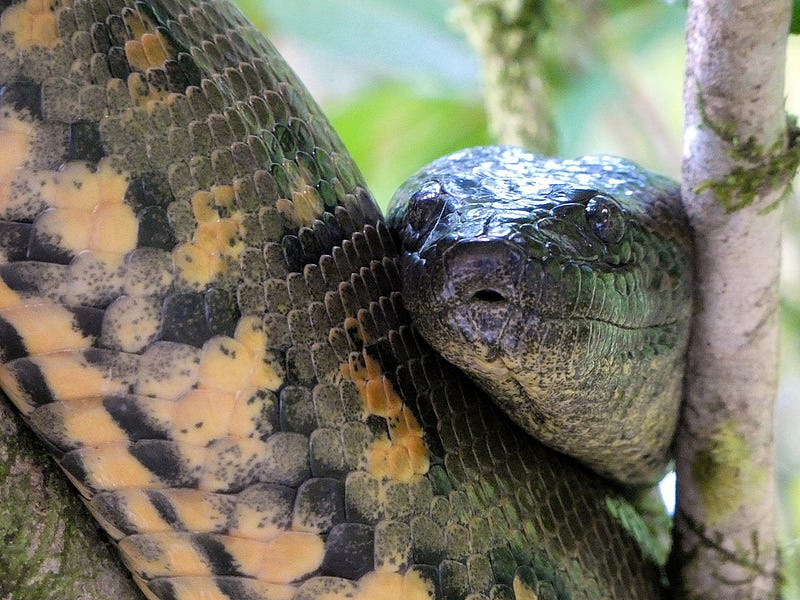

Anaconda — attacks on humans
And does the anaconda happen to taste a man? There is no definite answer here. Certainly the reticulated python, an Asian cousin of the anaconda, can eat a baby. The last such case was recorded in 1972 in Burma, where an eight-year-old boy was devoured. But pythons live close to human settlements. Their areas are highly populated, and the snakes readily feed on rats or dogs. Pythons are also, more often than anacondas, bred as pets, because they are gentler in character. And that with the character is sometimes different, there are accidents, as in 1993, when a domestic python killed (but did not eat) a 15-year-old boy.
The anaconda, on the other hand, inhabits the inaccessible Amazon and Orinoco river basins, swamps and marshes in the rainforest of South America. It rarely has the opportunity to meet humans. And it is already so in nature that the predator must recognize the prey as something edible. Otherwise it would waste time and energy attacking, for example, an unusual looking branch.
When seen for the first time, humans are not identified as potential prey. However, the fate of two female anacondas, which were the subject of the scientists’ study, turned out somewhat differently. They were captured and transmitters were installed under their skin to track their activity over several weeks. During that time, they had a number of opportunities to get a good look at humans. Then they twice attacked researchers in Dr. Jesús Rivas’s group who were apparently bothering them.
The researchers, a man and a woman, were fortunately wearing long wellingtons as they walked through a floodplain covered to the knees with aquatic vegetation. In the first case, the anaconda bit badly into the wellington and when it attacked a second time, the man managed to dodge. The disheartened snake escaped. The second incident was accidentally filmed and the camera operator managed to warn the person the anaconda was about to pounce on. Both attacks were certainly not “self-defense.” The would-be victims weighed 55 and 60 kg, so they were perfect for a solid meal. Still, these were two exceptional cases among the dozens of anacondas that Dr. Rivas’ group studied.
.jpg)
Anaconda — reproduction
Just as interesting as the anaconda’s hunting techniques is its intimate life. The female, ready to mate, sends out a message about her condition in the form of scents carried by the wind. Then all the males from the vicinity arrive. The courtship, however, is not a display of song or dance, or even the spectacular duels we know from watching birds or mammals.
Anaconda courtship is a tangle of writhing and hissing bodies. At the center of this living cluster is the female. It is not certain whether the female chooses her partner or whether the male, who pushed himself closest to the female, wins the copulation. Courtship lasts from 2 to 4 weeks. It often takes place in water. In order to copulate the pair must intertwine their tails, and then the male puts his head on the neck of the female. At this time, the genital openings of both animals meet and sperm transfer occurs. When there are no males around, the female can also reproduce by parthenogenesis (gonorrhea).
Six months after mating, 20 to 40 eighty-centimeter snakes are born. The maximum number of young in a litter can reach 100! Young anacondas hatch from eggs in the mother’s womb and are born already as free individuals. After a few hours they leave their lair. They feed on small animals, mainly rodents, birds, amphibians and fish. But at this stage of life they themselves often become food for animals, which in a few years they will hunt. Only a few individuals from a litter reach adulthood. Most siblings will be eaten by fish, caimans or birds.
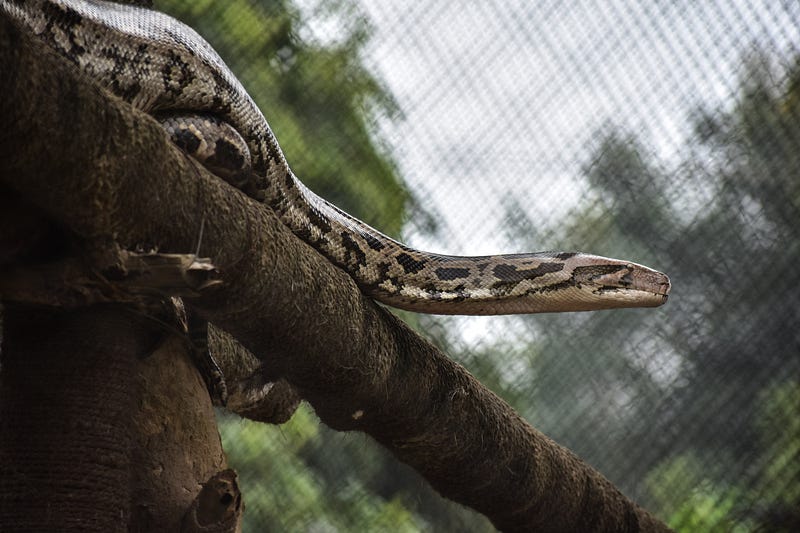
Only after three or four years do anacondas reach a safe size of a few meters. Then nothing can threaten them anymore. Except man. In natural conditions anacondas live about 10 years. However, in captivity can reach an age of over 30 years. The record in this area belongs to a 37-year-old individual.
Anaconda are often killed
Residents of the tropics kill anacondas with particular vehemence — because of their dislike of snakes, rather than because of the threat they pose to humans. To protect the species, governments in countries where this giant snake is found have banned trade in live anacondas and their skins. Fortunately for the snakes, their matte swamp-colored skin at night is not enticing to shoe or watch strap manufacturers. And their capricious nature and large requirements do not make them an attractive farm animal.
Anaconda movies
The anaconda’s bad reputation has been exploited many times by authors of horror books and movies. The most famous example is 1997’s “Anaconda”, which starred Jennifer Lopez, Ice Cube, Jon Voight, Eric Stoltz, Jonathan Hyde and Owen Wilson.
During an expedition to the Amazon jungle, the protagonists are attacked by giant anacondas that devour people. The film received a theatrical sequel, “Anaconda: The Hunt for the Bloody Orchid” (2004) and three television sequels.
Cool that you made it to the end of this article. I will be very pleased if you appreciate the effort of creating it and leave some claps here, or maybe even start following me. Thank you!