
The Gaia mission has already classified 1.8 billion Milky Way stars — What’s next?
The goal of this mission is to create the most accurate, multidimensional map of the Milky Way. Scientists have just presented the third catalog of information from the European Space Agency’s Gaia space observatory. They managed to obtain data on 1.8 billion stars of our Galaxy.
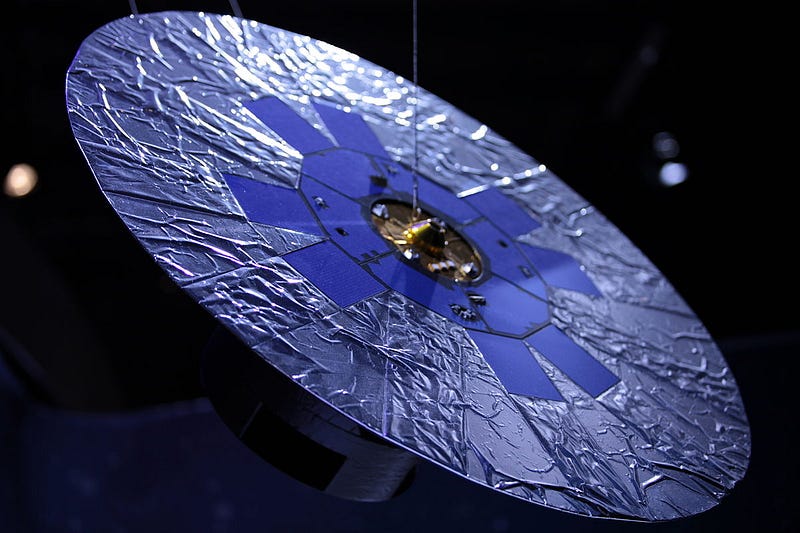
.jpg)
The Gaia mission is a comprehensive survey of the sky
“The chemistry of our Galaxy is something fascinating. It is something in which the entire history of the Galaxy — and what will happen to it over the next billions of years” — is written.
We’ve only been observing it for a short time, but with data like that provided by Gaia, we’re able to study its chemistry. And we can say: this part of the sky came from another galaxy, this one is old, and this one is young. This now becomes possible for the entire sky. Up until now, astronomers have had very accurately known fragments of the sky. Gaia gives us the whole sky. This is a revolution.
“The new data will help unravel the mysteries of billions of astronomical objects of all kinds, located in diverse areas of our Galaxy and beyond. — Unlike other missions that target specific objects and scientific questions, Gaia is a survey mission. This means that while repeatedly surveying the entire sky with billions of stars, Gaia is sure to make discoveries of phenomena that other, more specialized missions might miss”, says Dr. Timo Prusti, scientific manager of the Gaia mission at ESA.
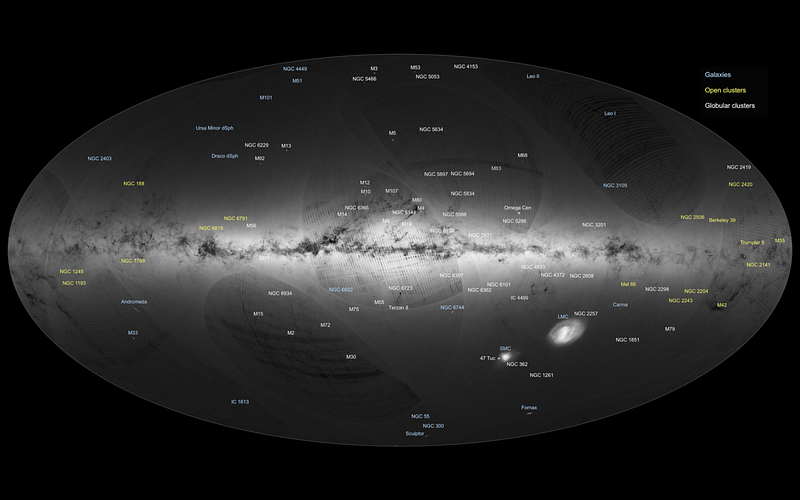

Gaia mission has detected future neutron stars and black holes, among other things
Among the data collected are those of celestial bodies whose evolution indicates that they will turn into black holes or neutron stars in the future. The researchers were able to isolate nearly 270 such objects. In the current Gaia DR3 catalog, exotic objects such as neutron stars or black holes are found by two methods. The first requires observing stars in binary systems with such objects and studying the deformation of the star by tidal forces. From the data we are able to estimate the minimum mass of the dark object. If it is about one-two solar masses, it is probably a neutron star. A larger mass suggests a black hole. The second method is gravitational microlensing, in which the mass of a dark object causes a distant star to brighten that has fallen in the same line. We can determine the mass of the lens by measuring the temporary change in position and the change in brightness of the distant star. Only Gaia provides a set of such information for a very large number of stars with sufficient accuracy.

Internet users will help with research
The vast amount of data from the Gaia mission will make it possible to solve mysteries of the Universe. However, large amounts of data are a problem. This concerns both the community of professional astronomers and astronomy enthusiasts.
With the opening of the DR3 archive scientists announced the first project aimed at amateurs, the citizen science of the Gaia mission. It’s the start of the countdown to the inauguration of the Gaia Vari community research project, which will allow Internet users to take an active part in the classification of variable objects observed by the mission.
Machine learning algorithms are often used to classify large amounts of data in astronomy. Among the billions of objects observed by the Gaia mission, there are some unusual ones that are difficult to classify. In this case, the human eye is invaluable for finding details that are beyond the scope of automated methods. Unusual phenomena are often the ones that change our knowledge. Hence, the contribution of astronomy enthusiasts to making new discoveries can be quite considerable.
Cool that you made it to the end of this article. I will be very pleased if you appreciate the effort of creating it and leave some claps here, or maybe even start following me. Thank you!