
Twilight of the Skeptics
Mick West’s UFO Spectrum Explained
The professional skeptic has built a ‘spectrum’ to illustrate the range of UFO conspiracy theories, but it needs an upgrade.
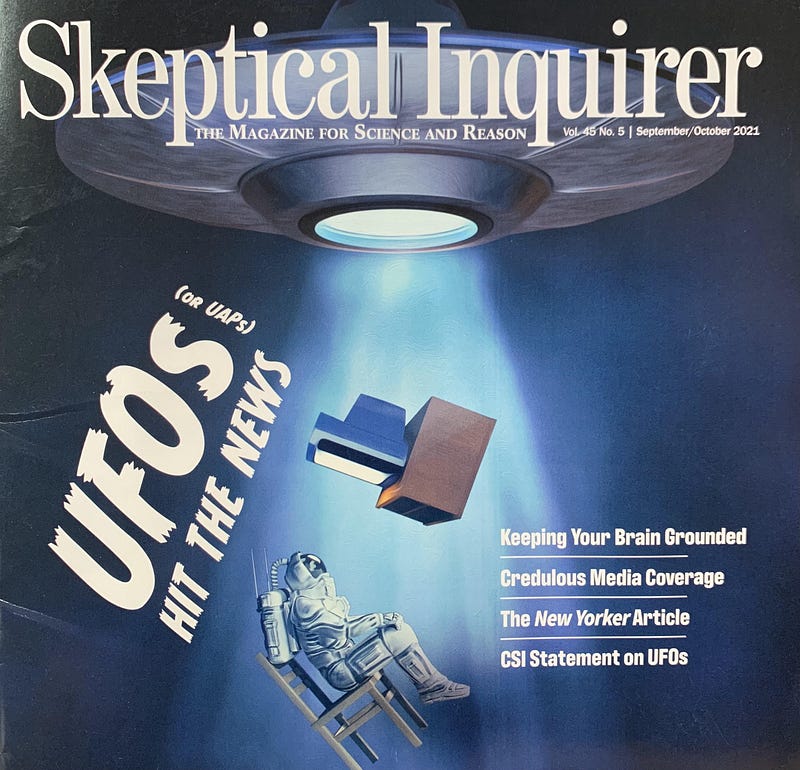
Twilight of the Skeptics is an occasional series that looks at the convergence of skepticism and ufology. It was inspired by Skeptical Inquirer magazine’s September/October 2021 issue which challenges the “credulity” of media coverage of UFOs and extols the virtues of “skepticism” in looking at the phenomenon. — The Editor
In THE CRUSADE AGAINST UFOLOGY and all things weird and paranormal, Skeptical Inquirer and all those who mindlessly “debunk” things they don’t understand have a problem, an elephant in the living room of sorts: The government takes UFOs more seriously than they do.
Obviously, they have to.
If you spend around $65 million on an F/A-18 Super Hornet and then millions more training someone to fly it, “Tic Tacs” that buzz them during training exercises and pop up at their secret rendezvous point 60 miles away before they know where it is themselves, you’re likely to pay attention.
Particularly if the pilots see them day after day. Or when they swarm an $8.5 billion U.S. Navy aircraft carrier. Or when they pop out of (or vanish into) the ocean. Or when they loiter next to your missile silos and exhibit the ability to tinker with your nukes. That, particularly, would make you very serious.
The hypotheses, deductions and conclusions ufologists have drawn from the history of government engagement with UFOs provide skeptics with an easy target that they call a “conspiracy theory,” which — by insinuation — should not be believed and can be safely ignored.
Which brings us to Mick West.
The Game Designer-Turned UFO Skeptic
West is a retired British-American game designer and relative newcomer to the scene of professional skepticism, which makes an analysis of his approach to UFOs tricky. To his credit, he seems to be learning and evolving. Even as I was preparing this article, West’s UFO rhetoric proved to be something of a moving target, as you’ll see below.

The author of the 2018 book Escaping the Rabbit Hole: How to Debunk Conspiracy Theories Using Facts, Logic, and Respect, West has, to his credit, done some good work. He is clearly alarmed by the rise of QAnon and seems genuinely interested in helping people out of that delusion-soaked swamp. He also co-authored a peer-reviewed scientific paper in 2016 with several climate scientists in a commendable effort to close the book once and for all on the silly “chemtrail” conspiracy nonsense. The paper was published in Environmental Research Letters and was found by the data science company Altmetric to be among the top five percent of all peer-reviewed research in terms of the interest it generated as evidenced by citations in other journals and mainstream news outlets.
He is not cantankerous (in writing, anyway) like veteran UFO debunker Robert Sheaffer, who clearly revels in the fight. The conversations he’s had with Seattle podcaster Zac Cichy, whose interest in and perspective on UFOs goes back a couple decades and is both complex and compelling, have been nuanced and interesting.
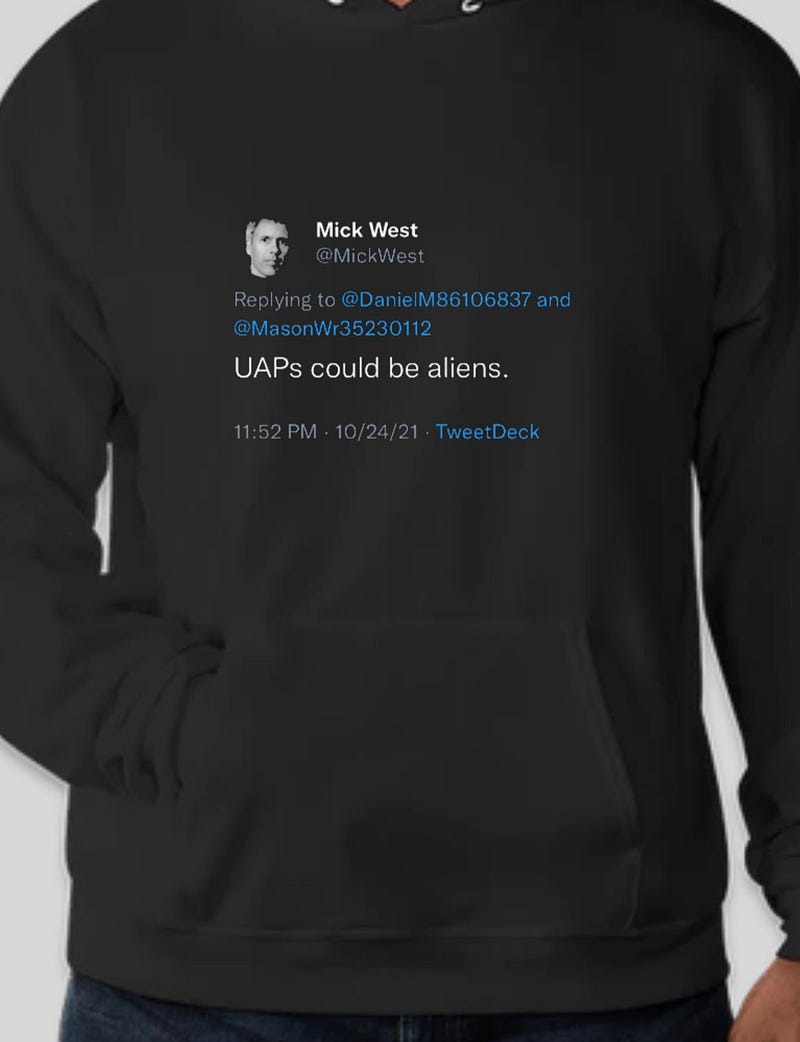
Most significantly, earlier this year on Twitter (but a couple months after his first column in Skeptical Inquirer appeared) West weighed in with these remarks:
For a professional skeptic to acknowledge that an extraterrestrial origin for UFOs “should be on the table” and that UAPs “could be aliens,” is remarkable, although I suspect most skeptics have probably at some point said as much in a grudging, perfunctory way — even if their work makes it clear they think the idea is rubbish. Possibly the real marvel here is not so much what West said, but that he said it in the #UFOTwitter thunderdome, where participants best wear a flak jacket or at least have a thick skin.
West is active on Twitter, where I’ve had the occasional exchange with him, and he is unfailingly cordial and even helpful. Candidly, I don’t pay much attention to his work because his focus (at least on Twitter) seems to be on trying to debunk UFO videos and photos, which is a YouTube rabbit hole that just doesn’t appeal to me.
All that said, West is committed to the UFO debunker’s role, which above all else is to insist: There’s nothing to see here. There is no ‘there’ there. Smoke doesn’t mean there’s a fire, etc.
Even when there is.
‘UFOs are aliens’
In his debut Skeptical Inquirer column, The Practical Skeptic, West this year tackled UFO conspiracy theories. “You might not think of the topic of UFOs as being a conspiracy theory,” he begins. “After all, who is allegedly conspiring?” Interest in UFOs, West says, “almost invariably comes along with some kind of conspiracy theory.”
He continues:
“To understand why, we must look at the other unspoken belief (or at least exceedingly strong suspicion) that UFOlogists have: That UFOs are related to aliens — creatures from another planet.”
If this is the foundation of West’s argument for what he calls a conspiracy theory spectrum, it’s made of quicksand. It’s like saying, “To understand why someone believes crazy shit, you need to look at this other crazy shit.”
West is skipping a step here.
Understanding why an interest in UFOs “almost invariably comes along with some kind of conspiracy theory” requires one to look at the evidence — limited though it may be —that forms the basis for those beliefs or exceedingly strong suspicions, the latter of which is just another way of referring to a hypothesis.
It also seems not to have occurred to West that the evidence for a government conspiracy (the threshold for proof of which is considerably lower than what would be required to prove the existence of aliens) easily justifies an interest in UFOs in the first place. One could argue that the secrecy — and that’s really the foundational conspiracy that matters — helps foment uninformed and silly speculation, and we all know how skeptics feel about that.
West goes on then to establish that the UFO-alien link — unproven though it may be — is, at some level, embraced by “everyone” who is interested in UFOs so he can then move on to swatting down their attendant and ostensibly irrational ideas about UFO conspiracies. The final sentence summing up this section, interestingly, offers ironic context for his tweet in October:
“Who is saying UFOs might be aliens?” he asks in his column. “Everyone is.”
Let the record show that West joined “everyone” at 9:52 p.m. Pacific Time on October 24, 2021.
The UFO Conspiracy Spectrum
Expanding on the model he presents in Escaping the Rabbit Hole, West argues that UFO conspiracy theories tend to fall on a spectrum that ranges from such “mundane” realities as corporate corruption and organized crime to obviously delusional ideas like flat-earth theory, or the epistemological junkyard where QAnon lives.
As a professional skeptic, I suppose West is obliged to acknowledge the full spectrum of UFO-related conspiracy, which at the far end includes subjects like interdimensional entities, “secretive magical creatures from earth,” time-traveling humans, etc.
But putting aside the fact that topics such as interdimensionality and even time travel are now acknowledged by some scientists to be at least theoretically possible, there’s really no reason to spend time on that end of West’s conspiracy spectrum.
For the purpose of establishing the legitimacy of the topic at all and clarifying the reality of a paranormal phenomenon that is worthy of serious inquiry, all one must do is venture a few steps in from what he calls the “mundane” end.
So let’s take this one step at a time.
‘Mundane’ Conspiracy Theories
Here’s West in his Skeptical Inquirer column:
“Ranking somewhere between zero and one is the simple idea that the government … has some evidence of anomalous objects, does not fully understand what that evidence shows, and is very loosely conspiring to cover up the fact that they don’t know.”
This, West adds, is “barely-a-conspiracy theory” because it makes no reference to aliens. He continues:
“But the stakes rapidly escalate for the majority of UFO enthusiasts. Most … believe that ‘the phenomenon’ (an overinclusive term that in reality covers a panoply of diverse and largely unconnected events) has been going on for seventy years or more years. The government has had ample opportunity over those years to gather data. So the conspiracy becomes a more fully-fledged cover-up. The government allegedly knows UFOs are ‘real,’ but won’t tell the public.”
At some point in Twilight of the Skeptics, we’ll revisit the “panoply of diverse and largely unconnected events.” For now, it is informative to parse this last sentence, because the implication of slapping quotation marks around “real” is to basically do the very thing skeptics say shouldn’t be done: Equate “UFO” with “alien.”
Since Kenneth Arnold saw whatever it was he saw in 1947, everyone has known that unidentified objects (or phenomena) are real. Literally no one disputes this. Skeptics remind us of this all the time: The ‘U’ stands for unidentified! It’s as much a mantra as it is a statement of fact.
The “‘real’-ity” here that merits our attention is the existence of a genuinely mysterious and seemingly exotic phenomenon that the government not only won’t explain but cannot explain — and not because of insufficient data, but because all available data suggests or affirms an ontological anomaly that appears to exclude all known natural or human origins. West has already acknowledged that reality by framing them as “anomalous objects.” And as far as that goes, a chorus of ex- and current government officials are singing that same tune.
“We don’t understand everything that we’re seeing,” Director of Intelligence Avril Haines said recently at a forum on “Our Future in Space” in Washington D.C., becoming the first DNI in history to acknowledge that extraterrestrials were a possible origin for at least some UAPs that have mystified investigators. Sen. Mitt Romney this summer on CNN — sorry, I keep coming back to this, because the significance of it seems to be lost on literally hundreds of millions of people — unequivocally ruled out China, Russia and the United States. NASA Administrator Bill Nelson said that when he read the DNI’s classified UAP report, “The hair stood up on the back of my neck.”
Skeptics can deny it all they like, but half a century of ufology has produced a staggering amount of evidence — and yes, by “evidence” we include testimony by thousands of credible, serious people — that such an anomaly, regardless of what anyone thinks or presumes or hopes or claims it might be, exists. Even famed UFO debunker Philip J. Klass seems to have understood this at some level. He put it in writing. In hindsight, it may be the most important thing he ever wrote.
A Flawed Spectrum
Now we circle back to the first two landmarks on West’s spectrum of UFO conspiracy, both of which add up to something like this:
Based on decades of study, the U.S. Government has evidence of anomalous objects, which we colloquially call ‘UFOs’ and/or ‘UAPs.’ Regardless of whether the government understands their precise nature and origin, it has historically been secretive about the fact that it was even studying the phenomenon (sometimes going so far as to deny they were doing so when they actually were) and reluctant and/or unwilling to disclose everything it has learned about them, hiding behind “national security,” etc.
On West’s spectrum of UFO conspiracy theories, presuming we’re using the “on a scale of one to ten” ranking system, that pretty much encapsulates 1–3, with the first one being so “mundane” (i.e., completely obvious and/or believable) as to be “barely a conspiracy theory.”
There’s just one problem with this piece of real estate on West’s UFO conspiracy theory spectrum, or rather, more like a fatal flaw: None of it is theoretical; it’s all true.
Let’s be clear about precisely what we’re talking about, and what we’re not talking about:
In the absence of an alien autopsy performed at the Mayo Clinic by licensed physicians from the American Medical Association selected by Neil deGrasse Tyson and live-streamed on high-definition video on every cable TV network in the country with the full results published in the New England Journal of Medicine and Lancet, people can debate the reality of aliens from now until the end of time.
That’s not what we’re talking about — not on the spectrum as defined by West. If we’re sticking to only these first few points on West’s spectrum, “aliens” is not a question we can resolve or even need to ask. This part of the spectrum does not include aliens; he says so. It refers only to “anomalous objects.” And, as skeptics insist at every opportunity, anomalous does not mean aliens. Anomalies in science happen all the time. And when they occur with the frequency that UFOs do and in the myriad of ways that they do, they ought to be investigated.
West is welcome to conceive whatever spectrum or matrix he wants to gauge people’s capacity for the varieties of what he regards as UFO delusion, but it’s time to upgrade the one he unveiled in Skeptical Inquirer. To be sure, it was flawed from the get-go, but the last few years have scorched one end of it.
West can put Bob Lazar, Roswell, reptilians, anal probes, and interdimensional time-traveling shape-shifting lycans anywhere he likes on the conspiracy spectrum. But with regard to 1–3, developments in just the last few months are enough to nudge those “theories” into the “fact” bin.
Even if West and Skeptical Inquirer aren’t ready to go that far, there is clearly enough — more than enough, in fact — at this point to press forward and give “conspiracists” on the left end of the spectrum the benefit of the doubt. A hypothesis, after all, isn’t supposed to be a stopping point, a perch from which “believers” can claim that the matter is settled; it’s a starting point for further investigation.
The problem facing ufology is that the public institutions that are best equipped to conduct such an investigation — and, in fact, have — won’t reveal all that they know. The various government agencies and personnel that have engaged with the phenomenon at all over the decades have conspired to keep much of what they know secret.
Sure, NASA’s Nelson said the classified material on UAPs made the hair on the back of his neck stand up, but he wouldn’t say why. Most of the U.S. Navy’s videos of UAP activity have yet to be made public. The Pentagon’s former UFO guy, Luis Elizondo, drops hints almost daily that we’re staring down the barrel of an epoch-shattering revelation about UAPs, but …sorry, non-disclosure agreement, can’t say more now, but it’ll come out, wink wink. The list goes on and on.
Skeptics lost the “mundane” ground long ago. It’s gone, whether they accept it or not, buried under the weight of history. The intellectually honest thing for serious investigators (and skeptics) to do at this point is to ask tough questions based on the view afforded by that ground and to demand the highest degree of government transparency about UFOs.
That’s what skeptics ought to do. What they do instead is remain silent on the transparency issue, bitch and moan whenever someone like Harvard scientist Avi Loeb or Senator Kirsten Gillibrand moves to study the topic, and blame the media for covering the issue in the first place.
As the UFO story continues to spill out — and it will, for a variety of reasons — that won’t be a comfortable place to be.
Trail of the Saucers is published by Stellar Productions and edited by Bryce Zabel. It focuses on UFO/UAP news, history, culture and analysis. Here are a few more articles from our archives —


