
Case Files
He’s the Reason We Know about the ‘Tic Tac’ UFO
Kevin Day saw something on his radar scope back in 2004 that just didn’t make sense. Then he saw the strange objects again… and again. Seventeen years later, he’s still bearing witness.
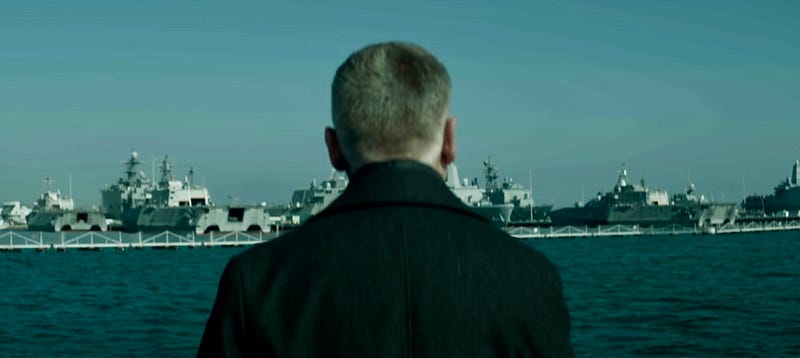
On December 16, 2017, the New York Times published a historic exposé revealing both a black-budget Pentagon program that had been studying UFOs in the shadows and several videos captured by Navy pilots of UFOs they’d encountered off the East and West coasts.
The most publicized of these events, the 2004 USS Nimitz “Tic Tac” event began when one man noticed something odd on the bright green radar screen staring back at him in the dark belly of the USS Princeton. Whether he meant to or not, that radar technician helped document one of the most significant UFO events in decades.
Along with other witnesses, Kevin Day will appear in the new Showtime series from J.J. Abrams’ Bad Robot, UFO, that drops all four of its episodes this Sunday, August 8.
A Day in the Life
In Cave Junction, Oregon, Kevin Day was at the Illinois Valley Golf Club restaurant, volunteering to wait tables and keep bankruptcy at bay. He and several patrons were watching a golf tournament on one of the televisions when someone abruptly changed the channel to CNN for what appeared to a breaking story. That’s when his jaw dropped.
The voice in the video broadcast was the same he’d heard that day in 2004 in the waters off of Catalina Island: The frantic voice of a TOP GUN fighter pilot who was engaged with something that defied logic. Day watched the screen, tears coming from his eyes. Not only was he there when this event had happened, but — he now realized — he’d hidden it for so long. And now it was staring him in the face. The world was about to learn about the extraordinary incident now know as the Nimitz UFO event.
“What Flies Like That?” — November 10th, 2004
Radar Operator and Air Intercept Controller, Kevin Day, was working the evening shift in the Combat Information Center aboard the USS Princeton carrier. The Princeton was making its way through the Pacific, accompanied by the USS Nimitz carrier strike group.
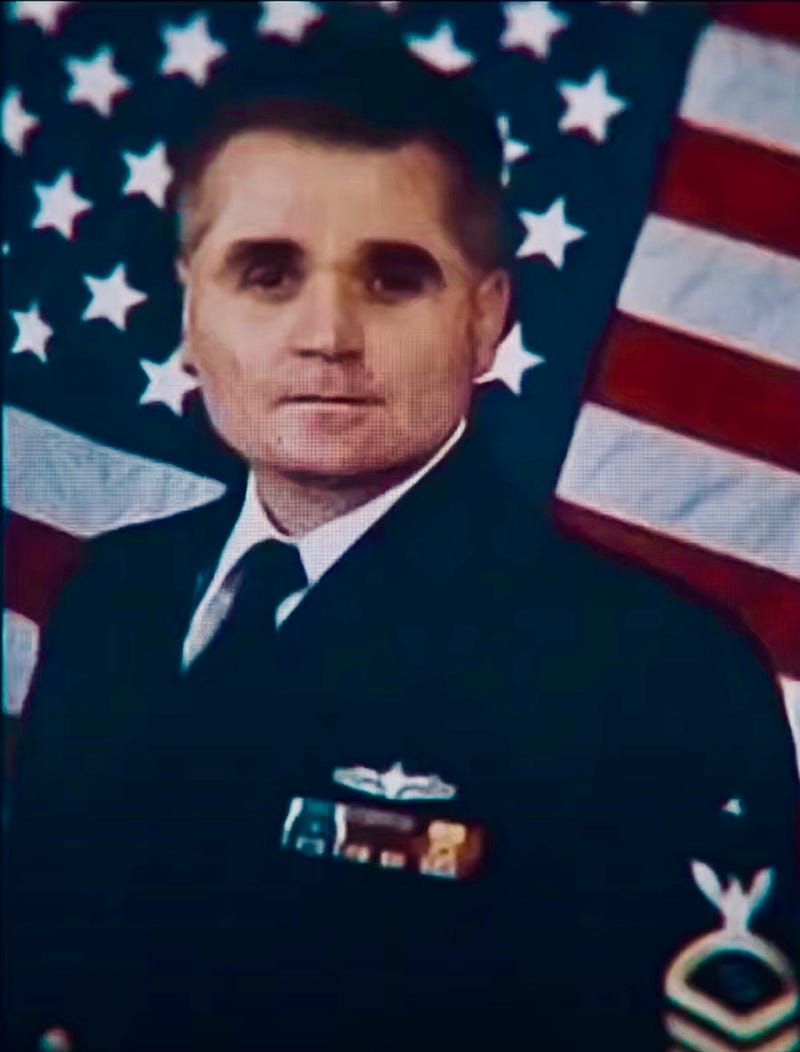
Both vessels were preparing for a training exercise in the waters and airspace of Southern California. Day was operating the SPY radar — a brand new and, at the time, highly classified multifunction phased-array radar capable of search, automatic detection, transition to track, tracking air and surface targets, and missile engagement support. It was the most highly sophisticated system Day had ever worked with, and he was one of the best with it.
That evening, Day noticed something odd about 100 miles north of his position near Catalina Island.
“As the on-watch anti-air warfare coordinator, I had asked the electronic warfare supervisor if he held any electronic emissions emanating from the new tracks that I held on SPY radar, giving him the system track number, just east of Catalina Island. He reported back that the system was not detecting any electronic signals originating from the odd formation of five new tracks that I held. I was confident the tracks were actual air contacts because they had the highest possible system track quality. However, the contacts were in a loose formation at 28,000 feet, tracking south at 100 knots, which was odd. What flies like that? How could something that high travel that slow? Anything lighter-than-air would be traveling in the direction of the prevailing winds, which were from west to east. Not south. It was definitely odd.”
With the contacts to the north, Day didn’t believe it to be too much of a concern from an air defense perspective. He decided to simply track and report, making it available to internal and external ship communications. “I thought that maybe it was something entirely civilian-related and they didn’t even know our strike group was at sea to the south.”
Day continued tracking the group of contacts for about two hours that first evening. “The contacts passed to the east of our ship’s position in formation and eventually faded from my radar off the coast of Baja, in the vicinity of Guadalupe Island, Mexico. And with that, I turned over the watch to the next watchstander, and headed below to the chief ’s mess for the evening.”
Whatever had happened was most likely a fluke. Or so he thought. Back on watch the following morning, Day detected the objects once again east of Catalina Island.
“Now I’m really curious, although not from an air defense perspective. Both the Princeton and Nimitz were at sea to conduct air defense training, but it was not scheduled to take place until November 14th, and I was not yet concerned about any potential airspace intrusions presented by the odd formations, which would indeed create safety-of-flight concerns during any would-be air defense exercise taking place in that same airspace.”
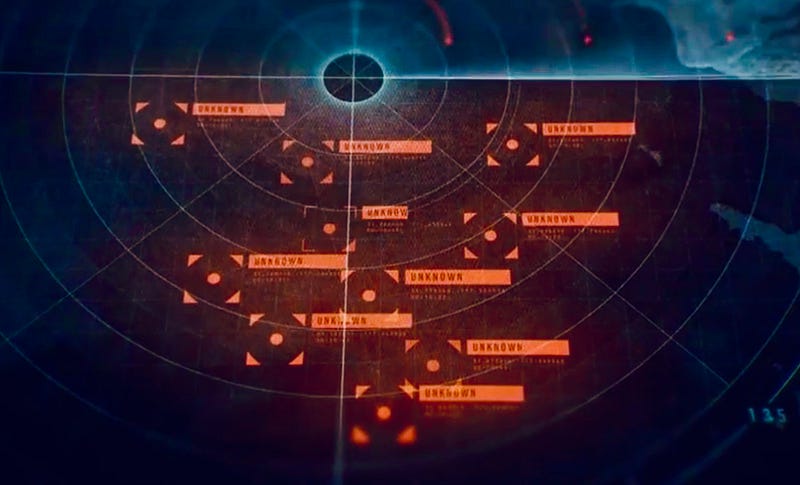
But over the course of the next few days, the Princeton continued to track additional groups of these contacts. The objects seemed to be in loose formation and anywhere from five to ten at a time. They repeated the same tracking over radar coverage. Same altitude and location, traveling from Catalina Island to Guadalupe Island, soon fading from radar. What the hell is going on? Day remembered thinking. He once again thought it must be something civilian, and surely would not be a problem come time for the actual training exercise.
The Day That Changed Everything
It was now November 14th, 2004. Back in the Combat Information Center, Day was on watch, preparing for the highly anticipated exercise. “The training scenario called for mock-enemy aircraft to launch from Naval Station North Island, Coronado, and attack our strike group located about one hundred miles southwest of San Diego.”Everything seemed normal and the entire crew anticipated a successful exercise by the books.
Until the objects returned yet again.
Now Day was concerned. “We would be launching exercise aircraft from two directions into the same airspace as the unknown air contacts.” The strike group was in position and ready for the exercise. But Day knew he couldn’t let this exercise happen without voicing his concerns about these unknown objects that had haunted the area and his radar. After convincing his captain of the potential threat these anomalies could cause, his captain the captain, agreed and ordered him to intercept and VID (visual identification) the object(s).
Soon, Day headed back to his radar console and ordered an intercept to visually identify the bogey. Commander David Fravor, a TOP GUN strike fighter pilot for the Black Aces, responded, eager to comply. Soon, Fravor headed toward the inbound unknown group. Back in the control room, Day watched as Fravor’s plane approached the bogey.
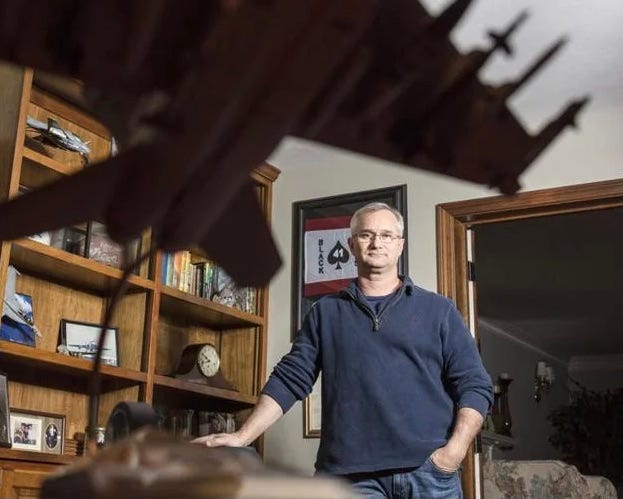
During this entire exchange, all communication was being fed to an overhead speaker. Day patiently waited for any updates, when suddenly the pilot’s voice blasted over the speaker.
“Oh my God! I’m engaged! I’m engaged!”
What happened next left Day and the team visibly shaken. As they watched on radar, the bogey suddenly descended from 28,000 feet in altitude down to the surface of the ocean in what Day would soon learn was .78 seconds, without a single sonic boom. Fravor did all he could to chase the object, attempting to identify it. Once he got eyes on it, he would describe a single oblong-shaped object, about forty feet long, no wings or signs of propulsion. (It would later be described as a white-colored “Tic Tac”) Besides the object itself, Fravor was also mystified as the object, when close to the surface of the ocean, created a disturbance in the water that almost looked like a cross and about the size of a Boeing 737 jetliner. The water appeared to be “boiling or “frothing” and then disappeared as the “Tic Tac” gained altitude, darting upward at unbelievable speeds again. Day would explain that:
“We all watched on radar when suddenly, the contact went from the new merge plot position to a point in space called the Combat Air Patrol station, or CAP point. Although well-known to the air defense team, a secret location to everyone else. We all looked in wonder at each other because the contact had somehow went to this CAP point. Latitude, longitude, and altitude. A point then about sixty miles away from the last merge plot position. It had taken the object approximately two seconds to make that maneuver.”
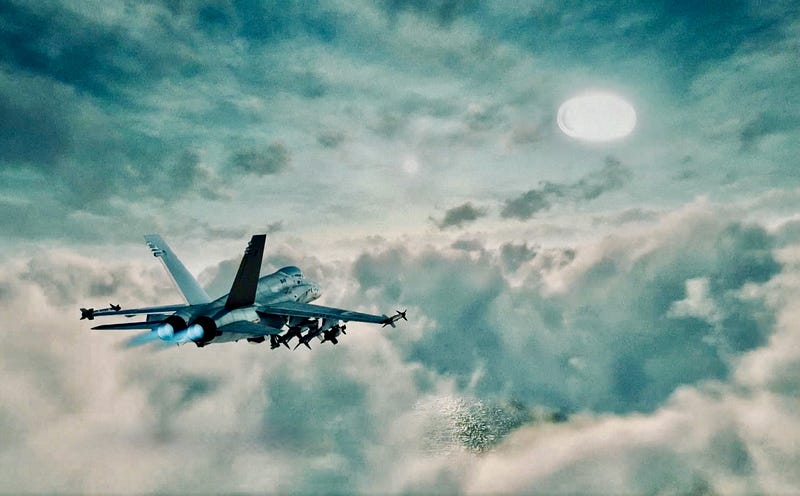
Back on the Nimitz flight deck, Commander David Fravor instructed the lead pilot of the next launch, Cmdr. Chad Underwood, to prepare to intercept and record the contacts using the Advanced Targeting Forward Looking Infrared Radar (ATFLIR). Underwood was able to get within a twenty-mile proximity of the object and set his infrared gun-pod camera to record. He was able to capture the object. He reported back to the Information Center that the object was behaving exactly like it had when Fravor was chasing it. “When the interceptors merged, the object once again fell from the sky to the ocean’s surface in less than a second,” Day would explain.
“At one point, it was raining UFOs.”
And just like before, when the interceptors chased them down, the bogeys shot straight back up from the ocean’s surface, back to 28,000 feet, back to 100 knots tracking south, reforming their group.
“It was then when I realized that I had just intercepted no-shit UFOs!”
The objects soon disappeared, and Underwood returned to base, having just recorded what would soon become one of the most famous UFO videos to ever be made public.
Not long after the event, Day was transferred off the ship, this event being his last duty station in the Navy. “A UFO was also my very last intercept out of the hundreds I’d made during my career as a TOPGUN- trained air intercept controller, including wartime operations. I had never seen anything remotely close to what we’d encountered over those days, much less be in a position to actually intercept a real UFO. But that is exactly what we did.” And as soon as the event had occurred, it faded into the skies and waters of Southern California, for what Day believed, would be forever.
The Aftermath
Day retired from the US Navy in 2008. Almost immediately, he went to work for a Defense Department contractor. “My work involved manning and training analysis as well as engineering in support of mostly weapons control systems on naval ships.” Things slowed down quite a bit for Day as he integrated back into civilian life, but the memories of the Tic Tac event didn’t fade. “I had retired from the Navy, but my concerns over what we had encountered certainly did not retire.”
While Day didn’t fully understand or realize it at the time, burying these concerns deep down began to slowly eat away at him. His nightmares became worse. It seemed as though life was spiraling out of control. The integration back into civilian life, and this highly strange event being so recklessly ignored by the Navy, was dizzying. He couldn’t keep silent any longer. “Not knowing what else to do and knowing nobody would likely ever believe my incredible story about intercepting UFOs, I decided to write my story in a semi-fictionalized version of the actual true story. My plan was to hide the story in plain sight, just in case the encounters ever became public.” Day felt that by putting the story in a fictionalized context, it would at least get the story off his chest and out to the public in some fashion. It would also protect the privacy of those involved who wished to not go public. The incident was written as a short story, “The See’r,” which was part of a two-book series Day titled Sailor’s Anthology: Books I and II. It was published in 2008 in the Library of Congress. Little did Day know that hiding the story in plain sight would prove beneficial, not only bolstering the entire event, but solidifying his direct involvement when the story would be blown wide open almost a decade later.

While he was able to put the incredible events down in print in the Library of Congress, it didn’t change the fact that Day, having served in wartime and also being solely responsible for originally tracking the UFOs raining over the coast of Southern California, was suffering greatly. “During these years, my life turned for the worst. I lost several homes during the 2008 housing crisis. My work suffered, too. I ended up quitting my job and moving to Sacramento to attend school. My wife and I separated shortly after. Immediately after graduating, I moved back to my home town by myself in Southern Oregon.” It was during all of this that Day finally went to see Veteran Affairs for help. He was subsequently diagnosed with a complex case of PTSD.
“My family, friends, and colleagues were shocked. I had gone from being on track for a nice retirement to living in the wilderness, completely broke and disillusioned about my former life.”
As time progressed, Day felt resentment creeping in. This UFO event, coupled with what seemed like endless other challenges in his life, made him feel quite lost. But slowly he began to rebuild his life. He would eventually purchase a new home, reconnect with his wife, and start volunteering at the local golf course. With the remarkable UFO event he’d experienced behind him, Day had truly started a new chapter in his life and was finally on a path he’d always wanted. Until the event would not only come back in to his life, but the whole world was about to learn about it.
The Next Chapter
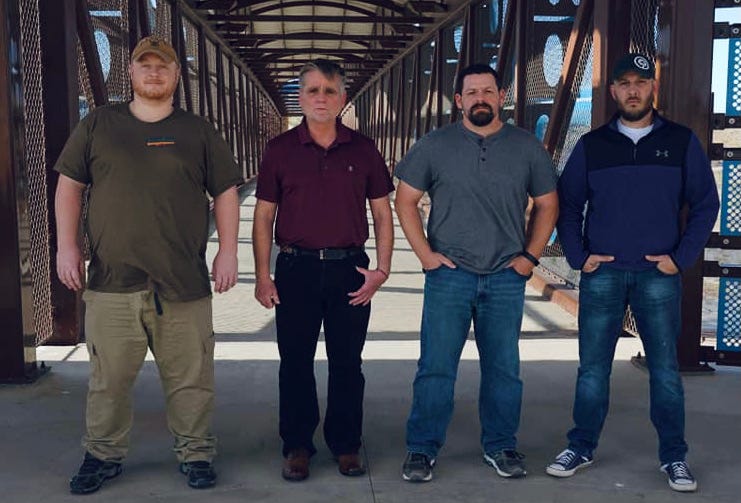
Knowing that Cmdr. Fravor had put his reputation on the line to speak about the “Tic Tac” event, Day felt he had to do the same and support Fravor’s testimony. “News of my involvement spread like wildfire. It was not long before I was contacted by Dave Beaty, a TV producer. Dave and I collaborated, on “The Nimitz Encounters.” Beaty was able to find other witnesses to the event to come forward as well. These included even more stunning testimonies from Gary Voorhis, fire controlman on the USS Princeton; Patrick Hughes, aviation tech on the USS Nimitz; Jason Turner, petty officer 3rd class on the USS Princeton; and Ryan Weigelt, leading petty officer and power plant specialist for the SH-60B “Seahawk” helicopter.
Soon, the black-and-white “Tic Tac” UFO video, spanning a little over a minute and a half, now had context and interlocking testimony from witnesses at different vantage points and involvement with the event. The video was one of three videos released alongside a hefty New York Times article concerning the Advanced Aerospace Threat Identification Program through the Pentagon.
As the larger story of the program and various other Navy encounters with UFOs were now circulating around the world, Day connected with the various other officers and Navy personnel to try to piece this puzzle together. What had they all seen while aboard those carriers in 2004? What had the pilots encountered in the skies? But perhaps most importantly, why was nothing being done about it? If the Navy wasn’t going to attempt to find answers, or at least make what they knew transparent to the public, then these former shipmates were going to attempt to find answers themselves.
UAP Expeditions

In 2018, Day, Gary Voorhis, and several other and several shipmates formed UAP eXpeditions Group. According to the group’s mission, they plan to “provide a free public service, field-testing UAP related technologies. Our top notch team of physicists, research scientists, and trained observers captures and records broad-spectrum evidentiary data from UAP sightings. Partnering with technology developers and entrepreneurs at no direct cost to them, our team tests new equipment and devices featuring multiple data capturing modalities. We hope to provide unassailable scientific evidence that UAP objects are real, UAP objects are findable, and UAP objects are knowable.”
The first planned expedition is already underway, bringing the team of former Navy, Air Force, and scientists together to investigate in the waters where the 2004 “Tic Tac” event had occurred. Day would state that:
“We want to see if these phenomena appear with certain frequency and if the phenomena can be observed on our own terms.”
UAP eXpeditions is an ambitious undertaking, headed by a passionate team putting their curiosity into an unprecedented experiment. Only time will tell what the UAP eXpedition Group will uncover, but as the world continues to discuss the short video captured that day in 2004, the men who were there are set to embark on a bigger journey to finding answers, whether the Navy, the Pentagon, or even the phenomena itself, likes it or not.
Looking Up and Looking Forward
The events of 2004 had affected everyone involved in many different ways. But for Day, it was an opportunity to rebuild a life he’d left out there on the U.S.S Princeton carrier. He no longer had to keep the event hidden deep down, fearing ridicule. Many were finally ready to listen. Since coming forward, he has been featured on countless television shows, documentaries, and in several books.
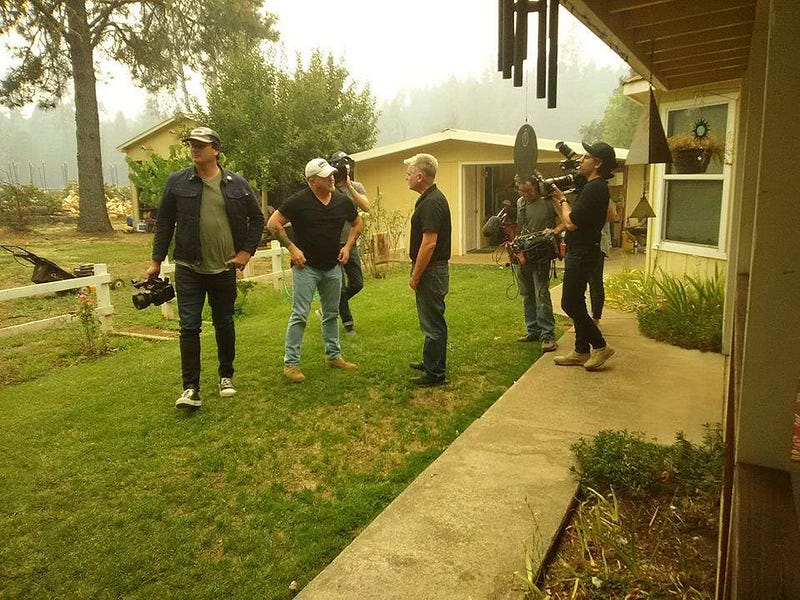
Most notably would have to be his appearance on the History Channel television show, Unidentified: Inside America’s UFO Investigation, featuring Luis Elizondo and Tom DeLonge, who personally met with Day at his home to hear his incredible story. Day will also be featured prominently in the upcoming Showtime docuseries, UFO, produced by J.J Abrams.
As the topic of UFOs continues to reach the mainstream like never before, it has prompted many former and current military personnel to come forward with their own UFO encounters, ushering in a discourse not built on ridicule and stigma, but on acknowledgement and acceptance. “What if the personal changes that happened to me suddenly happened to seven billion people worldwide?”, Day asked of all of us. “Effects on humans from UAP encounters are real. Expect to be changed.”
Kevin Day continues his journey to find answers to what happened in 2004. But now, he knows he doesn’t have to take that journey alone. And perhaps, as we all continue to search for answers, we’ll discover that we’re not alone either. We’ll discover more about ourselves and our place in the universe. And the next time we stare up in to the skies, we’ll finally realize, as Day and so many others have as well, that something extraordinary is always staring back.
If you are a former or current military service member and have a UFO encounter you’d like to share with Ryan Sprague, please contact him at: [email protected]
Trail of the Saucers, edited by Bryce Zabel and David Bates, focuses on UFO/UAP news, history, culture, and analysis. Here are three more of our articles that relate to this story.


