
Mexican axolotl: All about this unusual aquarium amphibian!
The Mexican axolotl is one of the most unique aquarium animals. What does the Mexican axolotl look like? What is worth knowing about breeding this amphibian? I answer these questions below.
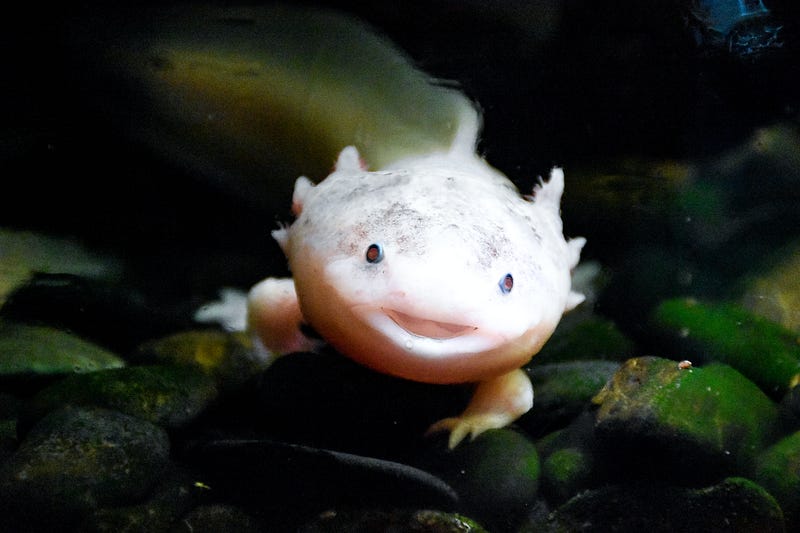
Imagine a form between a magnificent tadpole and a medium-sized fish with legs, whose mouth appears to be constantly smiling — this is what an axolotl looks like. This unique animal attracts attention not only by its unusual structure and apperception, but also by its expressive colors. All this makes it a real decoration of the home aquarium.
Are you dreaming of an exotic, uncommon pet? The Madagascar phalarope or African civet can not be kept at home, but the Mexican axolotl — as much as possible. This unique amphibian occurs naturally in Mexico, and came to Europe in the 19th century. However, it should be noted that the history of this animal is much longer. The name “axolotl” is derived from the Uto-Aztecan language Nahuatl, where the word “atl” means “water” and the word “xolotl” is the name of one of the Aztec gods. The name alone clearly indicates the animal’s role in the culture of the indigenous peoples of present-day Mexico — the Aztecs worshipped the axolotl as a sacred animal.
Mexican axolotl — description
The Mexican axolotl, (Mexican salamander or Mexican ambystoma), is often referred to as an aquatic lizard. This is a mistake, because contrary to appearances, this friendly-looking animal does not at all represent the same order as the spooky mollusk. The axolotl is a representative of the tailed amphibians of the ambystom family.
It is an endemic species, meaning that it is found only in a specific region. The Mexican axolotl’s natural habitat is the fresh waters of Lake Xochimilco. At one time, this unusual animal was also found in Lake Chalco, but due to periodic flooding, it has been almost completely drained.
What makes the axolotl one of the most unique amphibians? The very fact that this beautiful animal spends its life underwater is quite a curiosity, but that’s not all. The Mexican salamander permanently remains in the larval stage. The amphibian never embarks on metamorphosis, even when it reaches sexual maturity. This peculiarity is the result of limited function of the thyroid gland, which is responsible for the production of thyroxine — a hormone that stimulates the transformation to terrestrial form.
Another remarkable feature is the ability to regenerate members and organs. Torn off limbs of the axolotl grow back in a fairly short time, and damaged gills quickly regain full function.
What does the Mexican axolotl look like?
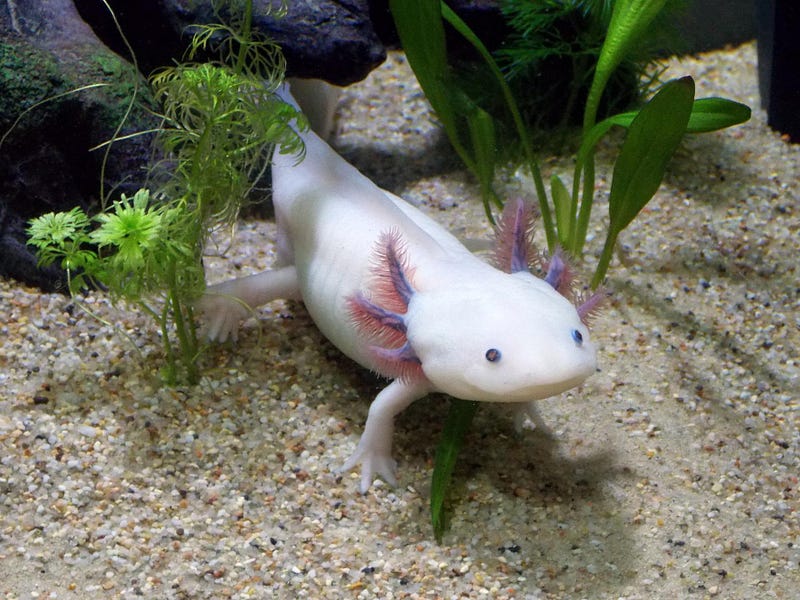
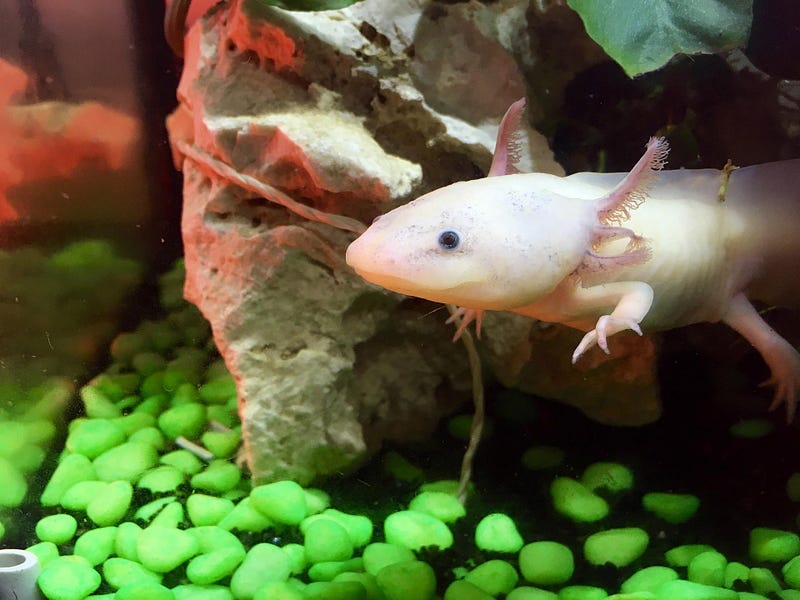
The body length of adult individuals closes in the range from 23 to 28 cm. Occasionally specimens of 35–40 cm in length can be found. The amphibian is characterized by a broad head (with small, black eyes and a large snout), a massive, elongated body and a tail equipped with a flattened caudal fin, which allows it to move in an aquatic environment. On either side of the head can be seen branching external gills, typical of amphibians in their larval form. The amphibian’s limbs are short and extremely delicate.
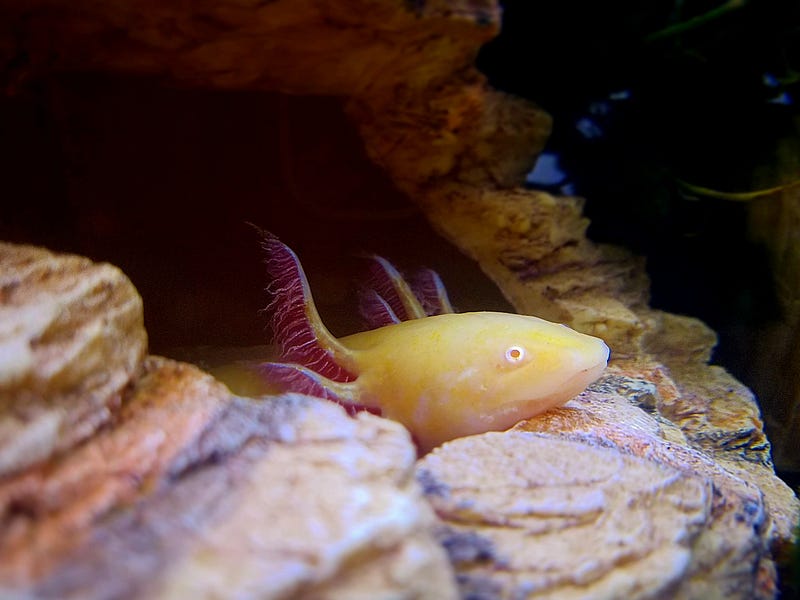
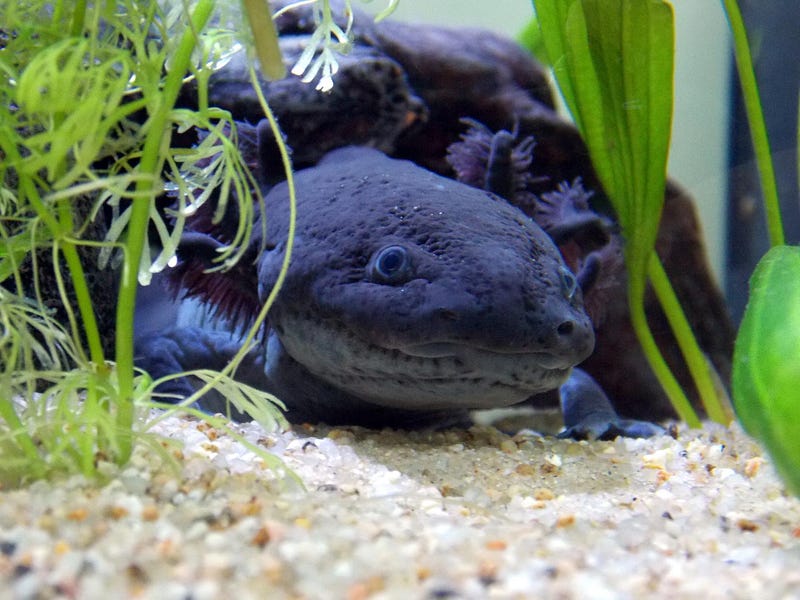
Individuals found in the wild are characterized by gray-black or brown (with numerous dark spots) coloration. Axolotls from breeding show much greater color variation. Under aquarium conditions, specimens can be found:
- white and pink,
- golden,
- copper,
- gray (in various shades),
- brown,
- white.
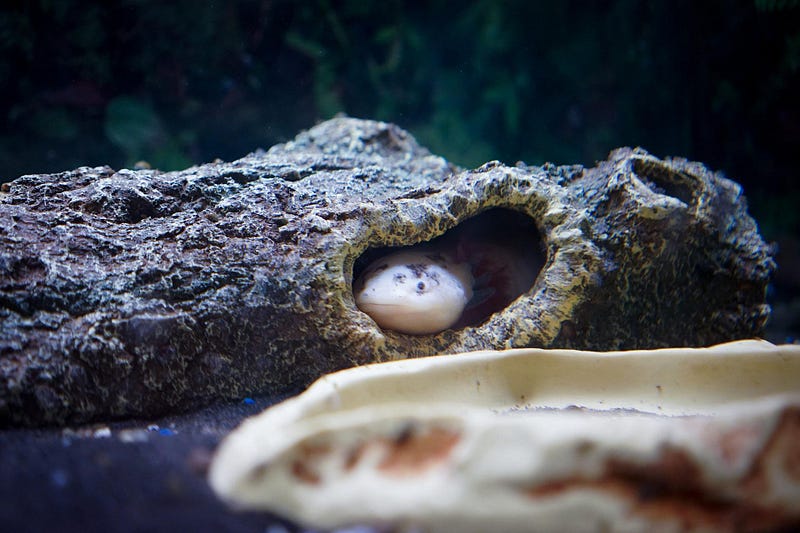
Particularly interesting are albino individuals, whose skin is almost transparent.
The Mexican salamander is a dioecious species. Females differ from males in that their cloaca is flat (in males a distinct bulge can be seen).
Mexican axolotl — habitat and lifestyle.
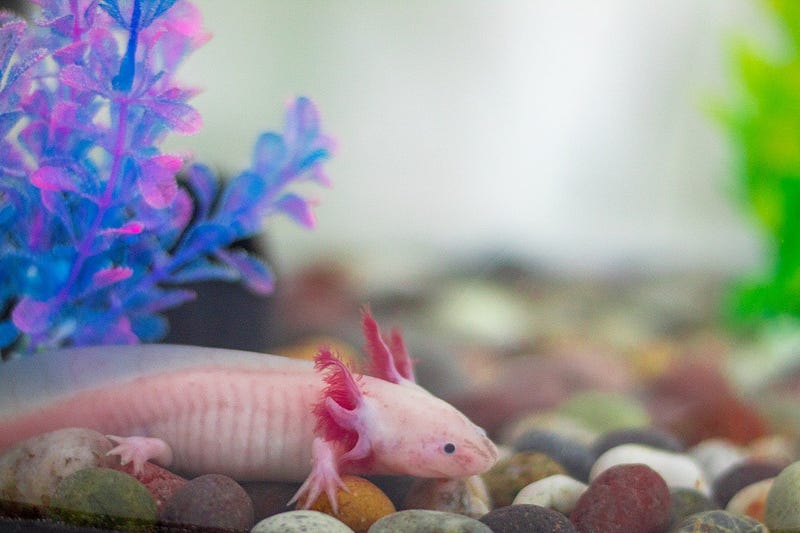
This unusual amphibian lives in cold, clear and well-oxygenated waters. It prefers a sandy bottom covered with vegetation. Axolotls used to be top predators in their environment. Due to the stocking of the lake with large predatory fish, today it looks different.
During the day, the axolotl remains almost inactive. The animal hides near the bottom. With the coming of night, the amphibian sets out to hunt. It tracks its prey using its sense of smell. It feeds on small aquatic animals that it can fit in its mouth — insects, crustaceans, mollusks and small fish. There are also cases of cannibalism among axolotls, especially when there is a high density in the area of occurrence.
It is worth noting that the Mexican salamander is not an active hunter. The animal hunts, waiting motionless for prey. When the prey approaches, the axolotl launches a lightning-fast attack and grabs it with vestigial teeth.
Mexican axolotl — requirements
The axolotl is extremely picky about its living conditions. Even in the wild, it chooses only those areas of Lake Xochimilco where it can thrive unhindered. Keeping this unusual amphibian therefore poses some challenges.
Aquarium
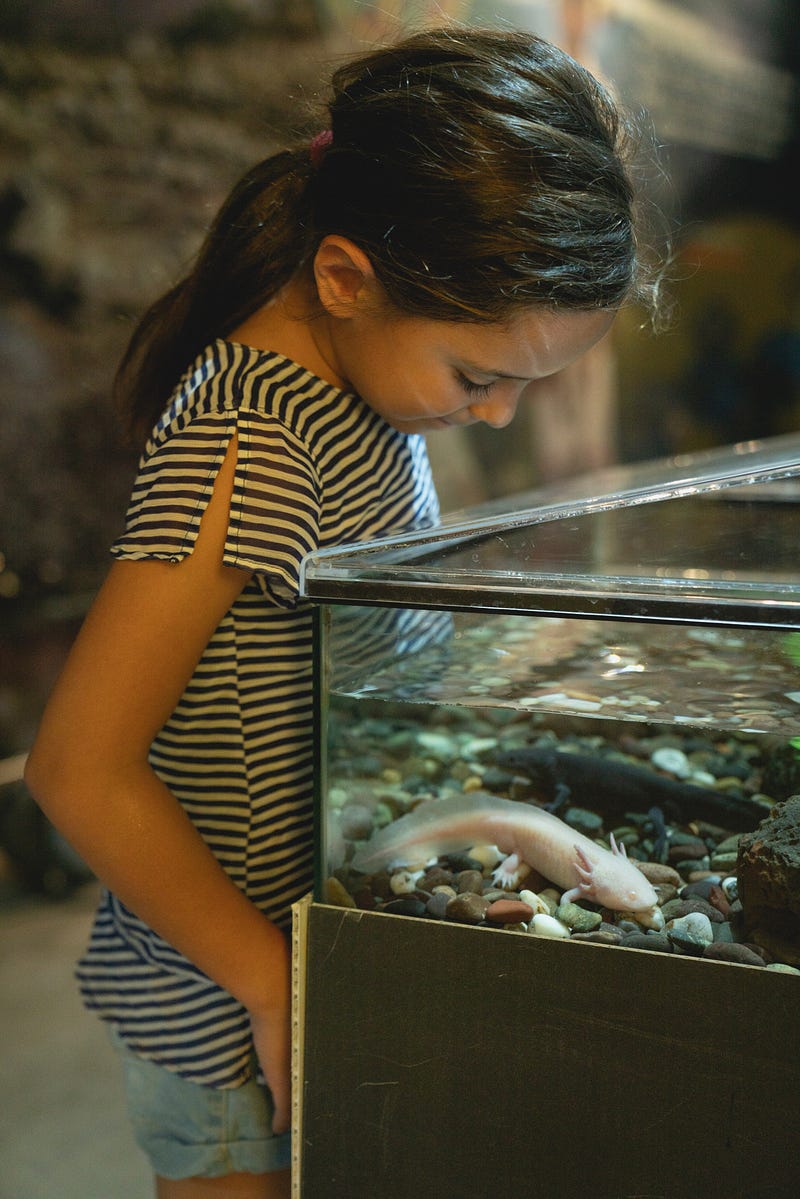
The water tank in which the breeder will create living conditions for the axolotl should be suitably spacious. There should be 50 to 80 liters of water per individual, so its size is fundamental.
An aquarium designed for one axolotl must accommodate 100 l of water, so the optimal size is about 80x35x40 cm. The tank in which two individuals will be kept should fit 200 l of water, so it should legitimize the size of 100x50x40 cm.
The place where the water tank will be set is also important. It is advisable to choose a shady area. That way, the water will not get too hot.
Water and substrate
It is also extremely important to maintain the correct water parameters. Axolotls feel excellent in hard water, the pH of which exceeds 7 (up to 7.5). In water that is too soft, the animal can lose its coloration, which does not only affect its aesthetics. This phenomenon causes severe stress, which can harm this amphibian. So if the breeder has access only to soft water, he should enrich it with potassium, calcium or sodium. The optimal content of nitrite is 0.5 g per 1 liter, and nitrate — 25 mg per 1 liter.
An extremely important issue is maintaining the correct water temperature. In their natural habitat, axolotls live in cold water. The ideal temperature closes in the range from 12 to 20 degrees Celsius. Lower (even below 10 degrees Celsius) will not harm the animal, but higher — yes. When the water temperature rises above 24 degrees Celsius, the animals become restless and panic. Such a reaction is the result of excessive stimulation of the metabolic process. The consequences can be diseases that can end in the death of the animal.
The substrate of the water tank should be lined with fine sand (the maximum grain size is 3 mm). Coarse grains or stones can cause intestinal blockage and, consequently — lead to the death of the axolotl. When choosing the decor of the aquarium, remember that these animals need a lot of free space on the bottom. You can grow plants, but with the indication that hardy species will work best.
Filtering the water
The breeder must not forget that axolotls require clean, well-oxygenated water. An internal filter will work, but most breeders choose an external filter. Such a device not only perfectly cleans and oxygenates the water, but also is unobtrusive and thus does not disturb the composition of the water tank. When choosing a filter, it is worth remembering that the water should not be excessively agitated, as this can cause stress to the animal.
Lighting
It is permissible to use low lighting of the aquarium, but only in one part of it. The Mexican axolotl prefers shaded waters, so the other part of the tank should be in semi-darkness. Do not forget about the lifestyle of this animal. At night, when the amphibian is most active, the light supply should be reduced.
Mexican axolotl — breeding.
Mexican axolotl can be bred singly, but if the breeder has a large enough aquarium, there are no contraindications before breeding a pair of these animals. It may turn out to be a great idea, especially since Mexican salamanders are not fond of the company of other species. Aquarium fish are treated by them as food.
Thanks to their developed regenerative abilities, axolotls prove to be extremely resilient animals, but this does not mean that they do not need to be given proper attention. The key issue is to maintain the correct water temperature (we remind you, up to 20 degrees Celsius) and the correct pH. If the water contains an excessive amount of acidifying components, there will be too much production of ammonia, which has a toxic effect on the Mexican salamander. Keeping the animal in such conditions will lead to its death.
It should also be borne in mind that, despite their considerable hardiness, Mexican axolotls are not free from disease. Parasitic infections are quite common. The most serious condition is an infection caused by gill crayfish. The disease leads to severe inflammation. Also dangerous for this amphibian are threadworms, wasps and mesomycetozoa.
Adult Mexican salamanders should be fed every 3–4 days, but small individuals require daily feeding. Note that the light should be dimmed for the time of feeding (due to the animal’s nocturnal lifestyle). Food can be dropped into the water or administered with tweezers. The diet of these animals consists primarily of earthworms and frozen or fresh fish. The Mexican salamander will also not disdain ochre larvae and artemia. In addition, it is worth introducing into the menu of axolotls:
- invertebrate larvae,
- flies,
- eggs,
- mealworms.
Granulated food for trout will also work well. From time to time the animal can be given raw meat.
If the breeder manages to provide his pet with the right conditions and takes proper care of it, the animal will easily live 10–15 years. Some individuals even live up to 25 years.
Mexican axolotl — reproduction.
Although Mexican axolotls remain in the larval stage throughout their lives, they reach sexual maturity and are capable of reproduction. Before this happens, the animals perform a mating ritual, which involves poking the cloaca of an individual of the opposite sex. It looks as if two amphibians are dancing a waltz. After mating, the male moves away and deposits a spermatophore. The female, who follows him, collects the sperm into the cloaca.
The hatch is laid several weeks after fertilization and contains up to 800 eggs. Two-centimeter-long larvae hatch after two weeks. 18 months later they reach sexual maturity. Note that if they are too numerous, axolotls may eat their offspring.
See how much an unusual aquarium amphibian costs
The Mexican axolotl is undoubtedly one of the most unusual animals that can be kept at home. At the same time, it is much more readily available than, for example, the collar agama, and remains much cheaper than this beautiful lizard. The price of this amphibian is ~$10, but it is worth noting that individuals that are large and of unusual color can cost more.
Cool that you made it to the end of this article. I will be very pleased if you appreciate the effort of creating it and leave some claps here, or maybe even start following me. Thank you!