
Grindadrap — the bloody annual slaughter in the Faroe Islands. Will anything change?
The Faroe Islands are the dream of many a traveler. However, the fascinating archipelago stirs up huge controversy every year over the traditional fishing of grindwalas and dolphins.

The Faroe Islands are often compared to Iceland. This is due to the equally phenomenal, though slightly different, landscapes and isolated location. The Faroese landscapes so delighted the creators of the James Bond films that it was on the island of Kalsoy that the final scene of “No Time to Die” was set.
Faroe Islands from beyond the postcard
The Faroe Islands are inhabited by Farriers. Compared to the populations of other European countries, they are few in number. The archipelago is permanently inhabited by 52,000 people. For many years the island community was quite hermetic. Only at the beginning of the 20th century, on the occasion of the wars, the British appeared on the islands. Today, the archipelago is already home to residents of many different nationalities.
However, the Farers are still very close to each other. An important role in maintaining a sense of community is played by traditions that have been cherished for generations, including the annual hunt for grindworms and dolphins, or Grindadrap.
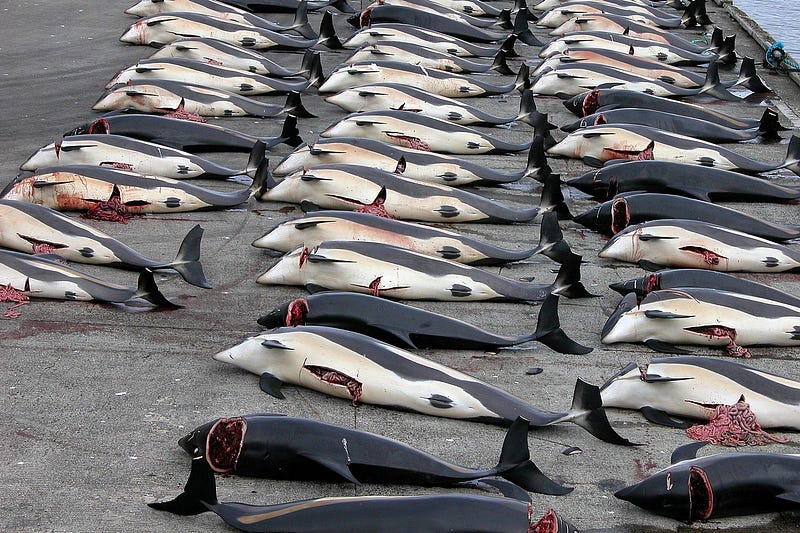

Grindadrap — a bloody tradition of the Faroe Islands.
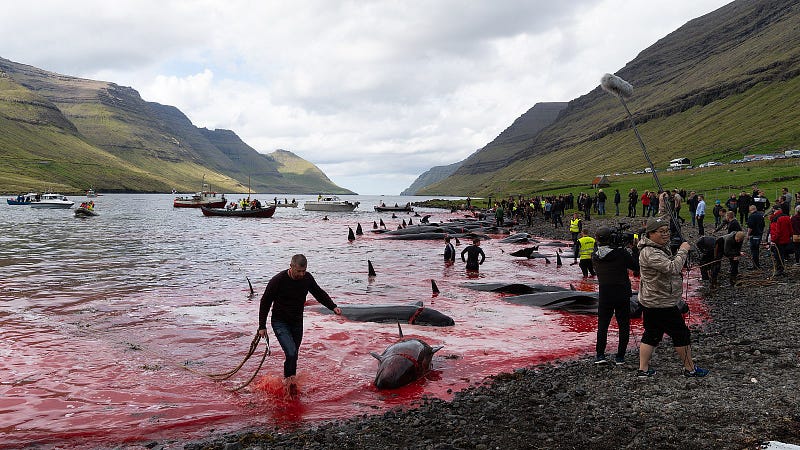
The hunting tradition is more than 1,200 years old. Its origins date back to around 800, when the first Vikings arrived in the Faroe Islands. The methods of luring and killing animals that are still practiced today differ little from those of the 9th century. After grindwhales appear near the islands, the men — because only they are allowed to take part in Grindadrap — get into boats. They then chase them into the bay, making noisy sounds in the process. Once the animals are trapped, the water is already too shallow for them to swim. Some individuals jump ashore in desperation.
Only now does the actual “ceremony” begin. Farers kill their victims with traditional knives of about 16 to 19 cm in length. The way the animals are cut is also important — around the neck, so that the carotid arteries and spinal cord are cut, and the head falls forward. Most often, grindworms die of exsanguination.
Every year, photos of red-stained water off the Faroese coast and dead animals lined up in rows on beaches hit the web. Environmental organizations regularly condemn the Faroese for what they consider to be cruel and unnecessary practices. The Faroese government, on the other hand, maintains that the way animals are killed is humane, and that hunting is an integral part of Faroese culture and a source of food for the archipelago’s inhabitants.
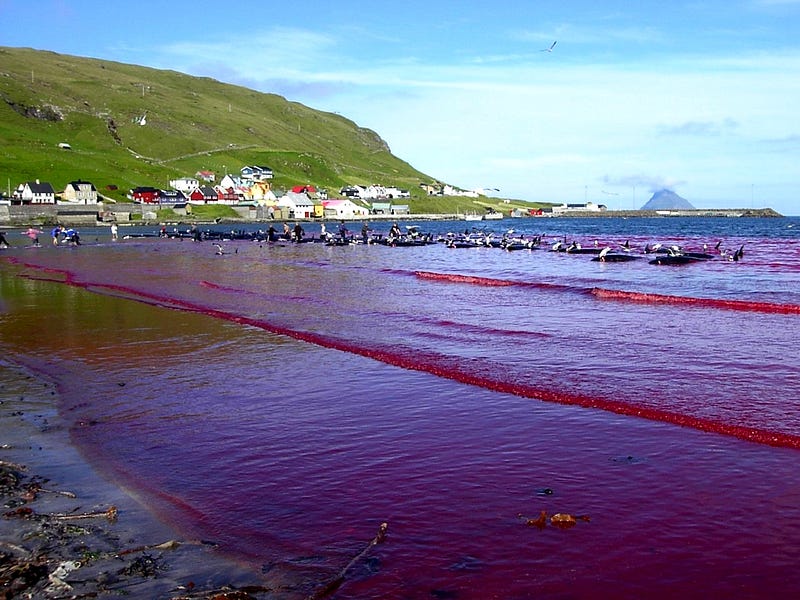

Faroese islands limit dolphin hunt
This year, however, Grindadrap will look a little different — at least in terms of numbers. The Faroese government has announced a limit of only 500 dolphins to be killed. The new law is set to take effect from the end of July until 2024.
Since 1996, an average of 270 white-sided dolphins have been killed annually in the Faroe Islands. 2021 was exceptional in this regard. The number of dolphins killed exceeded 1,400.
The introduction of the limit does not reassure environmentalists.
“This is a farce. The Faroe Islands have formalized something that was not formalized before,” comments Sally Hamilton, director of the marine conservation charity Orca, quoted by The Guardian.
Faroe Islands Fisheries Minister Árni Skaale maintains that Farriers “have the right to hunt,” but stresses that they must use it in a sustainable manner. Activists, meanwhile, point out that hunting dolphins is not part of Faroese tradition, and there is no market demand for their meat.
Grindadrap usually takes place in the summer. This year’s hunt is still ahead of Farers. Meanwhile, statistics say that 83% of islanders support Grindadrap.
Cool that you made it to the end of this article. I will be very pleased if you appreciate the effort of creating it and leave some claps here, or maybe even start following me. Thank you!