avatarDark Energy Articles

Free AI web copilot to create summaries, insights and extended knowledge, download it at here

4028

Abstract

" frameborder="0" height="281" width="500"> </div> </div> </figure></iframe></div></div></figure><h1 id="e537">What was found on the ocean floor?</h1><p id="5c82">The research expedition, sponsored by Charles Hoskinson, co-founder of the Ethereum platform and Ether cryptocurrency, took place in June of this year. Loeb’s team traveled on the M/V Silver Star to the vicinity of Manus Island, where the meteorite remnants were expected to have fallen. They lowered “sleds” equipped with neodymium magnets into the water and dragged them along the seabed, which lies 2 km below the surface. The researchers hoped that the magnets would attract underwater fragments of the meteorite rich in metals.</p><p id="7b80"><b>According to Loeb, this is precisely what happened</b>. <b>Researchers found 700 spherules with diameters ranging from 0.05 to 1.3 meters.</b> The composition of 57 of them was analyzed, and it is believed to provide evidence that they may be fragments from an object originating from outside the Solar System. This claim is based on an unreviewed preprint article recently released by the scientists.</p><blockquote id="a096"><p>“This is a historic discovery,” said Charles Hoskinson, the research sponsor. “For the first time, humans have held material from a large interstellar object in their hands. I am immensely pleased with the results obtained through rigorous scientific analysis,” added Hoskinson, quoted in a press release on the Galileo Project’s website. The Galileo Project is conducted under the auspices of Harvard and was conceived by Loeb to search for extraterrestrial technologies on Earth and in its vicinity.</p></blockquote> <figure id="edbd"> <div> <div> <img class="ratio" src="http://placehold.it/16x9"> <iframe class="" src="https://cdn.embedly.com/widgets/media.html?type=text%2Fhtml&amp;key=a19fcc184b9711e1b4764040d3dc5c07&amp;schema=twitter&amp;url=https%3A//twitter.com/blackvaultcom/status/1696516167253500116%3Fs%3D20&amp;image=https%3A//i.embed.ly/1/image%3Furl%3Dhttps%253A%252F%252Fabs.twimg.com%252Ferrors%252Flogo46x38.png%26key%3Da19fcc184b9711e1b4764040d3dc5c07" allowfullscreen="" frameborder="0" height="281" width="500"> </div> </div> </figure></iframe></div></div></figure><h1 id="d183">“I am quite certain.”</h1><p id="3266">However, is Loeb’s team’s work truly “historic”? Most of the spherules examined did not contain anything surprising. The iron isotope composition matched that found in objects from our Solar System. However, five of the spheres were unusual, containing particularly high levels of <b>beryllium, lanthanum, and uranium</b>. None of the spherules found so far (i.e., melted meteorite remnants) had such a composition, although, as acknowledged, it somewhat resembled lunar samples.</p><p id="202f">According to Loeb, especially the presence of beryllium, a rare element in the universe formed when larger atoms are bombarded by cosmic radiation, suggests that the spherules are remnants of a rock that has traveled extensively between star systems.</p><blockquote id="3e90"><p>“I am quite certain that they originate from an interstellar object,” said the scientist, as quoted by “<a href="https://www.newscientist.com/article/2390244-have-interstellar-meteor-fragments-really-been-found-in-the-ocean/">New Scientist</a>.”</p></blockquote> <figure id="54b5"> <div> <div> <img class="ratio" src="http://placehold.it/16x9"> <iframe class="" src="https://cdn.embedly.com/widgets/media.html?type=text%2Fhtml&amp;key=a19fcc184b9711e1b4764040d3dc5c07&amp;schema=twitter&amp;url=https%3A//twitter.com/motherboard/status/1698403050296156400%3Fs%3D20&amp;image=https%3A//i.embed.ly/1/image%3Furl%3Dhttps%253A%252F%252Fabs.twimg.com%252Ferrors%252Flogo46x38.png%26key%3Da19fcc184b9711e1b4764040d3dc5c07" allowfullscreen="" frameborder="0" height="281" w

Options

idth="500"> </div> </div> </figure></iframe></div></div></figure><h1 id="d1ca">“It’s nonsense.”</h1><p id="a0d9">However, his assertion has been strongly and widely criticized. Martin Schiller, a planetary chemist from the University of Copenhagen (as quoted by <a href="https://www.science.org/content/article/did-interstellar-debris-fall-sea-floor-claim-meets-sea-doubt%C2%A0">science.org</a>), labels Loeb’s conclusions as “nonsense.” In his view, there is insufficient evidence to support the claim that the spherules come from outside the Solar System.</p><blockquote id="43f6"><p>“I am surprised that anyone took this seriously,” Larry Nittler from Arizona State University (ASU) echoes Schiller.</p></blockquote><p id="2789">According to Nittler, the spherules could be of volcanic origin. Loeb’s team, in his opinion, did not do enough to rule out this possibility.</p><blockquote id="20b9"><p>Steve Desch, an astrophysicist from ASU, goes even further. “The ocean floor is littered with various things,” he says in <a href="https://www.newscientist.com/article/2390244-have-interstellar-meteor-fragments-really-been-found-in-the-ocean/">New Scientist</a>. “These spherules have been there for at least nine, probably thousands of years, reacting with seawater and accumulating contaminants.” These are natural explanations for the supposed phenomenon.</p></blockquote><p id="b5b4">Furthermore, according to Desch, Loeb could have been mistaken in assuming that the 2014 meteorite was of extrasolar origin. Why? Because its unusually high speed might have been inaccurately determined. Last month, it was demonstrated that government satellite sensors overestimate the speed of meteorites, especially those moving faster.</p><blockquote id="9e0a"><p>“In one-third of cases, these numbers are far from accurate,” Desch said.</p></blockquote><p id="39e8">Desch also points out that if any object were to enter Earth’s atmosphere at a speed of several tens of kilometers per second, it would completely burn up, leaving nothing behind. In his view, Loeb collected too few control samples from other parts of the ocean floor to be certain that the spherules are indeed something unusual.</p><blockquote id="97a8"><p>“They knew what they were looking for, and as a result, they became susceptible to confirmation bias,” Desch concludes.</p></blockquote><div id="f825" class="link-block"> <a href="https://readmedium.com/physics-revolution-redux-latest-discoveries-rock-the-scientific-world-6c29b6297c9e"> <div> <div> <h2>Physics Revolution Redux: Latest Discoveries Rock the Scientific World!</h2> <div><h3>Without going overboard or succumbing to euphoria, it’s impossible not to acknowledge that the recent weeks have…</h3></div> <div><p>medium.com</p></div> </div> <div> <div style="background-image: url(https://miro.readmedium.com/v2/resize:fit:320/1*UWtL5argvI6RE7pvU8TMZQ.jpeg)"></div> </div> </div> </a> </div><h1 id="716f">Attention all readers!</h1><p id="c391"><b><i>As content creators on Medium.com, we face minimal compensation for our hard work. If you find value in my articles, please consider supporting me on my “<a href="https://www.buymeacoffee.com/oconnel">Buy Me a Coffee</a>” page. Your small contributions can make a big difference in fueling my passion for creating quality content. Thank you for your support!</i></b></p><figure id="1329"><img src="https://cdn-images-1.readmedium.com/v2/resize:fit:800/0*cPN7NjD5awlZ6qmj.png"><figcaption><a href="https://www.buymeacoffee.com/oconnel">https://www.buymeacoffee.com/oconnel</a></figcaption></figure><figure id="010c"><img src="https://cdn-images-1.readmedium.com/v2/resize:fit:800/0*j9FiNQRxeFr9tIGB.png"><figcaption><a href="https://www.buymeacoffee.com/oconnel">https://www.buymeacoffee.com/oconnel</a></figcaption></figure></article></body>

Metallic spherules from beyond the Solar System in the Pacific: “Nonsense” or a “historic discovery”?

Avi Loeb, an astrophysicist from Harvard, along with his team, combed the floor of the Pacific near Papua New Guinea. The controversial scientist claims to have found remnants of an object from outside the Solar System. However, his research was immediately criticized by the scientific community.
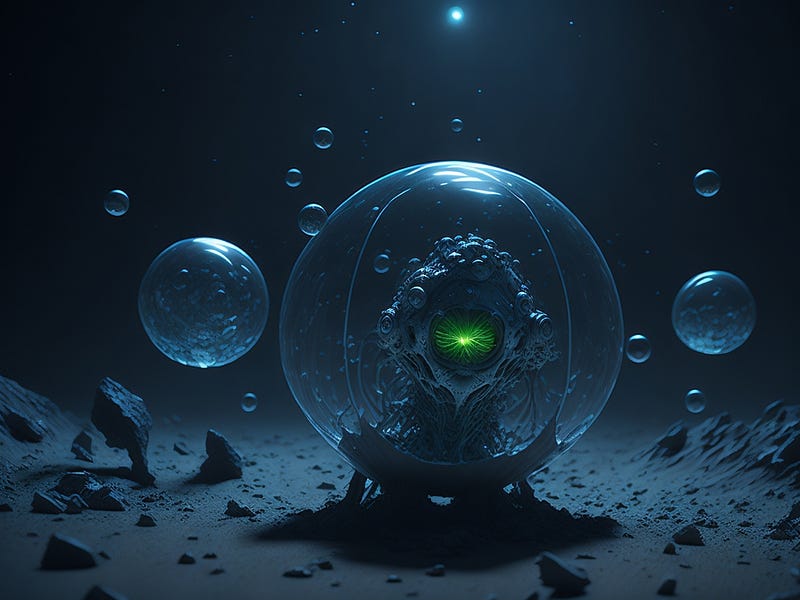
[Image generated by AI, Free to use]

At the bottom of the Pacific Ocean, a group of researchers discovered tiny metallic spheres. Their chemical composition is said to indicate that they are remnants of a rock originating from outside the Solar System, which burned up in Earth’s atmosphere. If true, these unusual spheres, called spherules, would be the first material from other star systems that humans have ever come across (and on Earth, no less!). However, the theory is controversial and immediately sparked heated debates among scientists.

The search for cosmic mysteries

The discovery is attributed to Prof. Avi Loeb from Harvard. This astrophysicist gained notoriety in connection with ‘Oumuamua, the famous asteroid discovered in 2017. ‘Oumuamua captured imaginations for two reasons: firstly, it had an unusual shape, resembling an elongated, flat cigar, and secondly, it exhibited increasing speed at certain points, as if something were pushing or propelling it.

Prof. Loeb publicly suggested that ‘Oumuamua might be the wreckage of a spacecraft drifting through the Solar System. SETI took an interest in the object, but no evidence was found to suggest it was artificial. In March of this year, the mystery of ‘Oumuamua was solved. In a paper published in “Nature,” scientists explained what happened to the unusual asteroid during its interstellar journey and how this affected its speed as it passed through the Solar System.

Prof. Avi Loeb from Harvard — [Photo: Aviloeb, CC BY-SA 4.0, via Wikimedia Commons]

Objects from beyond the Solar System

After gaining fame through ‘Oumuamua, Avi Loeb shifted his focus to searching for objects that might originate from outside the Solar System. He concluded that if ‘Oumuamua had appeared in our vicinity, there was a small chance that another extrasolar object had already entered Earth’s atmosphere, with remnants making it to the surface. A candidate was found in NASA’s meteorite registry. It was a meteorite observed in 2014 near Papua New Guinea, moving at an exceptionally high speed of around 200,000 km/h.

Last year, the United States Space Command (USSC) declassified data regarding this event, confirming with 99.999 percent certainty that remnants of an extrasolar object fell to Earth nine years ago. The ultimate proof would be finding even the smallest fragment of that rock. As we reported last year, Avi Loeb immediately announced his intention to conduct a search.

What was found on the ocean floor?

The research expedition, sponsored by Charles Hoskinson, co-founder of the Ethereum platform and Ether cryptocurrency, took place in June of this year. Loeb’s team traveled on the M/V Silver Star to the vicinity of Manus Island, where the meteorite remnants were expected to have fallen. They lowered “sleds” equipped with neodymium magnets into the water and dragged them along the seabed, which lies 2 km below the surface. The researchers hoped that the magnets would attract underwater fragments of the meteorite rich in metals.

According to Loeb, this is precisely what happened. Researchers found 700 spherules with diameters ranging from 0.05 to 1.3 meters. The composition of 57 of them was analyzed, and it is believed to provide evidence that they may be fragments from an object originating from outside the Solar System. This claim is based on an unreviewed preprint article recently released by the scientists.

“This is a historic discovery,” said Charles Hoskinson, the research sponsor. “For the first time, humans have held material from a large interstellar object in their hands. I am immensely pleased with the results obtained through rigorous scientific analysis,” added Hoskinson, quoted in a press release on the Galileo Project’s website. The Galileo Project is conducted under the auspices of Harvard and was conceived by Loeb to search for extraterrestrial technologies on Earth and in its vicinity.

“I am quite certain.”

However, is Loeb’s team’s work truly “historic”? Most of the spherules examined did not contain anything surprising. The iron isotope composition matched that found in objects from our Solar System. However, five of the spheres were unusual, containing particularly high levels of beryllium, lanthanum, and uranium. None of the spherules found so far (i.e., melted meteorite remnants) had such a composition, although, as acknowledged, it somewhat resembled lunar samples.

According to Loeb, especially the presence of beryllium, a rare element in the universe formed when larger atoms are bombarded by cosmic radiation, suggests that the spherules are remnants of a rock that has traveled extensively between star systems.

“I am quite certain that they originate from an interstellar object,” said the scientist, as quoted by “New Scientist.”

“It’s nonsense.”

However, his assertion has been strongly and widely criticized. Martin Schiller, a planetary chemist from the University of Copenhagen (as quoted by science.org), labels Loeb’s conclusions as “nonsense.” In his view, there is insufficient evidence to support the claim that the spherules come from outside the Solar System.

“I am surprised that anyone took this seriously,” Larry Nittler from Arizona State University (ASU) echoes Schiller.

According to Nittler, the spherules could be of volcanic origin. Loeb’s team, in his opinion, did not do enough to rule out this possibility.

Steve Desch, an astrophysicist from ASU, goes even further. “The ocean floor is littered with various things,” he says in New Scientist. “These spherules have been there for at least nine, probably thousands of years, reacting with seawater and accumulating contaminants.” These are natural explanations for the supposed phenomenon.

Furthermore, according to Desch, Loeb could have been mistaken in assuming that the 2014 meteorite was of extrasolar origin. Why? Because its unusually high speed might have been inaccurately determined. Last month, it was demonstrated that government satellite sensors overestimate the speed of meteorites, especially those moving faster.

“In one-third of cases, these numbers are far from accurate,” Desch said.

Desch also points out that if any object were to enter Earth’s atmosphere at a speed of several tens of kilometers per second, it would completely burn up, leaving nothing behind. In his view, Loeb collected too few control samples from other parts of the ocean floor to be certain that the spherules are indeed something unusual.

“They knew what they were looking for, and as a result, they became susceptible to confirmation bias,” Desch concludes.

Attention all readers!

As content creators on Medium.com, we face minimal compensation for our hard work. If you find value in my articles, please consider supporting me on my “Buy Me a Coffee” page. Your small contributions can make a big difference in fueling my passion for creating quality content. Thank you for your support!


https://www.buymeacoffee.com/oconnel
Aliens
Science
Space
Research
Life
Recommended from ReadMedium