
Men vs Women
AN EXPLANATION
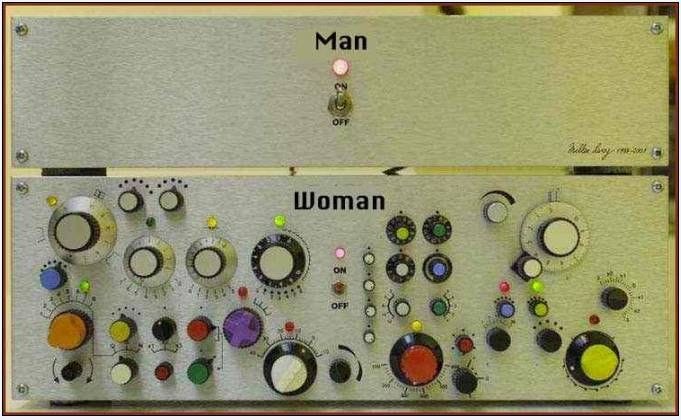
Having recently read a couple of poems, one by Holly Jahangiri
and one by Charles Roast,
Their poems reminded me of an image (above photo) that I had seen years ago. It so happened my wife and I were in counseling at the time. I was between jobs and things were tough, but that’s another story.
We men are simple beings. (Forgive me guys, but it’s true.) Women are more complex. Holly put that fact nicely into words.
I confess, I am a “Mr. Fix-it” guy. Give me a problem, I immediately start searching for solutions. You’ve flipped my “On” switch. I was born that way and my engineering training ingrained it — I just can’t help it. It’s in my DNA.
My wife, the woman who’s provided almost all of my experience with the opposite sex, is much more nuanced than I am; that’s for sure. While I take a bold, direct approach, she takes a softer stance and looks for the subtleties. She’s diplomatic; I’m blunt. I see a piece of cloth; she sees form and pattern and texture and color. I want to get to the destination, to get the job done. She wants to take her time and enjoy the journey. “Slow down,” she says. “Don’t be in such a hurry. Take a break now and then. Smell the roses.”
“But… but… but,” I stammer. “We’ve miles to go. We’ve got to get-er done!”
I analyze the facts. She sees the big picture.
I think it through, look at alternatives. She jumps to conclusions. “It’s intuitively obvious,” she says.
“But, where’s the proof?” I counter. “How do you know?”
“I just do,” she says.
G-r-r-r-r-r!
We play a little card game called “UNO.” She usually wins. She knows just which color to play and when. I wish I could get inside her head and see what’s going on. She won’t tell me. It’s her secret. I suffer on.
Intuition is something I know little about. She has it, I don’t. Some say I could develop mine, but I think of it like ‘Speed Reading.’ You need to learn it at an early age. Fine tune and practice the skill over a lifetime. But if you are not born a protégé, you likely will not become a concert pianist.
Stephen King in On Writing says that you can make a good writer better, but you can’t make a good writer into a great writer. He has a point. You need to have a certain amount of innate talent, whatever the field, to really stand out. (But I digress.)
I learned to analyze. I’m a process engineer. I know there’s a beginning and an end to each process with inflows and outflows along the way. It can be analyzed step by step. The sum of what goes in comes out, one way or another.
I loved math where we developed the proof one line at a time, each line flowing logically from the one before. I did well in school. Followed directions. Got good grades. She did not.
Still, I was a daydreamer. I had imagination, at least when I was young. I’d much rather sit in class and gaze out the window than add up boring columns of numbers, which never came out right.
She has skills that I do not. She can paint and sketch and sew and knit and crochet with great skill, AND she can beat me at UNO, most of the time.
When it comes to crafts, she’s amazing. She makes greeting cards that delight our relatives and friends. And, she remembers birthdays and anniversaries. Even with the help of calendars and Facebook, I have trouble doing that. As for crafts, forget about it!
I think the photo at the beginning of this article provides an accurate description of the relative difference between men and women. Do you agree? Let me know your thoughts in the comments.
If you enjoyed this article, you might also enjoy:
If you’d like to learn a little more about who this Bob Jasper is. Take a peek at this.
Happy reading, writing and connecting!


