
Memoir or Autobiography? Preserve Your Memories
We need to tell our stories more than ever
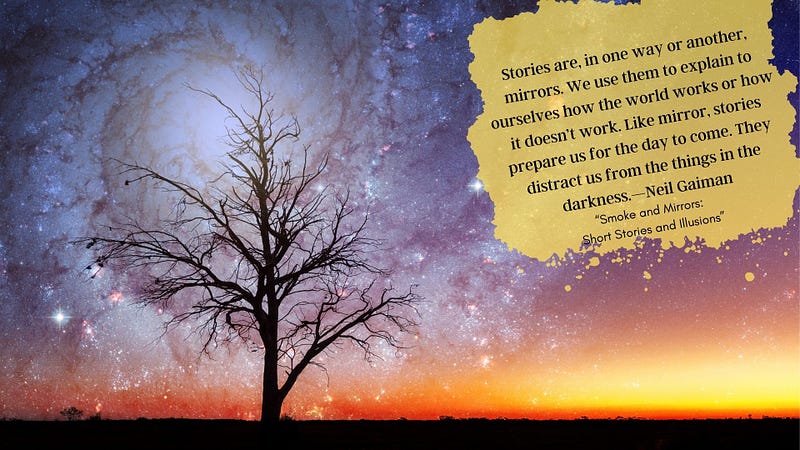
I believe stories have power and can share the truth.
By the time I was 18, all my grandparents were dead. Three of them I’d never met. The fourth, I barely knew. But how I wish I had their stories.
While the question of epigenetic storing of experiences in our DNA isn’t entirely settled yet, I’ve always felt the pull to understand my ancestors. I know the power of inherited traits; as a former breeder of registered dogs and livestock, I learned offspring are influenced by their ancestors as far back as four or five generations. We don’t know about humans.
Temperament, health, and physical structure are heavily influenced by genetics, making me curious about previous generations. I understand why research into one’s family tree can be so addicting.
I wish for words of wisdom and inspiration from those who came before. Why didn’t they leave any notes?
There’s value in telling our stories. True or fictional, the process is often life-changing for the writer and meaningful for the readers. And our stories can be actual books, even if we never offer them for sale.
Go ahead, write your life story.
To help you get your mind around the process, some brief notes.
- As a literary category, memoir is considered a sub-genre of autobiography.
- An autobiography generally covers the person’s entire life, emphasizing family history, childhood, education, and perhaps, career.
- A memoir is more focused, often covering a specific period of time, theme, or significant event. It usually includes the author’s reflections — their feelings and interpretations about what happened.
Here are a couple of ideas to get you started.
Make a timeline. Whether you decide to go with a straightforward life story or a memoir, you can begin by creating a list. Write down where you lived, went to school, and major life events. Leave room to add more items as you recall them.
Speed write a list of 100 memories. Nearly everyone has dozens of what are often called rehearsed memories. These are the stories that you recall from time to time, the ones your family talks about when they get together, or events either too glorious or so traumatic; that you never forget them. Just brainstorm and write a word or phrase.
Look at photographs. If you are fortunate enough to have photos from your childhood, start there. If not, perhaps you can search for online images of your elementary school or use google maps for street views of former houses. Images often unlock our memories.
I’m fortunate to have lots of photographs.
This week, preparing to move, I’m consolidating papers. First, I spent hours separating old photos from their former albums and filing them securely in boxes.
And I realized most people younger than 40 are unlikely to own a photo album. So instead, their life is preserved in a different medium; a digital one.
I still have a few cardboard-covered albums with small adhesive corners firmly holding the snapshots for nearly 100 years. But unfortunately, there are also horrible albums with a slightly sticky background and an acetate flap that is supposed to protect the images. The photo eventually bonds with the paper, and you must peel the damaged memory free.
Working, I wondered do images restore memories, or do the photos shape our memories?”
Think about it. What are your earliest memories? Have you seen a photograph of that moment? So, are you remembering the photo or what happened?
Either way, photographs can jog our memory.
Photo albums have been the illustrations of my life.
My mother had photo albums that were surely antiques, I thought as a child.
She’d pull them out and fade back into time. “Look here’s a photo of me with Satan, my cat. We called her that because she was a black and wild thing. Climbing the drapes, shredding them with her claws.”
“And here I am with my brother on the old mule at Aunt Flossie’s farm in Vermont. We’d go up there in the summer.”
I’d stare at the photos trying to imagine my mother as a child. And I still remember the stories because she reminisced while pointing at the photos.
I inherited mystery albums from my father and his sister.
My father was estranged from his family. Somewhere I learned that my mother hated her mother-in-law. As a result, she told my Dad, “Choose me, or choose your parents.” He chose my mother.
On one trip, driving from Tucson, Arizona, to Alaska, we stopped at his parents’ small house in Inyokern, California. It was dusk, and we children were firmly told to stay in the car. My Dad and possibly my mother went into the house for a short time. Then, with no explanation, we left.
I don’t believe I ever met my grandparents or my father’s sister and brother.
But, when my father died, in his possessions were two old photo albums. They are filled with untold stories and questions, just like his relationship with his family. I feel adrift, somehow.
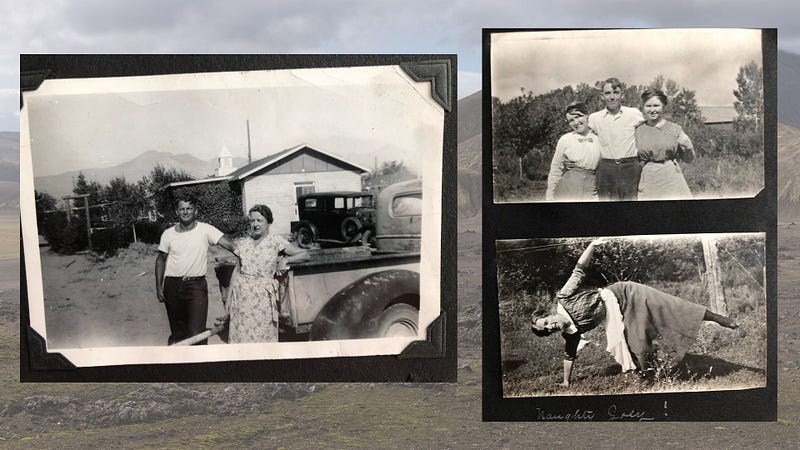
I know the man and the woman leaning on the old pickup are my father and his mother but I have no stories.
The older photos of the happy boy with two girls and ‘naughty joey’ beginning a cartwheel are unknown people in my family history. I can only imagine their lives.
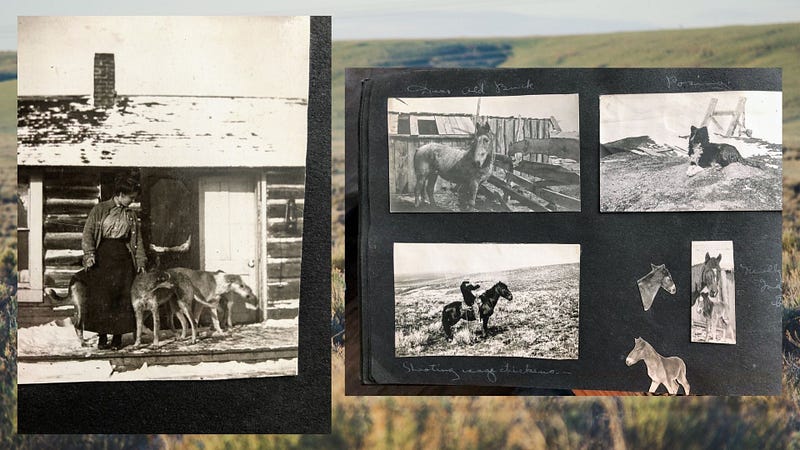
My grandmother was born in the late 1800s in Shelburne Falls, Massachusetts. Some of the photos in this album are of horse-drawn threshing machines and labeled Wyoming. What were they doing there?
Is that woman with all the dogs, who seems like me, my grandmother? One year, I lived with twenty dogs, culminating in a lifelong dream to own a kennel.
Look at those carefully trimmed photos of the colt and horses. See the much-loved dog and a woman proudly shooting off the ugly-ass, Roman-nosed ranch horse. I, too, galloped across the desert, shot coyotes, and loved my dogs.
I’m greedy, hungry to know that woman’s stories. And even more than just what happened, I wish I knew how my grandmother felt. What would she have told me if I’d known her? Did she grieve the loss of her horses and her dogs when she left Wyoming? How did she cope with her youngest son departing California for Alaska and never knowing the six children he eventually had?
Did she have insights that would have helped us navigate our own lives?
Tell your stories. Written or recorded. Preserve your photos.
Digitally processed images are easy to store. Create some albums to share with those that may care. And label people, dates, and locations. Then, store them in the cloud.
If you don’t have any photos, do you have family members who can share?
I realize photos can be more fragile than memories, so those of us who have them are lucky. When my children were small, film and development were expensive in a pre-digital world, so I have few pictures. The ones I have are all holidays and birthdays!
Once you’ve spent time brainstorming and you have a list, you’re ready.
Do you want to write a factual retelling of events? Then, you can build off your timeline to write an autobiography.
If you’re drawn to reflecting on what happened, you may be heading toward a memoir.
Look at your list of memories and highlight the most compelling. Then, start writing a scene. For example, I often find it helpful to imagine I’m watching a film.
Where does it take place? Who was there? What do you smell and hear?
Don’t worry about your grammar or spelling; just get your thoughts down. And then do it again and again. Once you’ve written lots of scenes, you’ll begin to sense a theme or realize you want to create a historical account of your history. Either one is great.
If you decide you want to polish your draft and create a book, great. If not, you’ll still have more history to leave behind than most people.
What to do with your masterpiece in process?
That’s up to you. The joy of creation and the self-knowledge gained in reflection are their own rewards for many people. Others want to persist in learning more and creating a book to be shared with their families, while others want to master the challenge of a published manuscript.
For me? I want to leave my recollections, wisdom gained, and yes—regrets, should my family want to know more. If others are curious, great, but it’s not my main goal. Nobody else will ever live our exact life and not too many people will make it through the writing process. Perhaps it’s a compulsion? I’m not entirely sure.
Curious? Ask your questions here, and I’ll try to find answers. Suggestions? Please share tips. And this publication—The Memoirist, exists to publish your musings, stories, and essays.
I’m still chipping away at my memoir, and I can’t wait to read your stories.
When you read a memoir, do you want to see photos of the people in the book? Get a free photo book here if you’d like to see vintage photographs of the folks in Cindy’s stories.


